The financial press is currently obsessed with a "recovery" in Chinese EV stocks. They point at export numbers climbing like a panicked mountain goat and domestic sales figures that look green on a spreadsheet. They call it a surge. They call it a comeback. They are fundamentally misreading the mechanics of a collapsing margin profile.
What Wall Street analysts see as a growth story is actually a massive liquidation sale. When BYD, NIO, and Li Auto report volume growth, they aren't winning because of superior "synergy" or brand loyalty. They are winning because the Chinese domestic market is a pressure cooker of overcapacity, and the only way to keep the lights on is to dump hardware into foreign markets at prices that make profit impossible. Also making news recently: The Bread and the Barrel.
Buying Chinese EV stocks right now isn't betting on the future of transportation. It is betting on how long a state-subsidized industry can bleed before the tourniquet of global tariffs cuts off the circulation entirely.
The Myth of the Surging Export
The prevailing narrative suggests that Chinese EVs are taking over the world because they are "better." This is a lazy half-truth. While the software stacks in a Xiaomi SU7 or a high-end NIO are impressive, the export "surge" is a symptom of desperation, not dominance. Additional information on this are detailed by Harvard Business Review.
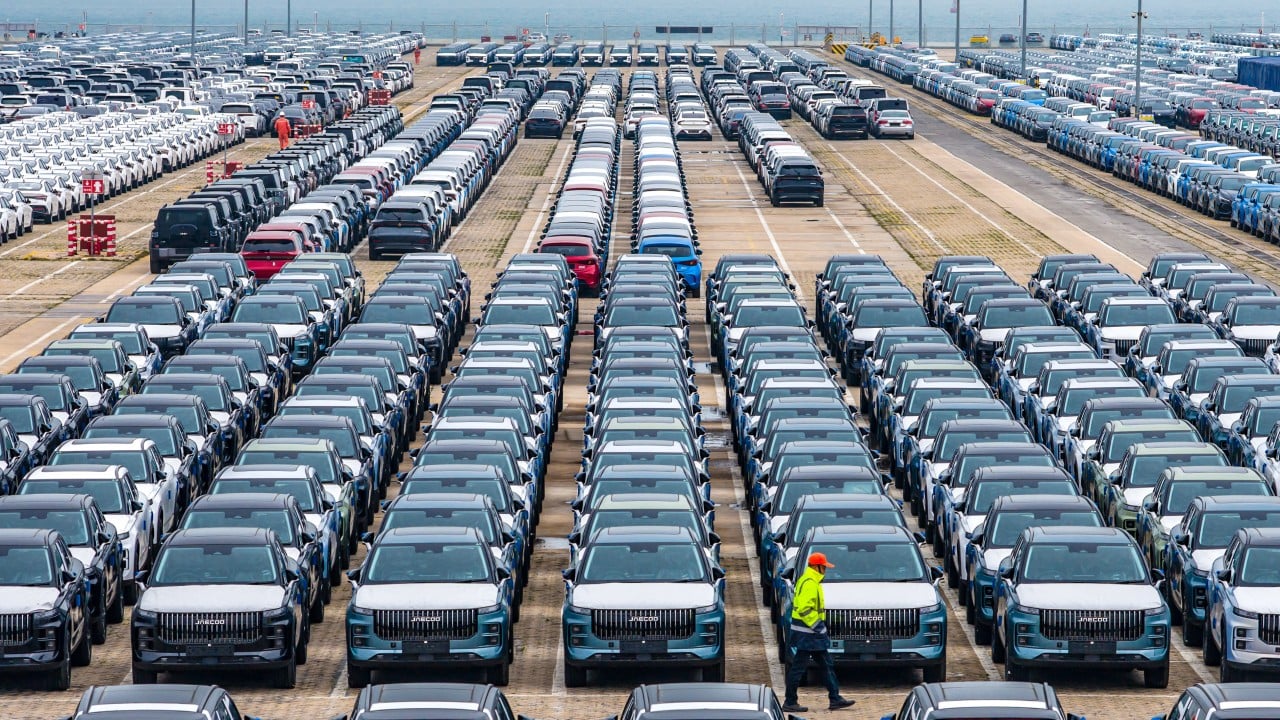
China has the capacity to build roughly 40 million cars a year. Its domestic market struggles to absorb 25 million. That 15-million-car gap is a ghost that haunts every boardroom in Shenzhen and Shanghai. If these companies don't export, they die. They aren't expanding into Europe and Southeast Asia because they want to; they are doing it because they have no choice.
When you see a headline about "record exports," you should read it as "record oversupply." In a healthy market, exports represent the overflow of a successful domestic base. In the current Chinese EV climate, exports are a desperate vent for a domestic market defined by a brutal, race-to-the-bottom price war that has erased the margins of everyone except perhaps BYD.
Why Domestic Recovery is a Mirage
Hopes for a domestic demand recovery are based on the "replacement cycle" and government subsidies. This ignores the psychological shift in the Chinese consumer. After years of aggressive price cuts, the consumer has been trained to wait.
If you bought an EV last year, you likely saw its value crater by 30% in six months as the manufacturer slashed prices to stay competitive. This creates a deflationary spiral. Why buy today when the same car will be 15% cheaper in October?
The "recovery" is a series of artificial sugar highs. Every time the government introduces a trade-in subsidy, there is a momentary blip in the charts. But the underlying structural issue—too many brands, too many factories, and not enough wealthy buyers—remains untouched. We are witnessing the "Kodak moment" of the internal combustion engine, yes, but we are also witnessing the "Dot-com bubble" of the electric drivetrain.
The Margin Trap Nobody Wants to Discuss
Let’s talk about the math that analysts ignore because it ruins the "buy" recommendation. Most Chinese EV startups are still losing thousands of dollars on every door handle they ship.
In a traditional hardware business, you scale to reach profitability. In the current Chinese EV ecosystem, scaling often increases the total loss because the price-per-unit is falling faster than the cost-per-unit. This is a negative-sum game.
- Gross Margin vs. Net Margin: A company might claim a 20% gross margin, but once you factor in the R&D required to keep up with a six-month product cycle and the massive marketing spend required to be heard over the noise, the net margin is a black hole.
- The Hardware Devaluation: These aren't cars; they are smartphones with wheels. In the tech world, hardware eventually becomes a commodity. China has commoditized the EV three years faster than the market expected.
I’ve seen companies in the hardware space blow through billions of dollars trying to "buy" market share, only to find that the market share they bought has zero loyalty the moment a cheaper competitor emerges. This isn't Tesla in 2012; this is a commodity war in a saturated market.
The Tariff Wall is Higher Than You Think
The "export growth" narrative assumes that the rest of the world will just sit back and watch their domestic auto industries evaporate. It is a naive assumption.
The European Union and the United States aren't just looking at "fair trade." They are looking at national security and the survival of their industrial bases. The 100% tariffs in the US and the anti-subsidy probes in the EU are not temporary hurdles. They are the new baseline.
Chinese EV makers are trying to bypass this by building factories in Hungary, Turkey, or Mexico. But localizing production is expensive. It strips away the very advantage these companies have: the low-cost, integrated supply chain within China’s borders. Once a BYD is built in Europe, with European labor costs and European energy prices, the "price miracle" vanishes.
The Quality of Revenue Problem
If you look at the balance sheets of these "surging" companies, look at the accounts receivable. Look at where the cars are actually going.
Thousands of EVs in China have ended up in "EV graveyards" or registered to rental firms and ride-hailing companies owned by the manufacturers themselves. This is "channel stuffing." It creates the illusion of demand on a quarterly report while the actual vehicles sit in a lot, depreciating in the sun.
Investors are cheering for "deliveries" without asking who is taking the delivery. If the manufacturer is essentially selling the car to itself to hit a target, that isn't growth. It's accounting.
The Battery Tech Fallacy
The contrarian truth about battery technology is that being the leader today is a liability, not an asset. China leads in Lithium Iron Phosphate (LFP) batteries. They have mastered the current chemistry.
However, the capital expenditure required to maintain that lead is astronomical. The moment a solid-state breakthrough becomes commercially viable—whether it's from Toyota, QuantumScape, or a lab in Seoul—the billions China has poured into LFP infrastructure become "stranded assets."
China is doubled down on the current iteration of the technology. They are the world's masters of the 2024 battery. That doesn't guarantee they won't be the world's biggest victims of the 2028 battery.
Stop Looking at Volume Start Looking at Burn
If you want to know the health of the Chinese EV sector, stop reading the "total units sold" press releases. Start looking at the cash burn per delivery.
The industry is currently in a "Last Man Standing" phase. The goal for many of these companies isn't to be profitable; it's to outlast the competitor's cash reserves until the government steps in to force a merger. This is a consolidation play, not a growth play.
- NIO is betting on battery swapping—a massive, capital-intensive infrastructure project that only works if everyone adopts it.
- XPeng is betting on autonomous driving—a field where they are competing with the limitless pockets of Huawei and Tesla.
- Li Auto found a niche with Extended Range EVs (hybrids), but as they move into pure BEVs, they are entering the same meat grinder as everyone else.
The Brutal Reality of the Global Consumer
The "People Also Ask" sections of search engines are full of questions like "Are Chinese EVs reliable?" and "Should I buy a Chinese EV?"
The honest answer? For a lease, maybe. For a long-term investment, the risk is massive. Not because the cars are "junk"—they aren't—but because there is a very real chance the company that made your car won't exist in five years.
How does the resale value of a Zeekr or a HiPhi look when the manufacturer goes through a restructuring or disappears? The consumer isn't stupid. They see the volatility. This hesitation is the invisible ceiling on Chinese EV adoption globally.
The Trade is Crowded and the Premise is Rotten
Every macro fund is looking for a way to play the "China recovery." They see EV stocks at multi-year lows and think they've found a value play.
It's not value. It's a value trap.
A sector that requires constant government intervention, faces existential trade barriers, and operates in a deflationary domestic environment is not a sector that's about to "moon." It's a sector that is being forced to reorganize under extreme pressure.
The "surge" you see in the stock price is a relief rally, a short-covering bounce, or a reaction to the latest central bank liquidity injection. It is not a reflection of a fundamental shift in the profitability of making electric cars in China.
The industry isn't maturing; it's cannibalizing itself. If you’re holding these stocks expecting a return to the 2020 highs, you’re not an investor. You’re a passenger on a ship that is throwing its cargo overboard just to stay buoyant.
The cargo is the profit. The ship is still sinking.
Stop celebrating the volume. Start mourning the margins.