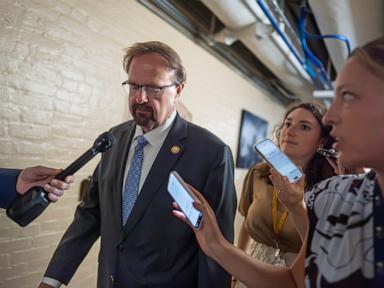
The United States House of Representatives voted overwhelmingly to censure Republican Representative Chuck Edwards of North Carolina following a bipartisan Ethics Committee investigation that exposed a deeply toxic pattern of professional boundary violations toward two young female staffers. The vote, which took place on the floor of the chamber with a 413-to-2 tally, marked a rare instance of a ruling-party member facing formal disciplinary action for workplace misconduct directed at women. While the investigation found no evidence of explicit physical propositions or quid pro quo sexual activity, the committee concluded that Edwards subjected his aides to intense, unsolicited personal attention—including personalized handguns, designer purses, tearfully recited poetry, and intrusive late-night communication—that fundamentally compromised their workplace environment.
This institutional reprimand forces a hard look at how power operates behind the closed doors of congressional offices. Capitol Hill has long functioned as a feifdom where traditional corporate human resources protections are weak, reporting mechanisms are fraught with political risk, and the inherent hierarchy between a member of Congress and their staff creates a coercive dynamic that defies simple categorization.
The Anatomy of Institutional Encroachment
When the House Ethics Committee released its findings, the dossier read less like a standard bureaucratic misconduct report and more like an anthropological study of unchecked workplace boundary erosion. Edwards showered his subordinates with high-end gifts totaling thousands of dollars, ranging from jewelry and kitchen appliances to engraved firearms and luxury vacations. He arranged for private musical performances, composed and publicly read emotional poems, and inserted himself into their personal lives under the guise of an affectionate friendship.
Edwards mounted a vigorous defense, distributing a six-page letter to his congressional colleagues arguing that the committee had made an extraordinary analytical leap. He insisted that affectionate friendships, poetry, gifts, and compliments do not legally or practically constitute sexual harassment. He argued that separating a few isolated interactions from 186,000 pages of digital records distorted benign mentorship into malicious intent.
The defense misses the fundamental reality of congressional power dynamics. A subordinate cannot easily reject the artistic offerings, lavish gifts, or constant text messages of a sitting member of Congress who controls their paycheck, career trajectory, and professional reputation. When a boss possesses absolute authority over a young staffer's livelihood, "choice" becomes an illusion. The Ethics Committee recognized this chasm, noting that Edwards was either entirely blind to his own leverage or callously indifferent to the quiet panic experienced by aides who felt trapped by their benefactor.
The Bipartisan Reality and Political Fallout
The censure vote itself exposed shifting internal calculations within the House. Traditionally, disciplinary actions in the chamber divide cleanly along partisan lines, with members rallying reflexively to protect their own. In this instance, Republican leadership and rank-and-file members alike chose to align with the objective findings of the Ethics panel. House Majority Whip Tom Emmer and other prominent party members indicated they would support the resolution, reflecting a growing weariness with defending indefensible workplace conduct as political liabilities mount ahead of national elections.
Edwards abandoned his reelection campaign in his competitive North Carolina district shortly after the committee released its report. Yet, a censure carries no direct constitutional penalty. It strips away no committee assignments, blocks no votes, and removes no legislative privileges unless followed by separate, explicit punitive measures. It is a formal expression of institutional condemnation—a heavily symbolic gesture in a building that frequently treats symbolism as a substitute for systemic reform.
The broader political landscape reveals that Edwards is hardly an isolated anomaly. The current election cycle has seen multiple congressional campaigns upended or defined by accusations of misconduct against women. From allegations of domestic abuse to accusations of harassment and assault, voters and lawmakers are being forced to confront the dark underside of political celebrity and unchecked authority. Each scandal follows a predictable trajectory: initial denial, institutional foot-dragging, a damning investigative report, a hurried exit from a primary or reelection race, and a toothless floor resolution.
Why the Rules Fail the Modern Office
The core issue lies in the structural inadequacy of the Congressional Accountability Act and internal House rules. These frameworks were historically designed to shield the institution from external lawsuits rather than to protect junior staffers from psychological isolation and manipulation by powerful bosses. Rules that focus narrowly on whether a physical assault occurred or whether an explicit sexual proposition was documented fail to capture the subtle, corrosive ways a hostile work environment can be engineered.
When a boss isolates a staffer, monitors their social life, comments continuously on their appearance, and blurs the line between professional duties and personal devotion, the damage is real even if no explicit law is broken. By leaning heavily on the defense that no quid pro quo transpired, politicians accused of misconduct attempt to reduce workplace safety to a crude legal threshold.
True accountability requires dismantling the feudal culture that treats congressional offices as personal fiefdoms. Until mandatory, independent human resources oversight is enforced with real teeth—including immediate financial penalties, stripping of committee power without requiring floor votes, and independent investigative bodies that bypass partisan gatekeepers—members of Congress will continue to push boundaries with impunity.
The vote in the well of the House ended with Chuck Edwards standing quietly while the resolution of condemnation was read aloud. The chamber moved on to its legislative calendar within hours, leaving the underlying systemic vulnerabilities untouched and waiting for the next inevitable breach of trust.