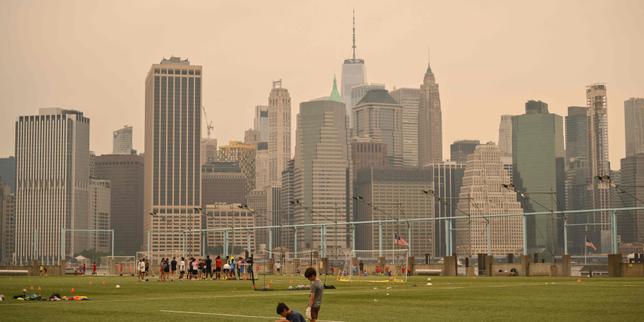
Air quality has become the most unpredictable tactical variable in international sports. As a massive plume of wildfire smoke from Canadian forests drifts south into the northeastern United States, FIFA organizers face a logistical nightmare that scheduling algorithms never anticipated. The immediate threat covers the densely populated corridor holding key tournament venues, throwing preparation into chaos just days before the highly anticipated World Cup final. This is no longer an isolated environmental issue. It is a direct disruption to global sport, forcing athletic organizations to confront a reality where the very air athletes breathe can compromise a multi-billion-dollar event.
The mechanics of this atmospheric crisis are straightforward but devastating for peak athletic performance. Wildfire smoke is heavily laden with fine particulate matter, specifically PM2.5, which consists of microscopic particles capable of penetrating deep into human lungs and entering the bloodstream. For an elite soccer player running upwards of seven miles over 90 minutes, the respiratory demand is immense. Inhaling compromised air at that level of exertion rapidly reduces VO2 max, triggers acute airway inflammation, and accelerates fatigue.
While leagues like MLS and the NFL have occasionally shifted domestic matches due to West Coast fires in recent years, the World Cup operates on an entirely different scale of complexity. Broadcast rights are locked into rigid global time slots. Hundreds of thousands of international travelers have purchased non-refundable tickets, hospitality packages, and flights. The financial machinery behind the tournament cannot simply pivot to a backup date or easily relocate a final to a stadium a thousand miles away without triggering catastrophic legal and financial liabilities.
The Toxic Atmospheric Corridor
Meteorological patterns have created a stubborn pipeline moving smoke from active blazes in Quebec and Ontario straight down through New York, New Jersey, and Philadelphia. A persistent low-pressure system over New England is acting as a giant atmospheric wheel, pumping the hazy, particulate-heavy air mass directly into the urban centers hosting tournament infrastructure.
[Low-Pressure System Over New England]
               │
               ▼  (Clockwise Airflow)
    [Canadian Wildfire Smoke]
               │
               ▼  (Southeastern Track)
  [Northeast US World Cup Venues]
Stadiums with open-air designs offer zero protection against this type of pollution. Even modern facilities feature architectural setups that can trap heavier, cooled air masses near the pitch level, meaning the air quality at field height can actually be worse than the regional average reported by standard monitoring stations.
Team doctors are privately expressing deep concern over the lack of a clear, standardized threshold for cancellation. FIFA guidelines broadly reference player safety, but they lack a hard, binding Air Quality Index (AQI) number that triggers an automatic postponement. This policy void leaves room for intense behind-the-scenes lobbying by sponsors, broadcasters, and local organizing committees who want the games to play on regardless of the haze.
Player Health Versus Corporate Liability
Medical staffs are currently monitoring players with aggressive preventative measures, using hyperbaric chambers, strict indoor training regimens, and localized asthma medications. However, these are temporary fixes for an systemic problem. If the AQI breaches the hazardous 200 mark on match day, the risk moves from decreased performance to acute medical emergencies, including exercise-induced bronchospasms and cardiac strain.
The legal implications for soccer's governing body are unprecedented. If a high-profile athlete suffers a significant respiratory event on the pitch due to visible, documented air pollution, the liability could be staggering. Conversely, postponing the final by even 48 hours incurs millions of dollars in damages from network broadcasters who have cleared premium Sunday afternoon television slots globally.
The Failure of Flexible Scheduling
The fundamental flaw in the tournament's planning was the assumption that weather risks remain seasonal and predictable. Historically, organizers worried about summer heatwaves or sudden thunderstorms, anomalies that usually pass within hours. Wildfire smoke is different. A single climate event can blanket an entire sub-continent for weeks at a time, rendering traditional weather-delay protocols completely useless.
Alternative venues are technically part of the emergency planning, but the logistics of moving the final are practically impossible at this stage. Indoor, climate-controlled stadiums in the South or West are either unvetted for FIFA's strict pitch specifications or have already dismantled their temporary natural grass systems. Moving the match means accepting a degraded playing surface, which introduces a whole new set of player injury risks.
- Logistical gridlock: Over 80,000 fans cannot be re-routed to a new city on 24 hours' notice.
- Broadcasting dead zones: Moving time slots to accommodate a venue shift disrupts prime-time schedules in Europe and Asia.
- Training facility contamination: It is not just the match venue that suffers; the training grounds used by the finalists have been cloaked in the same hazy air for a week, ruining their final tactical preparations.
A New Playbook for International Sport
Sporting bodies can no longer treat environmental degradation as an anomaly to be managed by short-term delays. The geographic distribution of major tournaments must evolve to factor in regional wildfire seasons, shifting jet streams, and historical air quality data.
Future host bidding processes will likely require stadiums to possess advanced air-filtration capabilities or fully retractable roofs with sealed internal climates. This changes the economic math of stadium construction, favoring ultra-modern, enclosed domes over traditional open-air coliseums. Countries bidding for major events will have to prove their infrastructure can isolate a game from the surrounding environment.
The current crisis in the Northeast is a warning shot for the entire industry. As the match clock ticks down toward the final, organizers are reduced to watching wind maps and praying for a sudden shift in the jet stream. Relying on luck is a terrible strategy when hundreds of millions of dollars, and the health of the world's greatest athletes, are on the line.