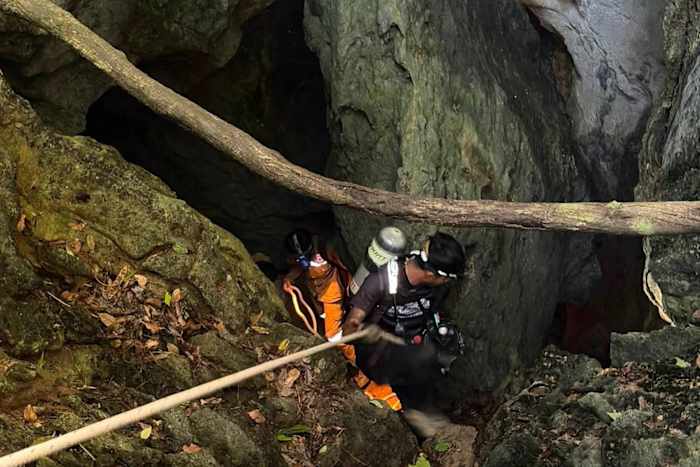
The sound of water inside a limestone cave is unlike anything else on Earth. It does not trickle. It echoes, bounces, and multiplies against the damp stone until a minor stream sounds like an approaching freight train. For two people trapped somewhere in the subterranean darkness of a Lao cavern, that sound is currently the only clock that matters.
Outside, the tropical rain is relentless. It sheets across the dense canopy of the jungle, turns dirt tracks into impassable brown rivers, and pools over the porous karst landscape. Every drop that falls on the surface eventually finds its way down. It seeps through cracks, fills underground reservoirs, and rushes into the narrow chambers where a rescue mission is currently locked in a desperate race against geography.
We often treat news of wilderness rescues as administrative tallies. Two people missing. A team of twenty deployed. A delay of twelve hours. But anyone who has ever stood inside a cave when the weather turns knows that these numbers mask a terrifyingly visceral reality.
The Weight of the Dark
To understand the crisis unfolding in Laos, one must understand the nature of karst topography. The region is beautiful, defined by towering limestone cliffs that rise abruptly from flat green valleys. Over millennia, water has carved these mountains from the inside out, creating vast, labyrinthine cave systems. They are magnets for adventurers. They are also incredibly volatile.
Imagine a giant sponge made of solid rock. When a storm hits, the sponge saturates instantly. The water has to go somewhere, so it channels into the lowest points—the very tunnels that explorers travel through. A dry path can become a churning, neck-deep torrent in less than an hour.
Consider the psychological reality of the two missing individuals. Total darkness in a cave is absolute. It is not the darkness of a bedroom at night; there is no ambient glow from a streetlamp, no starlight, no adjustment of the pupils. It is a thick, heavy absence of light that makes the mind play tricks. Your ears become hyper-sensitive. Every splash of rising water sounds like a promise or a threat. You are acutely aware of your own breath, the damp chill seeping through your clothes, and the finite life of your flashlight batteries.
In these situations, survival is not just about physical endurance. It is a mental battle against the claustrophobic weight of the earth above you.
When Help is Blocked by a Wall of Water
On the surface, the atmosphere is a mix of controlled chaos and agonizing helplessness. Rescue operations in remote Southeast Asian terrains are logistically brutal even in perfect weather. When heavy rains arrive, the entire operation grinds into a frustrating paradox: the urgency increases exponentially, but the ability to move decreases to a crawl.
The rescue teams face a cruel calculus.
- Rising water levels choke off the entry points, forcing divers to navigate zero-visibility currents.
- Mudslides block the mountain tracks, preventing heavy equipment and medical supplies from reaching the staging area.
- Unstable rock formations inside the cave, loosened by the sudden influx of water, threaten to collapse on rescuers and victims alike.
This is where the standard news reports fail to capture the true friction of the event. A "delay due to rain" is not a minor inconvenience. It is a heartbreaking standoff. Rescuers sit under tarpaulins, listening to the downpour, knowing that every hour they wait is an hour the water rises inside the mountain. They are expert divers, local volunteers, and military personnel, all itching to move, but moving too early means adding more casualties to the list.
The physics of cave diving are unforgiving. In open water, if a diver panics or runs out of air, they can swim up. In a flooded cave, "up" is solid stone. The only way out is back through the narrow, twisting tunnel they came from, often in water so thick with disturbed silt that they cannot see their own hands in front of their faces.
The Human Thread in the Jungle
Behind every headline like this is a community suddenly pulled into a vortex of anxiety. In the nearby villages, local guides and residents become the backbone of the effort. They know the mountains. They know how the caves breathe, how they flood, and where the dry pockets are most likely to be found.
There is a profound human solidarity that emerges in these moments. Language barriers and national origins melt away. The only thing that matters is the shared conviction that those two people must be brought back to the sunlight.
But the rain continues to fall. It beats a steady, maddening rhythm on the leaves outside the cave mouth.
We live in an era where we feel entirely connected and largely invincible, shielded by technology and instant communication. A crisis like the one in Laos serves as a stark, humbling reminder of the ancient power of the natural world. Beneath the mud and the limestone, two human beings are waiting, relying on nothing but their own resilience and the stubborn determination of strangers who refuse to let the weather win.
The search is stalled, but it is far from over. The rain will eventually ease. The water will recede. Until then, the rescuers watch the sky, the locals pray to the spirits of the mountain, and the clock beneath the mud keeps ticking.