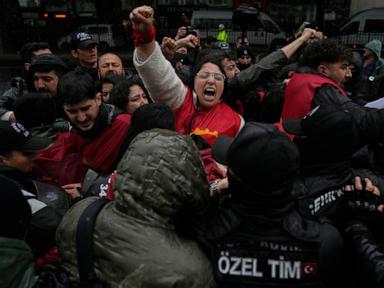
Elena stares at the digital display of her thermostat like it’s a ticking bomb. It is exactly 16°C in her flat. Outside, the London streets are beginning to pulse with the rhythmic thud of drums and the sharp, metallic chirp of police whistles. It is May Day. Historically, this is the season of rebirth, of ribbons tied to poles and the celebration of labor. But this year, the air is thick with a different kind of energy.
The heat is off. It has to be.
The war in the Middle East—a conflict involving Iran that felt like a distant headline three months ago—has finally come home to her kitchen table. It arrived in the form of a PDF from her energy provider that made her heart skip a beat. When the tankers stopped moving freely through the Strait of Hormuz, the global supply chain didn't just bend; it snapped. For Elena, and for millions of others lining the boulevards today, the geopolitical chess match has been reduced to a simple, brutal choice: heating or eating.
The Geography of a Shiver
We often talk about "energy markets" as if they are abstract weather patterns, things that happen to us but remain beyond our touch. This is a polite fiction. When a drone strikes a refinery or a naval blockade tightens in the Persian Gulf, the impact travels at the speed of light through fiber-optic cables and ends in the shivering limbs of a pensioner in Manchester or a line cook in Marseille.
Iran’s role in the global energy matrix is not merely as a producer, but as a gatekeeper. Roughly a fifth of the world’s total oil consumption passes through that narrow neck of water between the Gulf of Oman and the Persian Gulf. When conflict flares there, the "risk premium" is added to every gallon of fuel and every therm of gas. Speculators bet on scarcity. Prices moon. And the person at the end of the line—the one who actually turns the wrench or clears the table—is the one who pays the bill for the bombs.
The demonstrations we see today aren't just about wages. They are about the vanishing floor of the middle class. Workers are finding that even when they do everything right—work the overtime, skip the holidays, mend the old clothes—the macro-economy can still reach into their pockets and empty them.
The Anatomy of the May Day March
If you walked into the crowd today, you wouldn't just see the usual suspects. Yes, the hardline unions are there, their red banners snapping in the wind. But look closer at the faces. You’ll see young couples in tech fleeces. You’ll see healthcare workers still wearing their scrubs. You’ll see the "quiet" people who never thought they’d be holding a piece of cardboard with a handwritten grievance.
"I’m not a radical," a man named Marcus told me. He’s a logistics manager, someone whose entire life is built on the logic of efficiency. "But the math doesn't work anymore. My electricity bill has tripled. My rent is up because my landlord’s mortgage interest spiked. And now they tell me there’s a war, so I should be a patriot and just suffer? I’m patriotic. I’m also freezing."
This is the invisible stake of the current crisis. It is a crisis of faith. When the cost of basic survival becomes a volatile commodity tied to a missile range halfway across the globe, the social contract begins to fray. People start asking why their lives are so deeply tethered to a geography they’ve never visited and a conflict they didn't choose.
Why This Time is Different
Inflation is an old ghost. We’ve dealt with it before. But the current intersection of the Iran conflict and the green energy transition has created a unique kind of pincer movement.
- The Fossil Fuel Trap: While Europe and much of the West have committed to moving away from oil and gas, the infrastructure for renewables isn't yet robust enough to pick up the slack during a sudden supply shock. We are caught in the "in-between" years.
- The Logistics of Fear: Shipping companies are rerouting vessels around the Cape of Good Hope to avoid the conflict zones. This adds weeks to journeys and millions to costs. This isn't just about gas; it’s about the cost of the grain in your bread and the plastic in your toothbrush.
- The Interest Rate Hammer: Central banks are raising rates to fight the very inflation caused by these energy spikes. This means the worker is hit twice: once at the petrol pump and once when their credit card bill arrives.
Consider the ripple effect. A factory in Germany reduces its shifts because the cost of powering the assembly line has eclipsed the profit margin of the parts they produce. The workers are sent home with 80% pay. They spend less at the local grocery store. The grocery store cancels its order for new shelving. The shelving company lays off its designers.
It is a slow-motion car crash, and the May Day protests are the sound of the glass shattering.
The Human Cost of a Spreadsheet
Economic reports will tell you that "consumer confidence is low." That’s a sterile way of saying that a mother is crying in the bathroom so her kids don't see her stress. It’s a sterile way of saying that a small business owner is looking at the shop he built over twenty years and realizing he might have to hand over the keys by June.
The anger on the streets today is fueled by a sense of powerlessness. When the enemy is a virus, or a bad harvest, there is a sense of "we’re all in this together." But when the enemy is a geopolitical power play—a calculated move by a state actor like Iran to leverage energy as a weapon of war—the suffering feels manufactured. It feels like a choice made by men in suits in distant capitals, for which the woman in the 16°C flat must pay.
There is a psychological weight to living in an era of "permacrisis." We went from a global pandemic to a supply chain collapse to a continental war, and now to a Middle Eastern conflict that threatens to turn the lights out. The resilience of the average worker is not an infinite resource. It is a battery that has been drained for four years straight and is now flashing red.
Beyond the Banners
So, what are they actually asking for? The demands are surprisingly grounded. They want energy price caps that actually reflect the cost of living. They want a "windfall tax" on the companies that are posting record profits while the rest of the world tightens its belt. They want a fast-track to energy independence that doesn't leave the poorest behind.
But more than that, they want to be seen.
The May Day demonstrations are a collective scream for recognition. They are a reminder to the planners and the politicians that "macro-economics" is just a fancy word for the sum total of human struggle. Every basis point of inflation is a missed meal. Every dollar added to a barrel of Brent Crude is a child who doesn't get new shoes for school.
The Silent Spring
As the sun begins to set on the protests, the streets are littered with the debris of the day. Discarded signs, empty water bottles, the fading echoes of chants. Elena walks back to her flat. The temperature has dropped another degree. She wraps a wool blanket around her shoulders—a gift from her grandmother that she used to think was just for decoration.
She checks the news on her phone. There is more talk of "strategic deterrence" and "asymmetric warfare." There are more charts showing the price of natural gas futures. None of it tells her when she will be able to turn the dial on her wall without feeling a pang of guilt.
The true tragedy of the current energy crisis isn't found in the headlines about missile strikes or diplomatic walkouts. It is found in the quiet, domestic surrenders. It is found in the way we are learning to live smaller, colder, and more anxious lives while the world’s giants stumble over one another.
We are told that we are at a turning point in history. But for the people on the street today, the only turning point that matters is the one that brings the cost of a warm home back within reach. Until then, the drums will keep beating, and the spring will remain stubbornly, unforgivingly cold.
Elena reaches for the kettle. She’ll make tea. It’s a small warmth, a temporary fortress against a world that has forgotten the value of a steady life. She watches the blue flame of the stove—a tiny, flickering piece of the global energy market—and wonders how much that single cup of tea just cost her.


