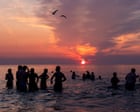
The North Sea at dawn does not forgive hesitation. I remember standing on the slick, shale-strewn edge of the East Sands at St Andrews, watching the sky bleed from bruised purple to a sharp, clinical gray. It was the first of May. The traditional May Dip was only moments away. Hundreds of students, shivering in oversized bathrobes and woolen beanies, were preparing to plunge into the freezing surf. Some were there for the ancient folklore, a superstitious ritual to wash away academic sins before the exams. Others were simply there for the adrenaline, the shared, reckless joy of communal shivering.
But there was another presence on the beach that morning. A silent, predatory observer lurking just beyond the breaking waves. For an alternative look, read: this related article.
We stood together, chattering teeth masked by nervous laughter, entirely unaware that our vulnerability was being commodified. Cameras with heavy telephoto lenses were perched on the dunes, pointed not at the grand spectacle of the sunrise, but directly at the shifting, soaking clothes of young women emerging from the water.
It is a strange feeling to realize that your moment of utter exposure has been transformed into an unauthorized spectacle. The cold water is supposed to be the only shock you face. Similar coverage on this matter has been provided by Associated Press.
The Anatomy of the May Dip
For centuries, the May Dip has stood as a sacred rite of passage at the University of St Andrews. Students run into the icy waters at sunrise on May Day, a tradition steeped in history and camaraderie. The cold is piercing. The air temperature hovers barely above freezing. The water bites. Yet, beneath the freezing spray lies an invisible current of tension.
Consider what happens when the sea air meets a camera lens. The telephoto lens compresses the distance, flattening the beach into a voyeuristic canvas. Photographers, many operating without accreditation or permission, position themselves to capture the moment of transition. It is the transition when heavy wool robes are dropped to reveal swimwear, and sometimes, far less.
The cold water forces people to seek warmth and privacy the moment they exit the surf. Towels are held aloft; hands scramble for cover. It is a desperate, frantic search for dignity in the open air.
Yet, as recent incidents have revealed, this scramble for privacy is precisely what draws the unwanted attention. Reports flooded the university's student union and local authorities after the dip, detailing photographers actively tracking female students. They were not aiming for wide, atmospheric shots of the crowd. They were targeting individuals, honing in on specific subjects without consent.
The Reality Behind the Lens
Let us look at the facts. Photography in a public space is generally permitted in the United Kingdom, but the line between public documentation and targeted harassment is incredibly thin. When a lens focuses repeatedly on an individual in a state of distress or vulnerability, the act shifts from journalism to intrusive surveillance.
The St Andrews community felt the sting of this shift deeply. In May, following the annual dip, students spoke out. The accounts were visceral. "It ruined my night," one student shared, her voice shaking with the lingering frustration of feeling violated on what was supposed to be a morning of celebration. Another described the sickening realization that her photograph had been taken, circulated, and potentially stored without her knowledge.
The psychological impact is profound. It turns a public celebration into a minefield of self-consciousness. Students begin to second-guess whether they should participate. They ask themselves if the joy of tradition is worth the risk of exposure.
This is not an issue of prudes and Puritans. This is a question of consent. It is the fundamental understanding that being in a public space does not grant an open license to gaze upon vulnerability with predatory intent.
The Invisible Stakes
To understand why this matters, you must understand the psychology of the crowd. When you step into the ocean with hundreds of your peers, you are masked by the collective. You are part of a massive, shared experience. You feel safe because you are one among many.
When a lens singles you out, that safety shatters.
Imagine, for a moment, the feeling of a glass of cold water being poured down your spine. Now imagine that sensation amplified by the knowledge that someone is watching you shiver through a high-powered scope. The anonymity you relied on is gone. The line between observer and trespasser is erased.
The university and local police have begun to address these incidents, urging victims to come forward and increasing security presence along the coastline. But the reaction time has sometimes felt slow compared to the speed at which images can travel across digital networks. Once a photograph is taken and uploaded to a local business website or social media platform, the damage is already done. The digital footprint is permanent.
The Broader Cultural Reckoning
This phenomenon extends far beyond the quiet, historic streets of St Andrews. It is a mirror reflecting a broader societal discomfort with the female body and public space.
Consider the debate surrounding street photography and the rights of the subject. While artists and documentarians have long captured the human condition in public, the digital age has weaponized these images. A photograph no longer stays in a physical darkroom. It travels instantly to forums and social media, where comments can reduce a person's vulnerability to a crude object of discussion.
The balance of power is unequal. The person holding the camera controls the narrative. The person in the water is simply trying to survive the cold.
We must ask ourselves what kind of culture we are building if we allow this behavior to be normalized under the guise of tradition or public interest. Is it acceptable to profit from someone's moment of cold, shivering vulnerability? Is it a fair exchange of art for exposure?
The answer lies in the silence of the beach.
The Path to Accountability
Real change requires more than just warning signs and security patrols. It requires a fundamental shift in how we perceive the act of observing.
When we look at another human being, we must see a person, not a subject. We must recognize the dignity that exists in the freezing surf and respect the boundary drawn by the towel clutched around a shivering frame.
The authorities in St Andrews have started taking steps to identify those who target individuals on the beach, but the responsibility also falls on the bystanders. If you see someone aiming a telephoto lens at a single, unsuspecting student, the silence is complicity.
The cold water will continue to draw students to the East Sands every May. The sun will rise, the mist will clear, and the laughter will echo against the ancient stone walls of the town. But the water must remain just water. The beach must remain a place of shared joy, not a hunting ground for the curious lens.
The true test of a community is how it treats its most vulnerable members when they are least protected. Until that lesson is learned, the shoreline remains an uneasy place.
The next time you see a photograph of a dawn dip, look closer. Look past the light and the spray. Look for the dignity that remains, even in the cold.



