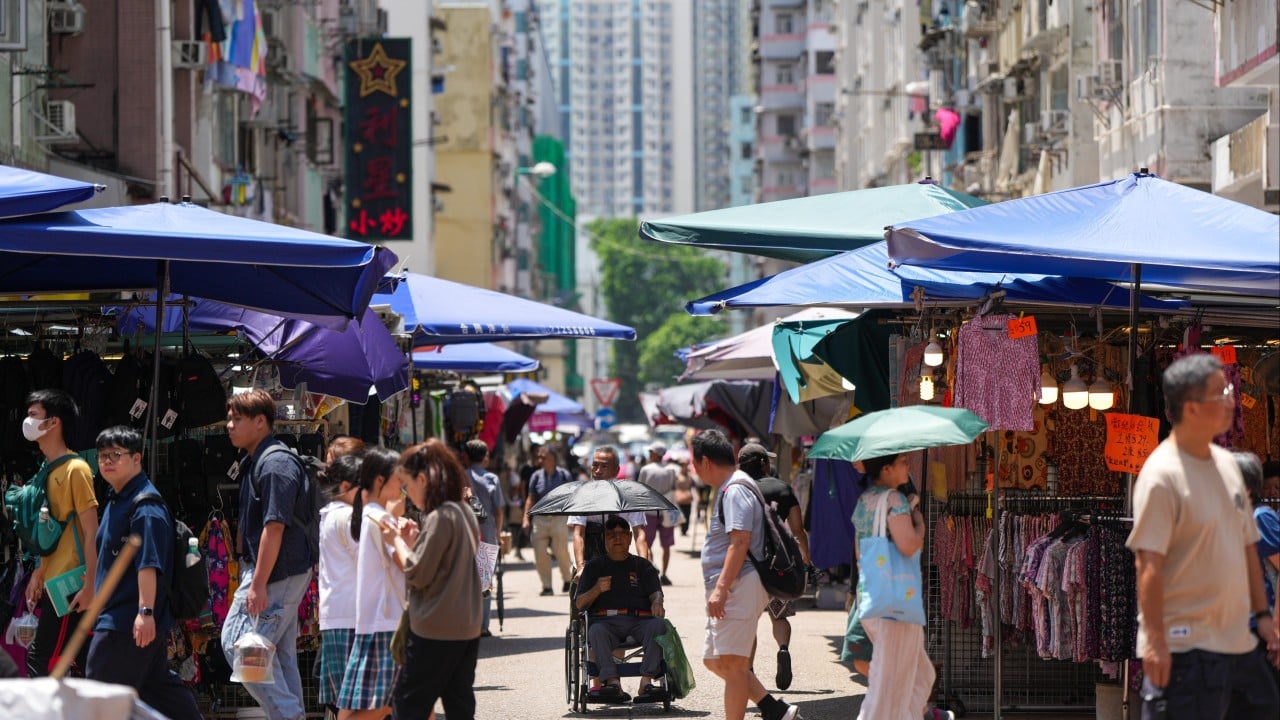
The air in Sham Shui Po sticks to your skin before you even step off Apliu Street. It is a dense, metallic soup scented by hot oil, melting plastic, and the damp wool of secondhand sweaters stacked ten feet high in roadside stalls. Neon tubes flicker overhead even at noon, casting sickly pinks and greens over the cracked tiles of old tenement blocks. This is not the postcard version of Hong Kong. There are no soaring glass monoliths reflecting the harbor here, no sleek trams gliding silently past luxury boutiques. This is the old machine. Gritty. Overcrowded. Exhausted.
Yet, walk three blocks deeper into the maze, and something strange happens to the noise. It organizes itself.
Street sweepers move with a rhythm that suggests they know every loose paver on the block by its first name. Small-business owners sit on plastic stools outside their tiny storefronts, nodding to municipal inspectors not with fear, but with the weary familiarity of neighbors who share a fence line. When a water pipe leaks or a drainage grate clogs under the sudden fury of a summer typhoon, the fix does not require an intricate bureaucratic circuit board stretching across five glassy towers on Hong Kong Island. It gets handled. Locally. Immediately.
For decades, urban planners across Hong Kong treated districts like Sham Shui Po as architectural patient zero. They looked at the cramped subdivided flats, the crumbling tong laus, and the aging population as a systemic failure waiting to be cleared away for another sea of identical skyscrapers. But they missed the engine humming underneath. They missed the governance model hiding in plain sight.
Governance usually sounds like a dry architecture of committee meetings and whitepapers. It smells like carpeted conference rooms and lukewarm water in plastic pitchers. But on the ground, governance is visceral. It is the distance between a citizen pointing at a broken streetlight and a technician tightening a bolt.
In Sham Shui Po, that distance is dangerously short. And that proximity changes everything.
Consider what happens in a typical top-down municipal structure when a neighborhood starts to fray. A central authority drafts a blueprint. They commission a study. They hold public consultations where working-class residents who work twelve-hour shifts cannot possibly attend. By the time the policy trickles down through three layers of intermediaries, the problem has mutated, grown teeth, and bitten someone else.
Sham Shui Po operates on a different frequency. Because the district’s civic machinery is forced to rub shoulders with its chaotic reality every single day, the feedback loop collapses into something approaching real-time. District councils, neighborhood welfare associations, hawker groups, and local volunteers form a messy, overlapping web of mutual accountability.
Imagine Uncle Chan. He is a hypothetical composite of the neighborhood’s shopkeepers, but his story is real enough to bruise. He runs a tiny hardware stall that has occupied the same ten square feet of concrete for thirty years. When the district government wanted to redesign the local market access routes to improve pedestrian flow, they didn't mail a survey to an empty inbox. They walked down Apliu Street, pulled up a plastic stool next to Uncle Chan’s inventory of copper pipes, and asked him where the bottleneck actually was.
That is not just community engagement. That is survival intelligence.
Most urban neighborhoods in modern metropolises suffer from an affliction called systemic amnesia. The people pulling the administrative levers live forty miles away in gated enclaves or pristine high-rises. They view the streets below them as abstract data points on a dashboard. Crime rates, square footage, median income, traffic flow. They optimize for the spreadsheet while the living room burns.
Hong Kong’s administrative geography has historically struggled with this exact disconnect. The territory’s vast bureaucratic apparatus is a marvel of efficiency when building massive infrastructure projects—railways that appear overnight, land reclaimed from the sea with terrifying precision. But when it comes to the messy, microscopic texture of daily life in high-density older districts, the macro-engine often stutters. It tries to apply a one-size-fits-all template to a neighborhood that requires a custom-tailored suit.
This is where the quiet revelation of Sham Shui Po enters the room.
The district proves that high density does not automatically breed civic alienation. In fact, when managed with a high degree of local responsiveness, density becomes a superconductor for community resilience. Because people live cheek-by-jowl, problems cannot be ignored. A blocked alleyway or an isolated elderly resident cannot be swept under the rug of suburban sprawl. The density forces a reckoning. And the governance structures that succeed here are the ones that lean into that friction rather than running away from it.
Other districts across Hong Kong have spent years trying to engineer community spirit from the top down. They build expensive cultural centers, launch glossy civic campaigns, and wonder why residents treat public spaces like hotel lobbies—visiting them, using them, but never caring for them.
The secret Sham Shui Po whispers back is radical in its simplicity: ownership cannot be prescribed. It has to be practiced.
When local shopkeepers and residents have a direct hand in shaping how their streets are cleaned, how community spaces are utilized, and how vulnerable neighbors are checked on during cold snaps, the psychological contract between citizen and state shifts. The government stops being an invisible landlord demanding rent and starts feeling like an extension of the household.
Of course, romanticizing Sham Shui Po would be a mistake. The district bears the heavy scars of economic inequality. Beneath the vibrant street life lie deep pools of poverty, substandard housing conditions that break the heart, and elderly residents navigating a rapidly digitizing world with cash and anxiety. The local governance model is not a utopian paradise; it is a battle-hardened survival kit. It works not because it is clean, but because it is responsive.
And that is precisely what the rest of Hong Kong’s districts need to steal.
As urban renewal projects loom large over the territory’s older neighborhoods, planners face a stark fork in the road. They can continue down the path of clean-slate gentrification—demolishing the old fabric, dropping in sterile residential towers, and erasing the messy human networks that took a century to grow. Or they can study the messy organic machinery of places like Sham Shui Po and figure out how to digitize and scale its intimacy.
The future of urban governance is not about building smarter algorithms in a vacuum. It is about shrinking the distance between the governed and the governor until accountability becomes unavoidable.
When you walk down those crowded Sham Shui Po streets at dusk, watching the metal security gates rattle down one by one, you realize something essential. A city is not built of concrete and steel. It is built of the friction between neighbors, the friction of small arguments resolved over tea, and the quiet, stubborn belief that the street outside your door belongs to you.
The rest of the city is finally starting to listen.