The smell of wet asphalt mixes with vinegar. If you have ever stood in a crowd when the canister pops, you know that sharp, sour tang. It hits the back of the throat first. Then the eyes sting.
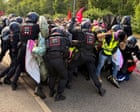
In the western German city of Essen, that scent hung heavy over the Grugahalle arena. Outside, thousands of people pressed against steel barriers. Inside, delegates gathered for the party congress of the Alternative for Germany, the AfD. Between them stood several thousand riot police, helmets gleaming under a gray sky, shields formed into a wall of dark blue plexiglass. Discover more on a connected topic: this related article.
This is what modern democracy looks like when it breathes heavily. It is not found in the clean text of a ballot paper or the polite acoustics of a television studio. It is found in the friction between heavy boots and tarmac. It is found in the high-pitched whistle of a crowd trying to drown out a speaker they believe shouldn't be allowed to speak at all.
To understand how Germany arrived at this specific intersection of anger and concrete, you have to look past the political slogans. You have to look at the geometry of the confrontation. Further journalism by Al Jazeera highlights related perspectives on the subject.
The Geography of Friction
Essen is an old coal town. Its bones are made of heavy industry, a place built on the literal grinding of gears and the lifting of weight. It is a fitting stage for a conflict that feels increasingly mechanical.
On one side of the police line stood the demonstrators. Estimates put their numbers in the tens of thousands. They came from across the country, riding night trains and organizing carpools, carrying banners that read "Keep Fascism Out of the Parliament." They see the AfD not as a political opponent, but as an existential threat to the postwar German republic. For them, blocking the road is not a minor disruption. It is a civic duty.
On the other side were the delegates. Men and women in sharp suits and sensible coats, clutching briefcases and security passes. They view themselves as the voice of a forgotten majority, a group being pushed to the margins by a political establishment they distrust. They see the protests as proof of their own narrative: that the system is rigged against them.
In the middle stood the police.
Imagine spending eight hours in thirty pounds of protective gear, moving only when a line surges, acting as a human shock absorber between two irreconcilable visions of the future. The police are often viewed as a monolith, a faceless wall of authority. But look closer. You see the sweat dripping from under the lip of a helmet. You see the tense grip on a baton. They are tasked with maintaining an order that feels temporary at best.
The Spark and the Surge
The tension broke early in the morning. A group of several hundred protesters attempted to breach a security perimeter near a highway off-ramp. They wanted to cut off the access routes, to make it physically impossible for the conference to begin.
Movement happened fast. A sudden rush of bodies. The metallic clatter of barriers being pushed over.
The response was immediate. Police used pepper spray and batons to push the crowd back. In the chaos, several officers were injured, including one who was kicked in the head while on the ground. This is the reality of political polarization when it spills into the street. It ceases to be an intellectual debate about immigration, sovereignty, or economic policy. It becomes a matter of physical survival, of holding your ground against someone who wants to take it from you.
By mid-afternoon, the area around the Grugahalle resembled a fortress. Barbwire coils sat on top of concrete barriers. Water cannons parked at key intersections, their massive nozzles pointed toward the crowds like silent, heavy artillery.
The AfD leadership used the chaos outside to frame the narrative inside. From the podium, party co-leader Alice Weidel declared that the protests showed the "undemocratic nature" of their opponents. Outside, speakers on makeshift stages shouted that the conference inside was an insult to the memory of a democratic Germany.
Two sides. Two completely different interpretations of the exact same moment.
The Long Shadow of the Past
Every political argument in Germany carries weight. The country’s history is not a textbook; it is a blueprint that everyone is constantly trying to avoid repeating. When protesters shout "Never Again," they mean it with a literal, historical urgency. When the AfD argues that they are being persecuted for their beliefs, they evoke a different kind of historical memory—the suppression of dissent.
This makes compromise impossible. You cannot negotiate with someone you believe is trying to destroy the foundation of your society. You can only outvote them, or you can try to stop them from meeting.
As the sun began to drop, the energy of the crowd shifted from active resistance to a stubborn, chilly endurance. The blockades had failed to stop the conference, but they had succeeded in turning it into a siege. The delegates were inside, but they were trapped there, surrounded by a city that largely did not want them.
A young woman sat on the curb a few hundred yards from the police line, her face flushed from the cold and the residual sting of the spray. She wasn't chanting anymore. She was just watching the blue lights flash against the windows of the arena.
Consider what happens when the sirens finally stop. The barriers will be loaded back onto flatbed trucks. The street sweepers will clear away the discarded plastic bottles and the torn cardboard signs. The delegates will go home, and the protesters will go back to their daily lives.
But the friction remains. It stays in the soil of the city, waiting for the next spark, the next conference, the next time two distinct ideas of what Germany should be find themselves sharing the same narrow stretch of road.