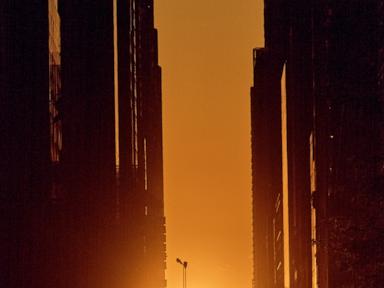
Twice a year, thousands of people choke New York City’s major cross-streets, holding smartphones aloft to capture Manhattanhenge, the viral astronomical event where the setting sun aligns perfectly with the borough’s east-west street grid. It looks like a spontaneous celebration of urban nature. It isn't. The phenomenon is a predictable consequence of 19th-century real estate greed, a rigid 1811 urban plan, and modern algorithmic hype that routinely packs intersections to a dangerous degree. While tourists see a romantic sunset, the event actually exposes how a historical decision to maximize property values accidentally created a biannual celestial amplifier.
The mechanics are straightforward but widely misunderstood. Manhattanhenge occurs around May 28 and July 12 for the full sun alignment, with half-sun variations occurring a day before or after.
The Commissioners Map That Chained the Sun
To understand why the sun kisses the asphalt of 42nd Street so precisely, you have to look back to the Commissioners’ Plan of 1811. John Randel Jr., the chief surveyor, was tasked with carving up the wild, hilly topography of Manhattan into a predictable, salable grid.
Investors did not care about natural contours, vistas, or astronomical alignments. They wanted square lots that were easy to buy, sell, and develop. Randel laid out 12 primary north-south avenues and 155 orthogonal east-west streets.
Crucially, the grid was not aligned with true geographic north.
The surveyors tilted the entire blueprint 29 degrees east of true north to mirror the natural orientation of Manhattan Island itself. If the grid had run true north-south, Manhattanhenge would happen precisely on the equinoxes in March and September. Because of that 29-degree clockwise rotation, the alignment shifted deep into spring and summer, landing on dates that now anchor New York's peak tourism season.
The sun does not change its path. The city simply built a concrete canyon that waits for it.
The Physics of the Concrete Canyon
Neil deGrasse Tyson coined the term Manhattanhenge in 1997, drawing an explicit parallel to Stonehenge. At Stonehenge, ancient humans moved massive megaliths to mark the solstices. In Manhattan, nineteenth-century politicians moved millions of tons of earth to do the exact same thing on a gargantuan scale.
The phenomenon requires specific structural geometry to work.
- Topographical clearance: The street must have a clear view all the way to the Hudson River and the New Jersey horizon beyond it.
- Corridor length: The long, unbroken vistas of cross-streets allow the sun's rays to funnel cleanly through the architecture without being blocked by diagonal interruptions.
- Building height uniformity: Dense walls of skyscrapers act like the stone pillars of Wiltshire, framing the light and preventing it from scattering across the broader cityscape.
True North
   ↑
   │   Grid North (Tilted 29° East)
   │     ↗
   │    /
   │   /   [Manhattan Cross-Streets] ───> Sun aligns here late May/July
   │  /
   └─── ── ── ── ── ── ─> True East
When the sun reaches the correct azimuth—the horizontal angle of a celestial object measured from north—it sinks to the horizon at the exact angle of the street grid's tilt. For a few minutes, the light behaves like a laser channeled down an optical fiber.
The Best Corridors Are Becoming Unmanageable
Not all cross-streets are created equal. The ideal viewing locations require wide thoroughfares with compelling architectural framing and a clear drop-off toward the river.
The prime corridors remain fixed. 14th Street offers a gritty, low-slung perspective, while 23rd Street provides an elegant framing near the Flatiron district. 34th Street introduces the Empire State Building into the background, making it an absolute madhouse for photographers. 42nd Street, framed beautifully by the Tudor City overpass, offers the most dramatic elevation but also the worst congestion. 57th Street benefits from its width but suffers from intense traffic patterns.
The Tudor City overpass has become a flashpoint for city crowd control.
Security personnel and police barricades are now permanent fixtures during the alignment windows. What used to be a niche gathering of amateur astronomers has turned into a logistical headache for the city. Pedestrians routinely spill off the sidewalks into active traffic lanes on 42nd and 34th streets, desperate to get a shot without a yellow cab blocking their frame. Drivers, frustrated by gridlock, honk indiscriminately, creating a deafening wall of sound that clashes violently with the serene aesthetic captured on Instagram.
The Atmospheric Gamble
Social media feeds present Manhattanhenge as a guaranteed, pristine event. The reality on the ground is far more frustrating.
Meteorology rarely cooperates with astronomy.
Even if the sky over Manhattan is perfectly clear, a bank of low-lying marine fog over the Hudson River or a cloud formation over New Jersey can instantly ruin the effect. The sun vanishes into a gray haze five minutes before it hits the grid line, leaving thousands of onlookers staring at a dull, smoggy sky. Veteran photographers know that air quality changes the entire experience. High humidity and particulates create a deep, blood-red sun, while crisp, dry days yield an blindingly bright golden light that washes out camera sensors entirely.
If you plan to view it, prepare for the distinct possibility of failure.
Survival Tactics for the Grid Lock
If you choose to join the fray, avoid the temptation to stand directly in the middle of the crosswalk when the light turns green. It is a quick way to get injured.
| Location | Pros | Cons |
|---|---|---|
| 42nd Street Overpass | Incredible elevation, iconic framing | Critically overcrowded, arriving 2 hours early is mandatory |
| 34th Street | Empire State Building backdrop | Narrower sidewalks, intense bus traffic |
| 14th Street | Wider street, more relaxed crowd | Less dramatic architectural framing |
| Hunter's Point (Queens) | Captures the sun hitting the canyons from outside | Requires a high-end telephoto lens |
Position yourself as far east as possible on the island while maintaining a clear view westward. This maximizes the tunnel effect of the buildings, lengthening the time the sun stays trapped within the architectural frame. Bringing a proper camera with a telephoto lens yields infinitely better results than a smartphone, which will automatically overexpose the sun and turn the surrounding buildings into a muddy, featureless black silhouette.
The city is already planning for the next shift. As supertall skyscrapers continue to sprout along 57th Street and the Far West Side, the shadows cast across the grid are changing. The perfect clean channels carved out in 1811 are slowly being chipped away by modern real estate development, meaning the Manhattanhenge of the next decade may look vastly different from the one captured today. The grid remains rigid, but the sky above it is constantly being rewritten.