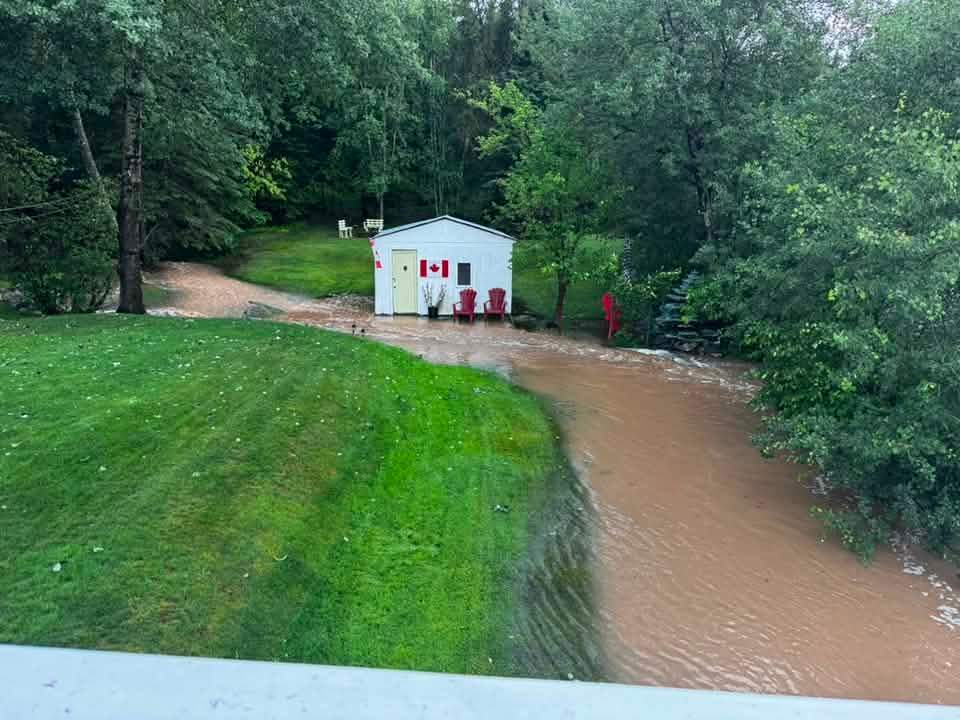
The headlines write themselves every time a dark cloud rolls over the Manitoba-Ontario border. "Raging Storm Batters Cottage Country." "Devastation at the Lake." Media outlets rush to frame summer storms in luxury vacation zones as existential tragedies, complete with dramatic photos of fallen pine branches resting gently on million-dollar metal roofs.
It is a narrative built on a lazy, middle-class consensus that treats seasonal playlands as fragile ecosystems on the brink of collapse.
Let's drop the theatrical sympathy. A heavy thunderstorm hitting the Whiteshell or Shoal Lake area isn't a national crisis. It is a predictable atmospheric event happening exactly where it always has, impacting a demographic that possesses the highest financial capacity to absorb the damage. The real story isn't the storm itself; it is the absolute delusion of urbanites who buy property in the middle of a dense boreal forest and expect the convenience of a downtown condo.
The False Premise of "Devastation"
When mainstream news reports on a storm straddling the Manitoba-Ontario border, they follow a tired blueprint. They focus on power outages, blocked gravel roads, and ruined weekend plans. They interview a disgruntled cabin owner who had to run a generator for 48 hours, framing it as a harrowing survival story.
This is a complete inversion of reality.
Meteorologically, the region between Winnipeg and Kenora is a known hotspot for severe summer weather. Warm, humid air pushing north from the United States collides with the cooler, stable air masses of the Canadian Shield. The result is a volatile atmospheric mixing zone. If you own property here, a severe thunderstorm with high winds and microbursts is not an anomaly. It is a baseline feature of the geography.
Calling a standard convective storm "devastating" to cottage country is like calling a blizzard "unprecedented" in Winnipeg. It ignores basic climatology to manufacture a sense of shock.
Dismantling the Victim Narrative
The panic surrounding these storms exposes a deeper flaw in how we view seasonal real estate. Property owners in these regions often demand massive public infrastructure spending to protect their private sanctuaries.
- The Power Grid Fallacy: Hydro crews spend millions re-stringing lines through dense, swampy bush to restore power to seasonal cabins that sit empty ten months of the year.
- The Road Subsidy: Rural municipalities drain their budgets clearing remote cottage roads while primary agricultural transit routes wait for maintenance.
I have spent years analyzing regional development and infrastructure allocation. The financial math of cottage country is completely broken. Urban taxpayers heavily subsidize the emergency response and infrastructure maintenance for seasonal playgrounds. When a storm hits, the narrative focuses entirely on the plight of the vacationer, completely ignoring the taxpayers footin the bill to fix the playground.
The Real Cost of Insuring the Wilderness
Let's look at the financial mechanics that the mainstream media completely ignores. The insurance industry is already waking up to the reality of cottage country, even if the public hasn't.
For decades, insuring a secondary property on the Canadian Shield was relatively cheap. It was viewed as a lower risk than a primary urban residence because there were no complex plumbing systems to burst over winter, and the structures were often simpler. That era is over.
Insurance conglomerates are drastically rewriting their risk models for the Manitoba-Ontario border region. They aren't just looking at localized windstorms; they are calculating the compounding risk of wind damage followed by prolonged power loss, which disables sump pumps and leads to massive water damage claims.
Cottage Risk Profile Shift:
Traditional View: Low occupancy = Low liability / Simple structures = Cheap repairs
Modern Reality: Extreme weather frequency + Remote access limitations = Exponentially higher claims
If you choose to build a sprawling, glass-fronted architectural masterpiece on a granite cliff surrounded by 60-foot jack pines, you have actively engineered your own vulnerability. A high-wind event isn't an act of god that demands public sympathy; it is a predictable insurance event for which you should pay a premium that reflects the actual risk.
The Flawed Questions People Ask About Storm Damage
Look at any online forum or community board after a major border storm, and you will see the same flawed questions repeated ad nauseam. The premise of these questions is fundamentally broken.
"Why is Hydro taking so long to restore power?"
This question assumes that a remote cabin down a single-lane dirt track should have the same grid resilience as a major urban center. The physical reality of the Canadian Shield makes rapid power restoration nearly impossible. Crews have to navigate downed trees, marshy terrain, and miles of dense bush just to isolate a single broken pole. Expecting instant restoration in a wilderness zone is a failure of basic spatial awareness.
"How can we make cottage country more resilient to extreme weather?"
The honest, brutal answer is that you can't—not without destroying the very reason people go there. To make a boreal forest resilient to wind damage, you would have to clear-cut every tree within a 100-foot radius of every power line, road, and structure. You would need to replace gravel roads with engineered, paved highways and bury utilities deep into solid granite bedrock at a cost of millions of dollars per kilometer.
If you want absolute safety and zero service interruptions, stay in the city. You cannot bring urban utility expectations into the Canadian Shield and complain when nature refuses to cooperate.
The Hard Truth for Property Owners
The contrarian approach to cottage country isn't about wishing harm on anyone's property. It is about demanding a culture of radical self-reliance.
If you own a property in a high-risk weather corridor along the provincial border, stop waiting for government agencies or utility companies to secure your investment. The current model of expecting public resources to bail out private luxury assets during routine weather events is unsustainable.
Build your structures to survive the environment. Install industrial-grade standby generators. Clear your own defensible space around your structures instead of crying foul when a tree falls on your deck. Accept that choosing to play in the wilderness means accepting the terms and conditions dictated by the wilderness.
Stop reading the sensationalized storm reports that treat a bad weekend at the lake like a humanitarian crisis. The storm didn't batter cottage country. Nature simply reminded a group of wealthy landowners exactly where they chose to build.