The Bank of England’s decision to transition its next banknote series from historical figures to native UK wildlife represents a fundamental shift in institutional branding, security architecture, and public stakeholder management. While superficial commentary centers on the aesthetic appeal of a shortlist containing 18 species—including the Atlantic puffin and the buff-tailed bumblebee—a rigorous structural analysis reveals that this transition is governed by a strict optimization problem. Central banks do not change banknote designs for novelty; they do so to maximize counterfeit resilience, minimize public divisiveness, and ensure multi-decade operational durability.
A public consultation involving over 44,000 respondents established nature as the dominant preference, captured by 60% of participants, outperforming architecture at 56% and notable historical figures at 38%. By analyzing the shortlist of 18 creatures through the lens of strict industrial design and central banking mandates, we can isolate the specific variables driving this currency overhaul.
The Six-Variable Optimization Framework for Currency Imagery
The selection of fiat currency iconography is bound by legal, technical, and psychological constraints. The Bank of England evaluates potential themes against six distinct criteria. When historical human figures are used, this model introduces significant tail risk: human legacies are subject to retrospective ethical re-evaluation, changing social values, and political friction.
Native wildlife addresses these vulnerabilities by optimizing the following framework:
- Geographic Representation: The subject must possess an intrinsic, non-controversial link to all home nations (England, Scotland, Wales, and Northern Ireland), eliminating regional bias.
- Public Resonance: The imagery must be instantly recognizable across diverse demographic cohorts, ensuring immediate cognitive association with British heritage.
- Divisiveness Mitigation: Unlike political, military, or scientific figures, biological species do not carry historical baggage or modern ideological polarization, eliminating the risk of alienation.
- Temporal Endurance: To justify the high fixed costs of re-tooling banknote printing infrastructure, the theme must remain culturally relevant for multiple decades. Biological taxa are immune to shifting cultural trends.
- Authentication Compatibility: The physical geometry, textures, and color gradients of the chosen subjects must map precisely onto high-security substrate features like holographic films, micro-print windows, and tactile raised ink.
- Statutory Compliance: The selection process must align with the public sector equality duty under the Equality Act 2010, ensuring the final imagery does not introduce implicit exclusion.
The 18-Species Shortlist: Taxonomical and Security Categorization
The Bank’s expert advisory panel distributed the 18 shortlisted candidates across three distinct biological classifications. This distribution serves a dual purpose: it reflects macro-environmental diversity while offering varied geometric and textural profiles necessary for anti-counterfeiting technologies.
Mammals and Birds
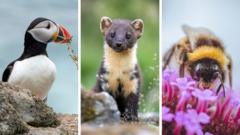
- Species Included: Bottlenose dolphin, Atlantic puffin, barn owl, brown hare, European hedgehog, common kingfisher, grey seal, Eurasian curlew, great spotted woodpecker, red fox, white-tailed eagle, pine marten.
- Security Utility: Avian plumage and mammalian fur present complex, highly repetitive organic patterns. These textures are exceptionally difficult for digital scanning and photocopying equipment to reproduce without introducing noticeable moiré patterns or loss of resolution. The distinct color blocks of the Atlantic puffin’s beak or the iridescent feathers of the common kingfisher provide ideal baselines for testing color-shifting inks.
Amphibians, Insects, and Fish
- Species Included: Atlantic salmon, basking shark, buff-tailed bumblebee, common frog, emperor dragonfly, marsh fritillary butterfly.
- Security Utility: The microstructures found in insects and fish scales introduce structural coloration principles. The transparent, segmented wing geometry of the emperor dragonfly or the intricate, high-contrast wing patterns of the marsh fritillary butterfly map directly onto complex geometric lathe work (guilloche patterns) and holographic patch window designs.
The Technical Bottlenecks of Banknote Authentication
The primary objective of any new banknote series is the mitigation of counterfeit risk. Introducing wildlife imagery modifies the underlying security architecture of the note across three specific tiers of authentication.
[Banknote Security Architecture]
 ├── Tier 1: Public Inspection (Macroscopic features: Color-shifting ink, holographic depth)
 ├── Tier 2: Commercial Cash Handling (Microscopic features: Micro-printing, UV fluorescence)
 └── Tier 3: Central Bank Automation (Machine-readable features: Magnetic/Infrared properties)
The first bottleneck occurs at Tier 1: Public Inspection. For a security feature to be effective, the public must notice when it is missing or flawed. Human faces are historically preferred because the human brain features a dedicated neurological region (the fusiform face area) optimized for facial recognition. Small deviations in a familiar human face are caught almost instantly by the naked eye.
Transitioning to wildlife requires a different cognitive anchor. The Bank must select animals with highly rigid, universally understood geometric profiles. The profile of an Atlantic puffin’s beak or the distinct silhouette of a barn owl must be rendered with absolute precision so that any blurring, line distortion, or color misalignment immediately triggers public suspicion.
The second bottleneck involves Tier 2 and Tier 3 Features. Banknotes must pass seamlessly through commercial high-speed sorting machines, vending machines, and automated teller machines (ATMs). The underlying security design must weave machine-readable infrared and magnetic inks into the artwork. An animal like the buff-tailed bumblebee provides a functional canvas for high-contrast, alternating yellow and black bands. These bands can be embedded with varying densities of functional inks without disrupting the visual integrity of the design for the end consumer.
Strategic Implementation and Public Consultation Phase
The transition process follows a multi-stage operational timeline designed to de-risk the deployment before physical production begins.
- Macro-Theme Validation: Achieved via the initial consultation where nature secured a clear mandate (60% preference).
- Shortlist Generation: The current stage, driven by an expert panel including wildlife broadcasters and academic specialists, narrowing the field to 18 viable species based on ecological relevance and design compatibility.
- Public Input and Selection: The launch of the secondary consultation phase, prompting the public to select specific pairings or individual representatives from the 18-species shortlist.
- Co-Design and Security Integration: Banknote designers will integrate the chosen species alongside the mandatory portrait of King Charles III. This retains the structural benefit of human facial recognition while shifting the thematic real estate of the note to wildlife.
- Industrial Scaling: Testing the designs on polymer substrates, ensuring ink adhesion, crease resistance, and optical clarity across high-volume printing runs.
A core limitation of this strategy is the balancing act required for multi-nation representation. If an animal unique to the Scottish Highlands is chosen for a specific denomination, the design team must ensure that the remaining denominations feature species that resonate strongly with Wales, Northern Ireland, and England. The Bank has explicitly noted that representation of the home nations remains a binding design requirement, meaning the final selection cannot be based purely on popularity; it must satisfy a geographic distribution matrix.
The final strategic play for the Bank of England relies on executing a dual-image matrix. By maintaining the monarch's portrait for face-validation mechanics while utilizing high-contrast, texturally complex native wildlife for polymer windows and holographic features, the new series can systematically lower counterfeit success rates while eliminating the socio-political vulnerabilities inherent in human historical themes.