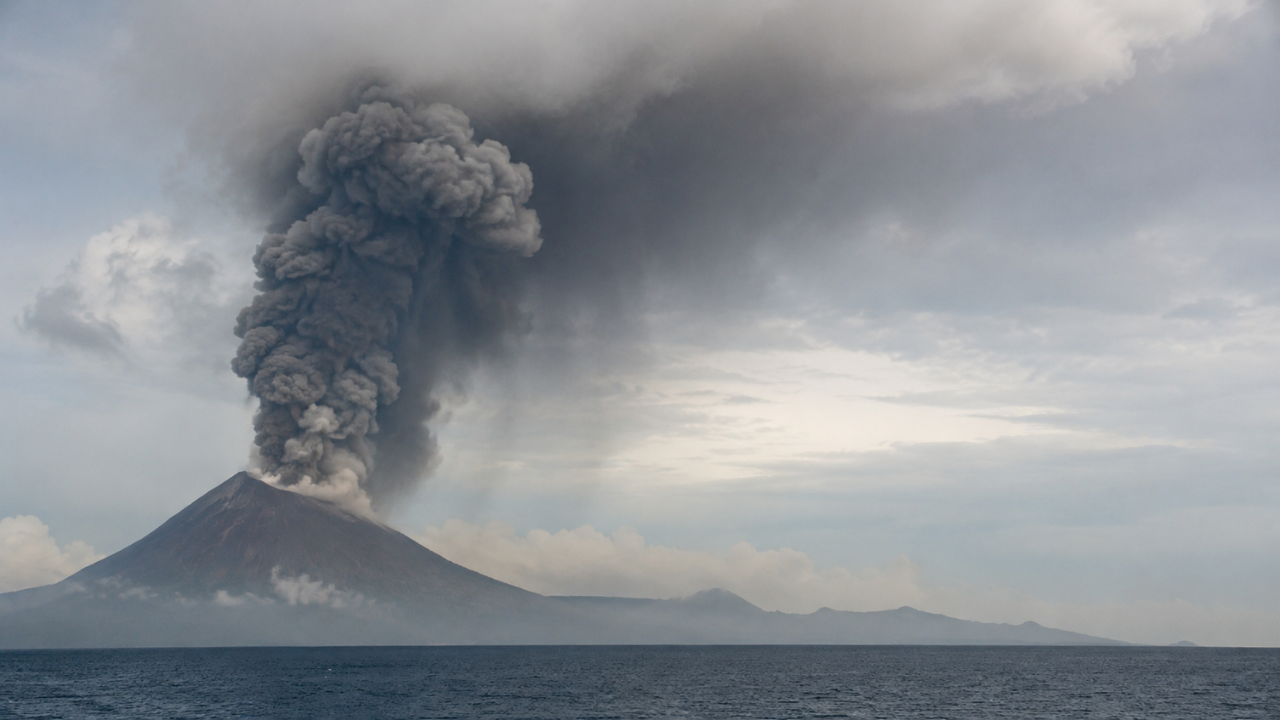
Geological records indicate that major climate cooling events during the Holocene epoch were not random anomalies, but direct consequences of high-magnitude sulphur injections originating primarily from the Pacific Ring of Fire. Recent empirical analyses published in academic literature demonstrate that over eighty percent of documented glacial advances over the past twelve millennia align with magnitude 7 or higher volcanic events in the northern hemisphere. Standard climatological models frequently treat volcanic forcing as a transient radiative shock lasting merely three to five years. However, structural feedback mechanisms involving sea-ice expansion and oceanic convection anomalies extend this cooling curve across multiple centuries. Deconstructing this geological feedback loop requires examining the precise chemical, physical, and oceanographic mechanics that transform a single tectonic event into a multi-generational thermal depression.
The Stratospheric Sulphur Threshold
The capacity of a volcano to alter global temperatures depends entirely on the mass and altitude of sulphur dioxide ($SO_2$) injected past the tropopause into the stratosphere, rather than the raw volumetric output of tephra or magma. When subduction zone volcanism along the Pacific perimeter—such as the Kurile Lake, Tao-Rusyr, or Kikai-Akahoya events—discharges volatile-rich magma, sulphur gas reacts with hydroxyl radicals and water vapor to form microscopic sulphate aerosols. Also making news lately: Why the Unrest in PoJK Keeps Escalating Under Media Blackouts.
These sub-micron droplets reside in the stratosphere for years because tropospheric weather scavenging is absent. Their physical properties dictate their climatic utility:
- Shortwave Backscattering: Aerosols reflect incoming solar radiation directly back into space, reducing the planetary net radiation budget.
- Longwave Absorption: While reflecting solar input, sulphate particles absorb upward-welling terrestrial infrared radiation, creating a thermal inversion that warms the stratosphere while chilling the surface layer.
The efficacy of this radiative forcing function scales non-linearly. Eruptions below magnitude 6 rarely pierce the stratospheric barrier with sufficient sustained momentum to affect hemispheric circulation. Conversely, magnitude 7 events and clustered sequences overwhelm atmospheric dispersion limits, establishing baseline optical depths that depress surface temperatures across wide geographic zones. Additional details regarding the matter are detailed by BBC News.
Cryospheric-Oceanic Feedbacks and Multi-Centennial Persistence
A short-term reduction in solar irradiance fails to account for cold spells persisting for hundreds of years. The transition from a transient radiative shock to a centennial climate anomaly is driven by a coupled ocean-cryosphere feedback loop.
When stratospheric aerosols suppress surface temperatures across the Northern Hemisphere, high-latitude cooling triggers rapid sea-ice expansion in the North Atlantic and Arctic basins. This expansion alters planetary surface albedo. Increased reflectivity prevents the absorption of solar energy during subsequent spring and summer seasons, effectively locking the high latitudes into a self-sustaining cold state long after the original volcanic aerosols settle out of the atmosphere.
Concurrently, this expansive sea-ice cover dampens wind stress and reduces heat loss from the ocean surface to the atmosphere. Beneath the growing ice sheet, a subsurface heat anomaly develops. This thermal stratification halts deep ocean convection, particularly the Atlantic Meridional Overturning Circulation (AMOC) components responsible for redistributing tropical heat poleward. By suppressing oceanic heat transport, the system enters a prolonged state of thermal inertia. The ocean ceases to act as a heat buffer, and the centuries-long climate depression stabilizes.
Empirical Validation and Spatial Distribution
Testing the correlation between tectonic activity and historical climate shifts requires cross-referencing independent geological archives. Researchers accomplish this by mapping radiometric ages from moraine stabilization—which mark periods when glaciers stopped retreating and maintained a positive mass balance—against sulphate deposition spikes preserved in Greenland and Antarctic ice cores.
Statistical evaluations utilizing Monte Carlo simulations confirm that the temporal alignment between magnitude 7+ eruptions and global glacial advances is non-random, achieving significance at the ninety-nine percent confidence level. Over seventy percent of these massive events display corresponding glacial signals in both hemispheres, underscoring the hemispheric to global reach of high-latitude sulphur forcing.
The structural dominance of the Pacific Ring of Fire within this dataset is a function of plate geometry. As the Pacific plate subducts beneath continental and lesser oceanic plates, it forms extensive volcanic arcs replete with hydrated crust and marine sediments. This subduction dynamic supplies the volatile elements necessary for explosive, sulphur-laden eruptions. Events like the 8.2-kiloyear cold event illustrate this architecture clearly, where closely timed caldera-forming eruptions in the Kuril Islands coincided with pre-existing orbital and freshwater-forcing shifts, tipping the Holocene climate system into an extended centennial trough.
Integrate high-resolution paleoclimatological records into contemporary predictive climate models by weighting subduction-zone volatile emissions as multi-decadal boundary constraints rather than instantaneous noise variables.