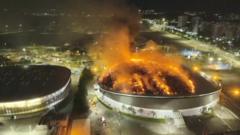
The fire at Rio de Janeiro’s Olympic velodrome represents more than an isolated maintenance failure; it is the physical manifestation of a systemic collapse in high-stakes asset management and post-event structural utility. When a roof fire breaks out for the second time in five years at a multi-million dollar facility, the root cause is rarely the spark itself, but rather the failure of the Operational Maintenance Cycle (OMC) and the inherent fragility of specialized sporting architecture. The destruction of the velodrome's roof—composed of specialized materials designed for thermal regulation and aerodynamics—highlights the widening gap between the capital expenditure (CAPEX) required to build Olympic venues and the operational expenditure (OPEX) required to prevent their atmospheric and structural decay.
The Material Physics of the Rio Velodrome Failure
The Rio velodrome’s roof construction utilized a multi-layered membrane system designed to maintain the precise internal climate required for track cycling. In high-performance velodromes, the track surface—typically Siberian pine—requires a constant humidity level and temperature to prevent warping and ensure speed consistency. This creates a high-sensitivity environment where the "envelope" of the building is the most critical component. For another view, read: this related article.
- Thermal Resistance and Ignition Vulnerability: The use of polymer-based membranes, while effective for weight reduction and light diffusion, presents a specific fire load profile. Once the external integrity is breached—whether by a flare, a fire balloon (a recurring cultural risk in Rio), or an electrical short—the stack effect within the roof’s insulating layers accelerates the spread of heat horizontally across the tensioned surface.
- Structural Interdependence: Modern Olympic venues use integrated structural systems where the roof provides necessary tensioning for the walls. A localized fire doesn't just destroy the "cover"; it compromises the structural tension of the entire facility. The heat from the Rio fire potentially weakened the underlying steel trusses, meaning the cost of repair involves not just replacing the fabric, but recalibrating the entire load-bearing frame.
- Atmospheric Exposure: The moment the roof is breached, the interior becomes an unconditioned space. For a velodrome, this is a terminal event for the track. The introduction of humidity and UV light to the wood track initiates a rapid cycle of expansion and contraction, likely rendering the facility unusable for competitive standards regardless of the fire’s size.
The Three Pillars of Post-Olympic Asset Decay
The fire is a symptom of a broader strategic failure in the Legacy Management Framework. Most Olympic venues fail because they are designed for "Peak Event Load" rather than "Continuous Utility." This leads to a predictable three-stage decay:
1. The Revenue-Expenditure Mismatch
Olympic venues are "single-use behemoths." A velodrome serves a niche demographic that cannot generate the foot traffic required to cover the electricity, security, and climate control costs. When the Brazilian Federal Government and municipal authorities shifted responsibility for the Barra Olympic Park, the funding for high-level fire suppression systems and 24/7 security monitoring was the first casualty of budget rationalization. Related reporting on the subject has been published by The Athletic.
2. Deterioration of Specialized Safety Systems
Fire suppression in sports arenas relies on active and passive systems. Active systems, such as specialized sprinklers or chemical suppressants in equipment rooms, require monthly testing and high-pressure maintenance. Passive systems, including fire-retardant coatings on the roof membrane, have a shelf life. In a tropical climate like Rio’s, high UV indices and salt air from the nearby Atlantic accelerate the chemical breakdown of fire-retardant layers, turning a protected surface into a flammable one over a 5-to-10-year horizon.
3. The Security Vacuum
The recurrence of fires at this specific site points to a failure in Perimeter Sovereignty. In urban environments where "fire balloons" (balões) are common, an active asset management strategy requires automated roof-monitoring drones or thermal sensors. The lack of these tools suggests the facility has moved from an "Active Asset" to a "Passive Liability" on the city's balance sheet.
The Cost Function of Structural Neglect
To quantify the loss, one must look at the Reconstruction Multiplier. Rebuilding a specialized roof on an existing, aging structure is often 40% more expensive than the original installation due to the need for forensic engineering and the removal of fire-damaged toxic residue.
$$C_{total} = C_{demolition} + C_{materials} + C_{recalibration} + C_{opportunity}$$
The $C_{opportunity}$ (Opportunity Cost) is particularly devastating. Every year the velodrome remains offline, the local cycling ecosystem erodes, and the "Legacy Value" promised during the 2009 bid process trends toward zero. The fire does not just destroy the roof; it resets the depreciation clock on the entire Olympic Park, signaling to international federations that Rio is no longer a viable host for Tier-1 competitions.
Structural Vulnerability and the Urban Microclimate
The "baloeiros" (balloon pilots) in Rio represent a specific environmental risk factor that was likely under-indexed in the original risk assessment. These balloons, often carrying fire to lift them, are a cultural staple but a technical nightmare for tensioned-membrane architecture.
- Risk Categorization: The fire should be categorized as an "Environmental-Cultural Hybrid Risk."
- The Protective Gap: While the building was designed to meet international fire codes (NFPA or equivalent), these codes assume a standard urban fire risk, not the constant aerial bombardment of incendiary devices.
- Mitigation Failure: A robust strategy would have involved a "Hardened Envelope" approach—replacing the top-tier membrane with a non-combustible metal or reinforced composite after the first fire in 2017. The decision to use similar materials for the repair was a failure of technical foresight.
The Failure of the "White Elephant" Mitigation Strategy
Following the 2016 Games, the strategy for the Barra Olympic Park was to transition to a mix of private management and federal oversight. This "Split-Governance Model" created a bottleneck in decision-making.
The second fire at the velodrome proves that the current maintenance protocol is "Reactive" rather than "Predictive." In predictive maintenance, sensors detect heat anomalies or structural stressors before a catastrophic event occurs. Reactive maintenance, which characterizes the Rio legacy, waits for a failure and then attempts to find the budget for a fix. This creates a "Death Spiral of Utility":
- Minor damage occurs.
- Budget is delayed.
- The damage compounds (wood rot, mold, structural rust).
- The cost to fix exceeds the value of the service provided.
- The facility is abandoned.
The fire is simply an accelerant to step five.
Strategic Realignment for Managed Assets
The survival of the remaining Barra Olympic structures depends on an immediate pivot in asset management logic. The authorities must move away from the "Stadium as a Monument" mindset and adopt an "Industrial Facility" mindset.
- De-risking the Envelope: Any remaining polymer-based roof sections across the Olympic Park must be treated with modern intumescent coatings or replaced with fire-stable alternatives. The cost is high, but the cost of total loss is higher.
- Automated Surveillance: Implementing thermal imaging across the park's rooflines to detect external ignition sources in real-time.
- Repurposing for High-Frequency Use: The velodrome cannot survive as a velodrome alone. It must be converted into a multi-use "Hardened Shell" that can host events with higher revenue density (trade shows, e-sports, logistics) to fund its own safety protocols.
The Rio velodrome fire is a terminal warning for the 2028 and 2032 host cities. It demonstrates that the lifespan of an Olympic venue is not determined by its construction quality, but by the resilience of its post-event economic model. Without a dedicated revenue stream to fund the OPEX of fire safety and climate control, the architecture itself becomes a liability. The strategic play now is not to "repair" the velodrome for a third time with the same vulnerable materials, but to perform a "Utility Pivot," stripping the specialized requirements in favor of a robust, low-maintenance, fire-resistant multipurpose shell that matches the reality of Rio’s current fiscal and environmental landscape.