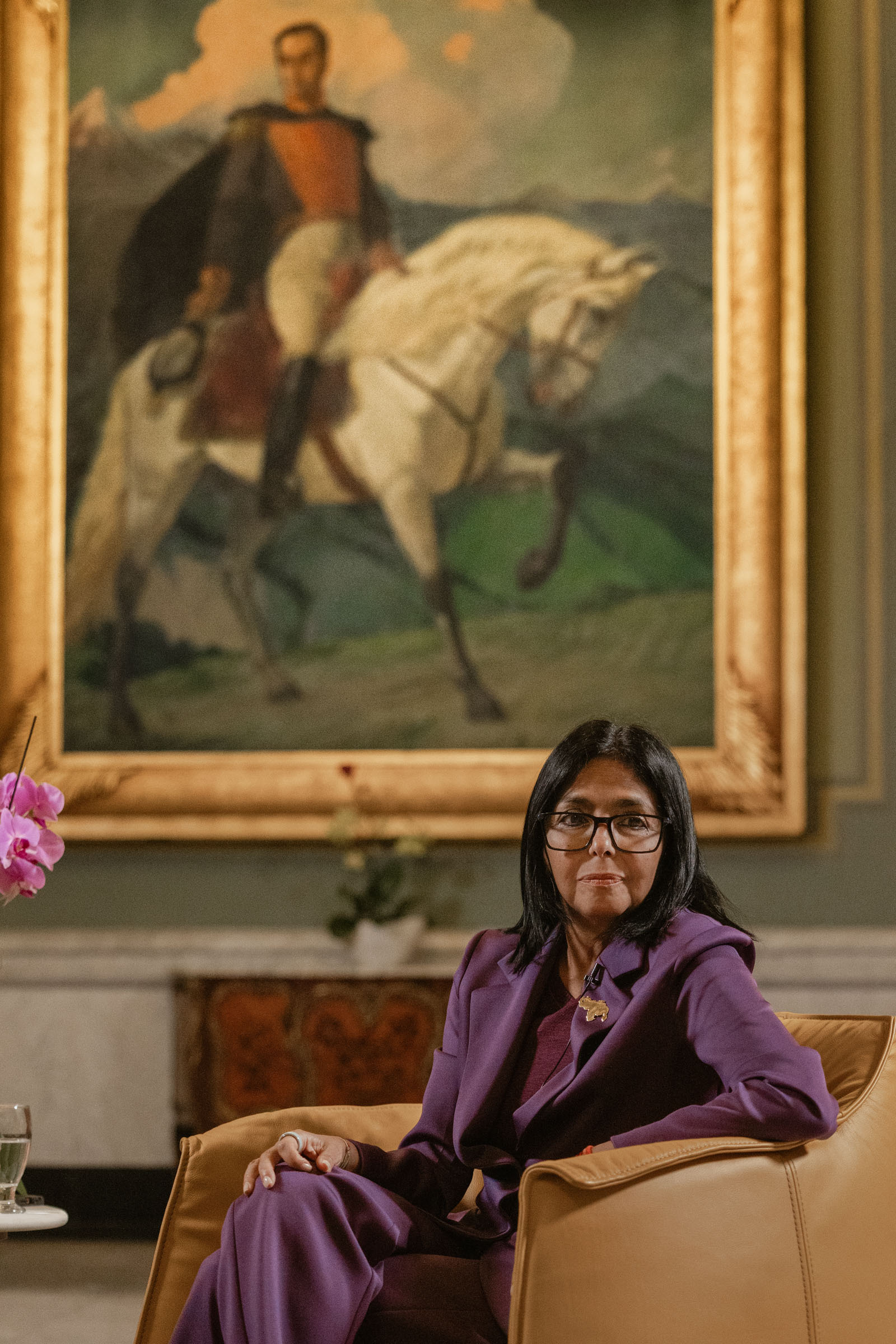
Power doesn't care about old slogans. When Nicolás Maduro was hauled out of Caracas by a U.S. Delta Force team, the architects of twenty-first-century socialism didn't fall on their swords. They adapted. At the center of this survival act stands Delcy Rodríguez, the 57-year-old technocrat who went from defending the anti-imperialist frontline to cutting direct deals with Donald Trump and Marco Rubio.
Most analysts miss the mechanics of how this transition happened so fast. You don't survive decades in the inner circle of Venezuelan politics by being a rigid ideologue. You do it by calculating where the gravity lies. Today, Rodríguez runs the Miraflores Palace with a quiet precision, trading decades of fiery anti-Washington rhetoric for closed-door WhatsApp coordination with American officials.
The Pragmatic Pivot
The speed of the pivot shocked casual observers. Barely forty-eight hours after the military raid that captured her former boss, Rodríguez wasn't calling for armed resistance or mass mobilizations. Instead, she extended an olive branch to Washington, signaling an eagerness to cooperate on economic development.
It looked like whiplash, but it was pure self-preservation. The economy was hollowed out, oil infrastructure was rusting, and the security apparatus had fractured. By offering the White House predictable access to Venezuelan oil and calming the geopolitical waters, Rodríguez secured something invaluable: American backing for her own interim presidency.
Washington made a cold calculation too. Instead of risking a total power vacuum or handing the keys directly to a fractured opposition, the Trump administration chose continuity under Maduro's former second-in-command. Officials in Washington communicate with her almost daily, consulting on domestic appointments and security measures. It’s an unusual arrangement, sometimes dubbed the "Rodrígato," where a nominally socialist regime implements strategic priorities dictated by the United States.
Navigating the Bargain
This partnership isn't a surrender of the state; it's a high-stakes renegotiation of terms. When a massive earthquake struck Caracas, killing thousands and causing billions in damages, the new diplomatic alignment paid immediate dividends. The State Department rushed a $300 million reconstruction package while the U.S. Southern Command provided relief support.
Store shelves in the capital are fuller now. Construction cranes have returned to the skyline. Dormant oil fields are pumping again. For everyday citizens exhausted by hyperinflation and scarcity, these signs of recovery matter more than ideological purity.
Yet the bargain remains intensely fragile. Rodríguez walks a tightrope between satisfying American demands for total market access and distancing the country from traditional allies like Russia, China, and Cuba, while simultaneously convincing domestic skeptics that client-state status serves the national interest. Meanwhile, domestic opposition figures like María Corina Machado refuse to participate in Washington-backed reconciliation talks, arguing that true democratic restoration has been sidelined to accommodate a loyalist survivor.
Her future won't be decided by public affection or ballot boxes anytime soon. It rests entirely on her ability to keep Trump's administration satisfied, manage internal factions within the regime, and prove that her brand of pragmatic realpolitik can keep the country stable.
Examine how authoritarian regimes bend when pressure peaks. They don't always break. Sometimes, they just change uniforms and keep the keys.
How Delcy Rodríguez courted Trump and rose to power in Venezuela | AP Explains
This video provides an essential look at how Delcy Rodríguez leveraged her diplomatic background to transition from a foreign minister under Chávez to the leader of Venezuela following Maduro's capture.