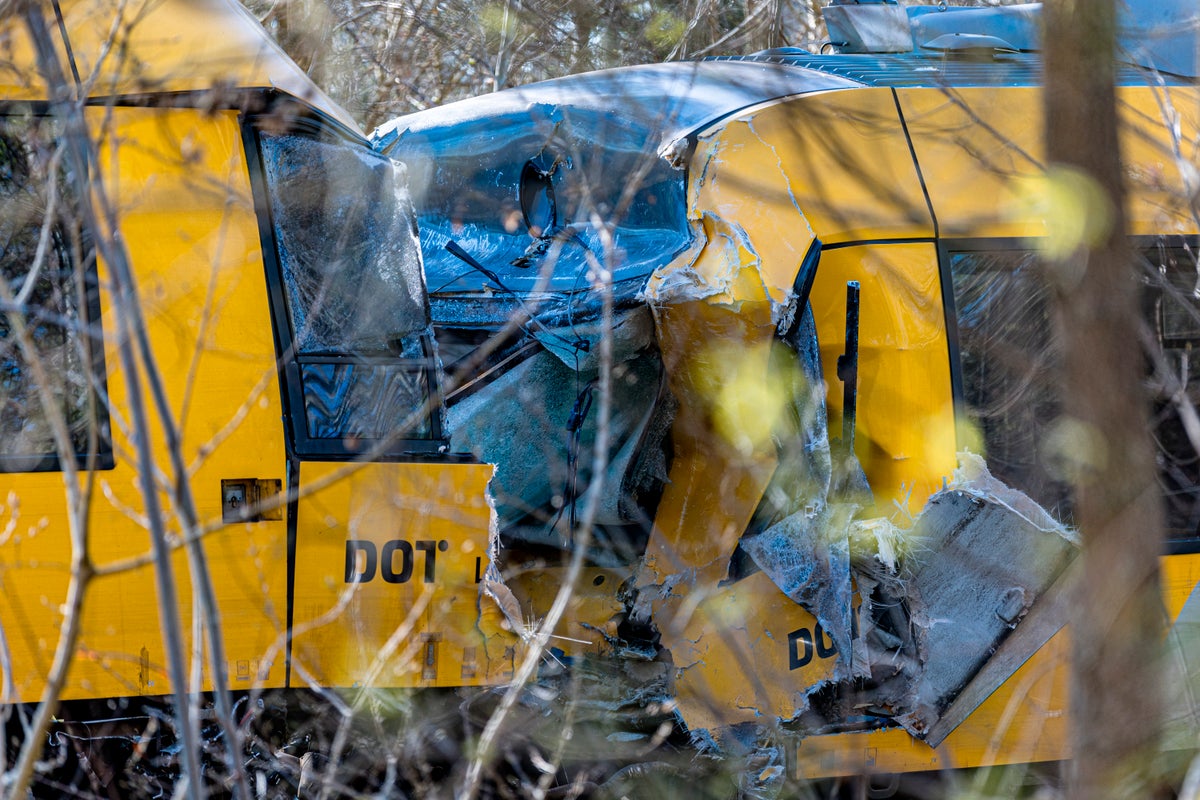
The headlines are predictable. Four people in critical condition. Two trains crumpled like soda cans in northern Denmark. A frantic search for a "cause" that usually ends with a single person being dragged before a tribunal.
The media loves the "human error" narrative because it’s neat. It suggests that if we just find the one guy who missed a signal or the one dispatcher who blinked, we can fix the system.
They are wrong. They are dangerously, fundamentally wrong.
When two massive kinetic objects collide on a fixed rail system in 2026, it isn't a failure of a person. It is a failure of a philosophy. We are currently living through a period where rail infrastructure is being pushed to its absolute physical limits by software that was never designed to handle the complexity of modern transit demands.
The Myth Of The Perfect System
The "lazy consensus" surrounding the Danish collision—and similar incidents globally—is that rail is a solved science. We assume that because trains run on tracks, the variables are limited.
I have spent years looking at the telemetry data from transit networks that "never fail." I can tell you that every major rail network in the West is currently a Rube Goldberg machine held together by legacy code and sheer luck.
The Danish collision happened because of systemic fragility, not a momentary lapse in judgment. In high-density rail environments, we have narrowed the margins of safety to such an extent that "human error" is actually a requirement of the design. We build systems that demand 100% perfection from biological entities (humans) and 100% uptime from hardware that is often decades old.
When that perfection wavers, we blame the driver. We should be blaming the architects who removed the buffers of time and space in the name of "efficiency."
Efficiency Is The Enemy Of Survival
We have been sold a lie that "optimized" schedules are a triumph of engineering. In reality, every second we shave off a platform turnaround or every meter we close between trains increases the probability of a catastrophic event.
The Danish network, like many in Northern Europe, has been under intense pressure to increase frequency without a commensurate increase in physical trackage. This leads to Dynamic Bottlenecking.
- The Compressed Gap: Modern signaling allows trains to run closer together.
- The Software lag: European Rail Traffic Management System (ERTMS) is supposed to be the gold standard, but it relies on handoffs between older local sensors and centralized digital hubs.
- The Ghost Signal: Imagine a scenario where a digital interlock registers a track as clear because a sensor failed "low" rather than "high." The driver sees a green light. The system says "go." The physics say "die."
By the time a human realizes the digital reality doesn't match the physical reality, the kinetic energy involved makes the outcome inevitable. You cannot stop several hundred tons of steel on a dime, no matter how hard you pull the emergency brake.
Why Automatic Braking Isn't The Savior You Think
"Why didn't the automatic systems stop it?"
This is the question everyone asks after a wreck. It’s the wrong question. The right question is: Why did the automatic system permit the conflicting movement to begin with?
We have over-relied on Positive Train Control (PTC) and ERTMS as if they are infallible gods. They aren't. They are layers of logic gates. In northern Denmark, we are likely looking at a "state-space" error. This occurs when the system enters a configuration that the programmers didn't account for—perhaps a combination of a delayed freight arrival, a localized power dip, and a manual override triggered by a minor sensor fault.
When you stack these "minor" issues, you get a catastrophic resonance. It’s not one big mistake; it’s a thousand tiny optimizations failing at the same time.
The High Cost Of Cheap Safety
Politicians love to talk about "upgrading" rail. What they mean is they want to buy new carriages with Wi-Fi and nice seats. They rarely want to talk about the brutal, expensive reality of Level 3 Redundancy.
True safety doesn't come from a smarter computer. It comes from:
- Physical Interlocks: Mechanical devices that physically prevent a switch from moving if a train is present. (We’ve replaced many of these with digital "virtual" interlocks to save money).
- Decoupled Scheduling: Accepting that trains shouldn't run every 4 minutes if the infrastructure only safely supports 8.
- The Right To Stop: Giving operators the absolute authority to halt the entire line if a single data point looks "weird," without fear of being fired for causing a delay.
In our current "optimized" world, a driver who stops because of a "hunch" or a "glimmer on the tracks" is penalized for ruining the KPI (Key Performance Indicator). We have prioritized the clock over the person.
Stop Asking Who Is To Blame
If you want to actually prevent the next collision in Jutland or anywhere else, stop looking for the person to fire. Look at the board of directors and the transport ministers who approved the "efficiency" mandates.
They are the ones who created the environment where a collision was not just possible, but statistically certain over a long enough timeline. We are running a 21st-century schedule on a 20th-century backbone, governed by 19th-century physics.
The people in critical condition in Denmark are victims of a spreadsheet, not a steering error. Until we admit that our drive for "seamless" transit has stripped away the necessary friction of safety, we are just waiting for the next set of sensors to disagree with reality.
Fixing this requires something no politician has the guts to do: slowing everything down. We don't need faster trains. We need trains that are allowed to be "inefficient" enough to stay on the tracks.
The next time you see a report on a "tragic accident," look past the wreckage and the crying witnesses. Look at the schedule. If the gap between "on time" and "disaster" is measured in seconds, the crash wasn't an accident. It was a deliverable.