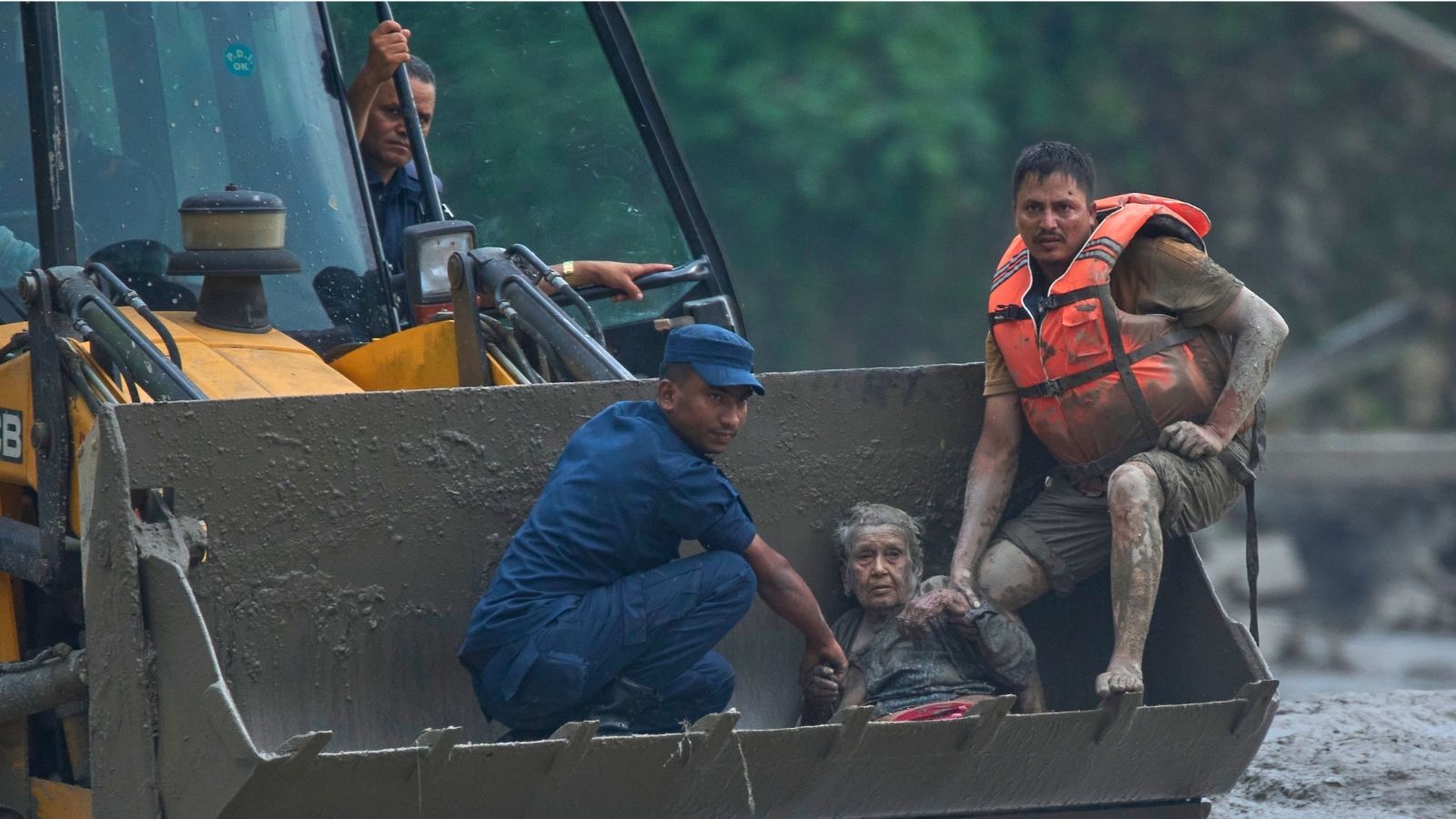
Every time a nonagenarian gets fished out of a rising river or dragged off a collapsing roof, the internet loses its collective mind. We turn on the tear-jerking corporate news music, slap the word warrior on a headline, and pretend we just witnessed proof of the unbreakable human spirit.
It is absolute garbage.
When media outlets fawn over a ninety-seven-year-old surviving a flash flood in South Asia, they are selling you a comforting myth. They want you to look at a statistical anomaly and feel warm inside. They want you to believe that grit, granddad stubbornness, and community backbone are enough to outsmart rising waters and archaic municipal planning. It is disaster tourism packaged as feel-good comfort food, and it is actively killing people by distracting us from the brutal math of structural failure.
I have spent the last fifteen years tracking disaster response infrastructure across developing floodplains and urban watersheds. I have seen millions of dollars in international aid vaporized by administrative corruption, watched early-warning sirens sit silent because the local council couldn't afford the maintenance batteries, and listened to politicians blame acts of God for what was clearly an act of engineering neglect.
The lazy consensus says that elderly flood survivors represent human resilience. The reality is that they represent a systemic abandonment of public safety.
The Myth of the Accidental Miracle
Let us look at the mechanics of what actually happens when a river breaches its banks. When water moves at ten feet per second, it carries enough kinetic energy to shatter concrete foundations. It does not care about your life experience. It does not respect your age.
When an elderly resident is pulled from a flood zone alive, we treat it like an Oscar-winning performance. We ignore the three hundred others who didn't make the cut because they lived fifty yards further down the slope or lacked a relative with a smartphone to broadcast their panic. Survival in a flash flood is not a testament to moral fortitude. It is a lottery dictated by topography, proximity to rescue assets, and pure, unadulterated luck.
By turning these events into heartwarming human interest stories, we commit a massive analytical error. We individualize a collective failure. We look at a miraculous extraction and say, look how resilient they are, instead of asking why the flood wall failed in the first place, why the zoning laws permitted construction in a natural basin, or why the evacuation notice arrived twelve hours after the living room was already chest-deep in mud.
The Economics of Inaction
Governments love a good human interest story because it shifts the financial burden of survival back onto the individual. If survival is a matter of being a warrior, then failure to survive becomes a personal shortcoming.
Look at the funding allocation for disaster management in high-risk zones across South Asia and parts of the Global South. Billions are pledged after the cameras roll, yet basic preventative maintenance—dredging riverbeds, reinforcing embankments, upgrading satellite-linked telemetry systems—starves for cash. Why? Because preventive maintenance doesn't generate viral video clips. You cannot slap a heartwarming headline on a drainage pipe that successfully carries water away without incident.
Heroism is what you resort to when your systems have completely collapsed. When someone has to pull a nonagenarian out of a window frame, every single layer of societal defense has already failed. The meteorologists missed the velocity, the telemetry failed, the civil engineers cut corners on the spillway, and the municipal evacuation protocol was non-existent.
Cheering for the rescue is like cheering for the paramedic who performs CPR after a drunk driver plows into a crowd. The paramedic is doing noble work, but the system that allowed the collision to happen is broken to its core.
The Hard Reset on Risk
We need to stop romanticizing disaster survival. If your disaster strategy relies on ninety-seven-year-olds swimming out of living rooms, you do not have a disaster strategy. You have a body count waiting to happen.
Fixing this requires an immediate, unyielding shift in how we evaluate risk. We have to strip away the emotional poetry of survival and look at the cold, hard mechanics of vulnerability.
First, we must ruthlessly audit municipal infrastructure against worst-case hydrological projections, not historical averages that no longer apply in a changing climate. If a bridge or a dyke was built for a fifty-year flood event that now happens every three years, it is a liability, not an asset.
Second, we need to dismantle the communication bottlenecks that leave marginalized populations stranded. A warning system that relies on a text message to a smartphone is useless if the grid goes down thirty minutes before the crest hits. We need decentralized, low-tech, hardwired redundancy—sirens that run on local solar arrays and hand-cranked generators, independent of cellular towers.
Finally, we have to accept the uncomfortable truth about managed retreat. Not every settlement can be saved. Not every village built on a historic flood plain deserves a heartwarming rescue story ten years from now. Pouring millions into rebuilding in the exact same geographic trap is a form of institutional malpractice.
The next time you see a headline celebrating an elderly survivor pulled from the rushing tides, do not smile. Ask why they were there to begin with. Ask why the water was allowed to rise that high.
Stop looking for warriors. Start demanding competence.