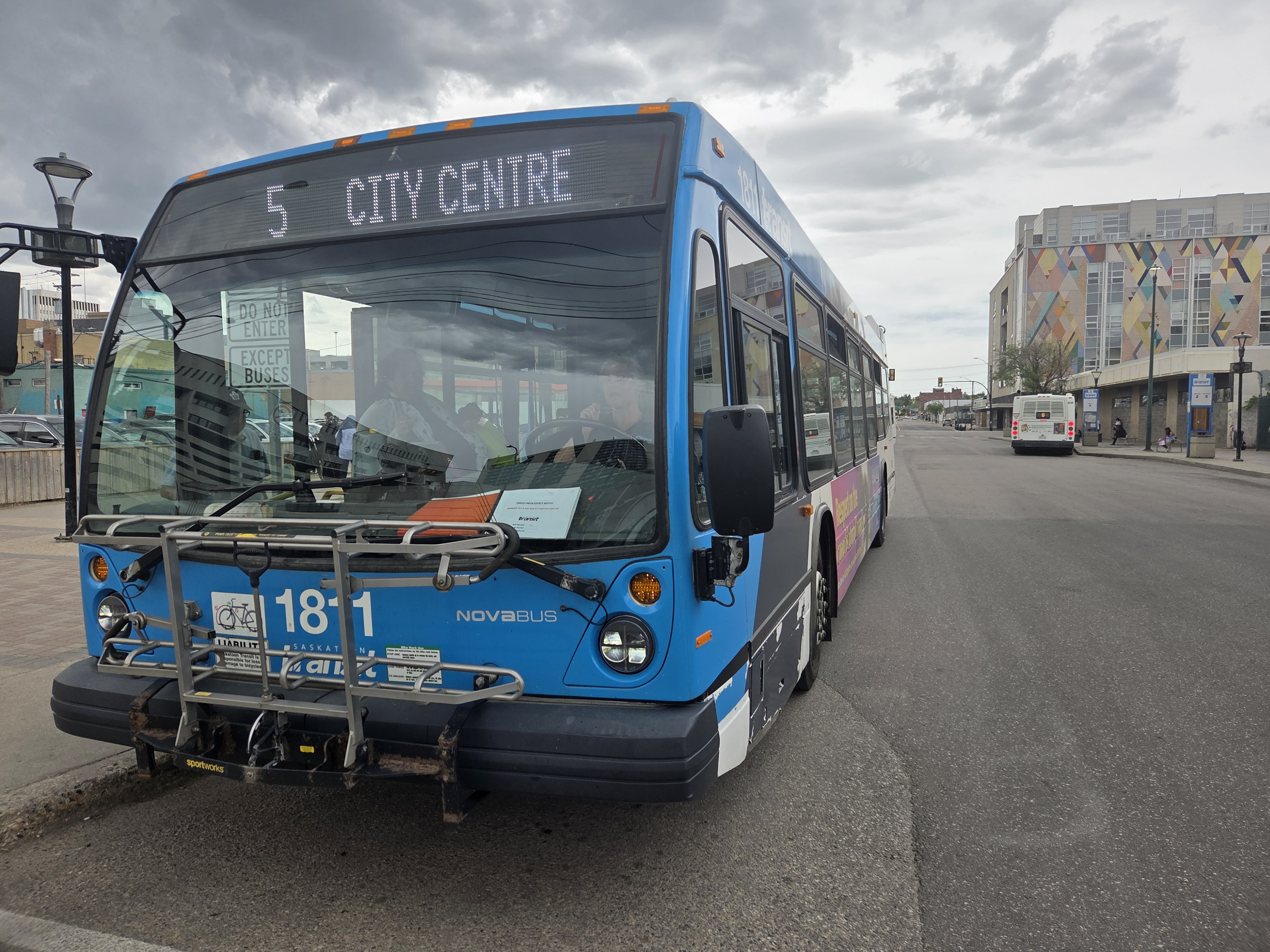
Public transit systems function through a delicate equilibrium: operational efficiency, financial viability, and rider security. When one variable degrades, a negative feedback loop accelerates. In Saskatoon, this structural decline manifested as a 15% drop in electronically recorded transit rides—falling from 8.5 million in 2024 to 7.2 million in 2025. This contraction resulted in an immediate financial shortfall exceeding $1 million, reducing annual fare revenue to $13.9 million.
The City of Saskatoon’s proposed transit bylaw, scheduled for a council vote in July and slated for implementation in September, represents an institutional pivot from passive monitoring to active behavioral enforcement. However, treating this crisis merely as a series of isolated safety incidents misinterprets the underlying systemic issues. This analysis establishes a framework to deconstruct the economic drivers of transit decay and assess whether a regulatory mechanism backed by a $50 fine structure can stabilize a municipal transit network.
The Transit Decay Loop: Quantifying the Mechanics of Rider Attrition
The loss of over one million rides within a single fiscal year is not a random fluctuation; it represents a systematic market flight driven by a breakdown in the core transit value proposition. The structural deterioration of public transit systems occurs via a predictable economic sequence.
[Perceived Safety Risk Increases] ➔ [Choice Riders Exit System] ➔ [Fare Revenue Contracts] ➔ [Capital / Service Reductions] ➔ [Concentration of Disorder Rises]
This sequence operates through specific operational friction points.
The Asymmetric Cost of Perceived Risk
Riders evaluate transit options based on total cost, which includes monetary fares and psychological transaction costs such as exposure to unpredictable or hostile environments. In Saskatoon, 59% of reported transit incidents involved substance intoxication, a 10% increase compared to prior tracking periods. When choice riders—those possessing alternative transport options like personal vehicles—perceive the psychological cost as exceeding the utility of the bus fare, they exit the system.
The Concentration of Disorder
As choice riders leave, the demographic composition of transit users shifts. Captive riders (those with no economic alternative) remain, while the absolute density of pro-social behavior on the vehicle decreases. This leaves a higher concentration of anti-social variables per capital asset, compounding the perception of risk for remaining passengers and accelerating ridership declines.
The Driver Enforcement Bottleneck
Historically, transit operators have been instructed to refrain from enforcing fare compliance to minimize physical confrontations. While logically sound for employee protection, this policy shifts the enforcement burden to zero. The resulting regulatory vacuum allowed recorded fare evasion to triple over three years, growing from 41,923 infractions in 2023 to 131,532 infractions, which represents 1.8% of total ridership. This structural gap transformed an unforced policy choice into a predictable revenue leakage of $394,596.
The Economics of Evasion: Mapping the Revenue Leakage
The financial shortfall within Saskatoon Transit is heavily concentrated across specific infrastructure points rather than distributed evenly across the city. Analysis reveals that more than two-thirds of all documented fare evasions occur on just 10 specific routes. Route 2 alone, running from the downtown core to the Confederation Mall, accounts for 21% of all system-wide non-compliance.
This concentration highlights a distinct economic reality: fare evasion behaves less like a random distributed crime and more like an established local norm. The economic equation governing an individual's choice to evade a fare can be modeled as follows:
$$E = U(F) - [P \cdot C]$$
Where:
- $E$ is the net utility of evading the fare.
- $U(F)$ is the financial utility of saving the fare cost.
- $P$ is the probability of detection and enforcement.
- $C$ is the total cost of the penalty (financial fine, delay, or social friction).
Under the historical operational framework, the probability of enforcement ($P$) was effectively zero due to the driver non-confrontation policy. Consequently, the net utility of evasion ($E$) was always positive, regardless of the penalty value ($C$).
The proposed bylaw alters this equation by introducing a dedicated nine-officer transit police program deployed over two years. By conducting random fare audits on active buses, these officers introduce a non-zero value for $P$.
Even with a relatively low financial penalty—a $50 fine reduced to $20 for early payment—increasing the probability of detection alters the decision matrix for marginal evaders. The primary limitation of this model is its assumption of rational economic choice among all actors, a framework that breaks down when applied to individuals experiencing acute substance dependency or unhoused crises.
The Regulatory Framework: Assessing the New Tool Matrix
The proposed bylaw establishes an explicitly tiered enforcement framework designed to address behavior by modifying the rights of access based on compliance.
Short-Term Administrative Bans (24 Hours)
Officers receive immediate authority to issue non-appealable, 24-hour exclusions from all transit properties for "unacceptable behavior." This mechanism functions as a rapid de-escalation tool, isolating volatile variables from the transit network without involving the backlogs of the formal judicial system.
Long-Term Multi-Day to Indefinite Bans
Reserved for chronic non-compliance or escalating safety violations, these exclusions require an established administrative appeal process. This tier balances operational security with the legal protections required for public infrastructure access.
Comprehensive Behavioral Restrictions
The bylaw expands the legal definition of public spaces to explicitly include transit cabins and shelters. This legal clarification allows officers to enforce prohibitions against spitting, urinating, defecating, public intoxication, and the use of illicit substances on vehicles. It also establishes mandatory requirements for basic attire, such as footwear.
The Behavioral Sleeping Conundrum
One clear operational challenge within the bylaw is the explicit prohibition against sleeping on buses or within transit shelters. City administration notes the target of this clause is not the commuter nodding off on a shift return, but individuals using illicit substances who remain unresponsive for extended periods.
From an operational perspective, instructing enforcement officers to distinguish between benign fatigue and substance-induced unconsciousness introduces significant subjectivity. This gray area creates a clear implementation risk, where enforcement consistency may vary wildly based on individual officer discretion.
Systemic Risks and Implementation Bottlenecks
While the proposed bylaw provides a clear legal framework, its operational success depends entirely on resource allocation and systemic constraints. A critical assessment reveals three primary bottlenecks.
- The Resource-to-Asset Mismatch: The Saskatoon Police Service is adding nine dedicated transit officers over a two-year rollout period. On any given operational day, Saskatoon Transit operates approximately 90 buses across an expansive geographic network. A small team of officers cannot achieve a high probability of detection ($P$) across 90 mobile assets simultaneously. Enforcement will inevitably be reactionary and concentrated heavily on known problem vectors like Route 2, leaving peripheral routes unmonitored.
- The Non-Collectible Fine Paradox: The bylaw relies on a $50 monetary fine to deter non-compliance. However, a significant portion of chronic behavioral disruption is driven by transient or deeply impoverished populations. For individuals lacking disposable income or fixed addresses, a civil municipal fine carries no real economic deterrence. The penalty cannot be collected through standard tax mechanisms, rendering the financial instrument ineffective against the very demographic driving the highest volume of severe behavioral disruptions.
- Capital Infrastructure Friction: The timing of this regulatory intervention is tied to a broader asset transformation: Saskatoon's $262-million Link Bus Rapid Transit (BRT) system, scheduled for a 2028 deployment. BRT models rely fundamentally on off-board fare collection and rapid all-door boarding to achieve target transit speeds. If safety and fare compliance are not stabilized prior to 2028, the open-boarding nature of BRT infrastructure will exacerbate fare evasion and security vulnerabilities, threatening the return on investment for the entire $262-million capital expenditure.
Strategic Recommendation
Saskatoon Transit cannot resolve its systemic ridership deficit through punitive enforcement alone, nor can it survive financially by maintaining a passive security posture. To break the transit decay loop, the city must pursue a dual-track strategy that coordinates law enforcement with environmental design.
First, enforcement resources must be deployed using a strict risk-pooling methodology. Rather than distributing nine officers evenly across the system, assets must be permanently embedded on the 10 routes driving 68% of fare evasions and behavioral incidents. This high-density presence artificially inflates the perceived probability of detection ($P$) on critical corridors, stabilizing the core of the network.
Second, the city must transition from a reliance on uncollectible civil fines to environmental design solutions ahead of the 2028 BRT launch. This includes installing physical driver-protection barriers across the entire active fleet to eliminate operator vulnerability, and establishing physical turnstiles or access-controlled shelters at high-volume transit hubs like downtown and Confederation Mall.
Regulatory boundaries only work when paired with physical or highly visible operational barriers. Saskatoon must use the period between the September bylaw implementation and the 2028 BRT launch to run targeted, route-specific pilot programs that test this coordinated approach, ensuring capital investments are protected by verifiable improvements in system security.