Structural Anatomy of Viral Pageantry
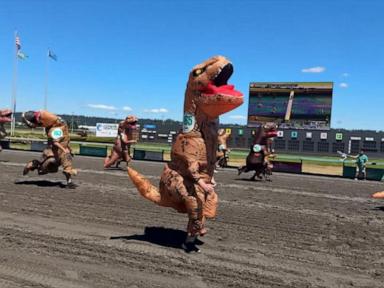
Cultural spectacles often evade rigorous economic classification because their output appears entirely intangible. The T-Rex World Championship Races held annually in Washington, featuring hundreds of participants sprinting in inflatable tyrannosaurus rex costumes, operate at the intersection of experiential marketing, community mobilization, and viral media production. Traditional observers dismiss these events as momentary anomalies or eccentric local gatherings. Such dismissal ignores the underlying architecture driving modern attention economies.
Participation in high-friction, low-utility physical tasks—running a sprint in an impermeable, air-inflated synthetic suit with severely restricted peripheral vision—generates a high-yield attention return on investment. The mechanics governing this phenomenon rely on specific operational inputs: visual dissonance, spatial constraints, and collective absurdity. When standardized humans operate within non-standardized constraints, the resulting friction creates immediate cognitive capture for observers.
Evaluating the sustainability and impact of such events requires dismantling them into component variables. The primary driver is not athletic excellence, but operational friction. The costume itself functions as an equalizer. It strips away conventional markers of athletic prowess, socioeconomic status, and demographic identity, replacing them with a uniform handicap.
The Operational Mechanics of the Inflatable Handicap
Execution within an inflatable costume introduces precise physical limitations that dictate the strategy of the participants. Understanding the event requires examining the operational constraints imposed by the hardware.
Thermal and Kinetic Friction
The physical barrier of thick polyethylene or polyester fabric combined with an internal battery-operated fan creates an enclosed microclimate. Core body temperature spikes rapidly, limiting sustainable exertion windows. Participants face a strict time horizon dictated by thermodynamics rather than cardiovascular capacity.
Sensory Deprivation
Peripheral vision is near zero. The field of view is restricted to a narrow mesh aperture positioned near the chest or neck of the costume. Spatial awareness is compromised, turning a standard linear sprint into a stochastic collision process. Competitors cannot draft behind opponents effectively because visual tracking of adjacent runners is degraded.
Propulsion Inefficiency
The oversized padded feet and trailing tail alter the center of gravity. Traditional running mechanics, characterized by optimal stride frequency and ground reaction force, are rendered obsolete. Momentum management replaces raw acceleration. A runner who attempts maximum velocity immediately will experience terminal destabilization upon encountering uneven turf.
Physical Input -> Costume Restriction -> Sensory Degradation -> Stochastic Motion -> Attention Capture
This sequence illustrates how physical inefficiency translates directly into audience engagement. The more difficult and ridiculous the movement appears, the higher the entertainment yield.
Economic Drivers and Community Scalability
From an organizational perspective, events of this classification solve a primary logistical challenge: low capital expenditure paired with high organic distribution. Traditional spectator sports require massive infrastructure investments, broadcasting rights management, and complex talent payrolls. Novelty championships bypass these capital requirements by crowdsourcing the participants and the primary asset.
Participants purchase their own costumes, travel at their own expense, and self-select into the competitive pool. The host organization provides a designated tract of open land, basic timing infrastructure, and safety personnel. The marginal cost of adding a participant approaches zero, while the marginal utility of each additional unit of visual noise scales linearly with network effects.
The target audience spans multiple segments. Local participants derive value from tribal inclusion and shared physical hardship. Digital consumers derive value from compressed, high-impact video clips distributed across social platforms. Media outlets utilize the imagery to balance serious news cycles with whimsical human-interest segments.
The scaling model relies on replication without proprietary lock-in. Because the costume design is commoditized and widely available via global supply chains, the barrier to entry for any municipality wishing to replicate the event is negligible. Consequently, differentiation depends entirely on execution scale, participant density, and local cultural integration.
The Attention Capture Matrix
Modern media consumption favors discrete, high-contrast visual stimuli. Traditional athletic competitions require long-form narrative understanding—rules, standings, historical context—to generate engagement. Novelty sprints eliminate the barrier to comprehension.
A viewer requires zero domain expertise to evaluate a race of fifty inflatable dinosaurs tumbling across a finish line. The success metric is binary and immediate: who remains upright and crosses first. This cognitive accessibility explains the disproportionate digital footprint relative to the local physical footprint.
The attention capture process follows a distinct lifecycle:
- Pre-Event Anticipation: Local media coverage focuses on registration spikes, costume customization, and participant origin stories.
- Live Execution: Physical chaos creates unpredictable micro-moments—collisions, falls, and dramatic photo finishes—that serve as raw material for short-form video algorithms.
- Post-Event Distribution: User-generated content fragments across digital networks, decoupling the event from its geographic origin and transforming it into global pop-culture currency.
Strategic Deployment and Future Viability
Replicating or scaling this specific format requires careful management of diminishing returns. As novelty events proliferate, audience fatigue sets in. To maintain high engagement, organizers must introduce structural variations that increase the complexity of the friction without compromising safety standards.
Future iterations of hyper-localized novelty competitions will likely incorporate telemetry data, structured tournament brackets, and synchronized multi-stage obstacles to elevate the entertainment product from a casual spectacle into an optimized, repeatable entertainment property. Organizations that treat these gatherings merely as whimsical community days miss the underlying mechanics of modern attention economics. The T-Rex Championship demonstrates that physical absurdity, when bounded by clear rules and executed at scale, remains one of the most efficient mechanisms for capturing collective human focus.