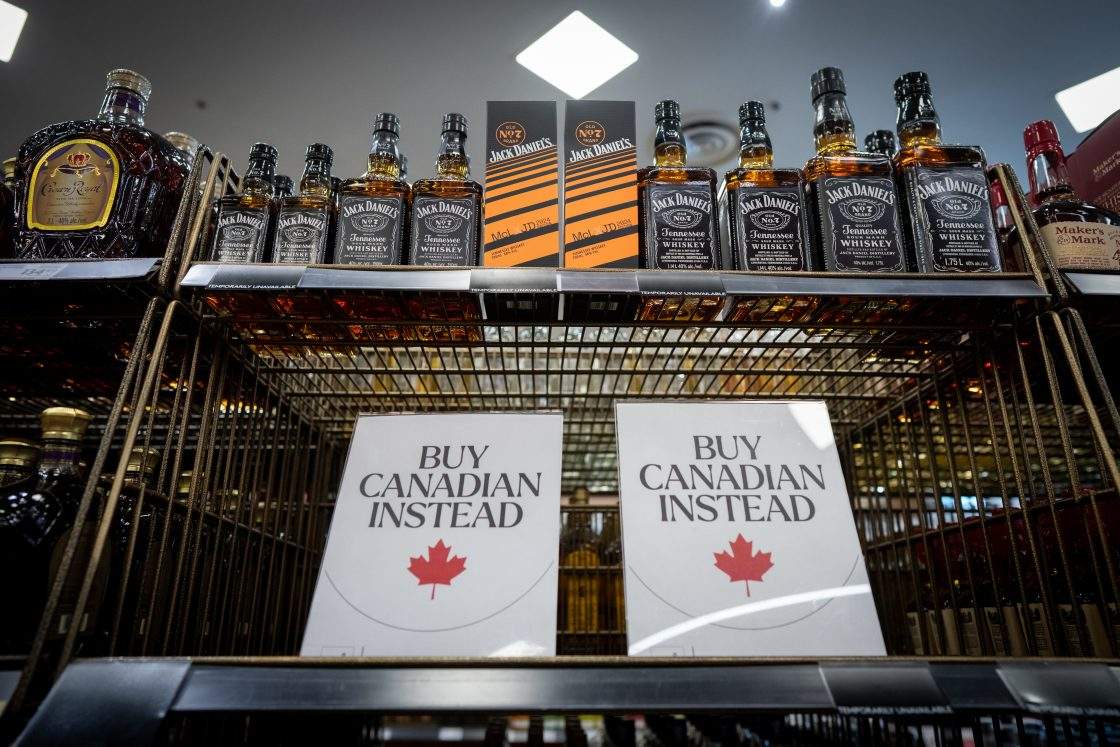
Macroeconomic negotiation strategies frequently rely on concentrated, symbolic commodities to exert outsized political pressure. When the administration in Washington targeted Canada with aggressive Section 338 tariff measures, the ensuing friction immediately converted provincial distribution monopolies into active trade weapons. Specifically, the systematic removal of American wine, beer, and spirits from government-run retail shelves across several Canadian provinces transformed the beverage alcohol sector into a high-visibility bargaining chip. Analyzing this mechanism requires deconstructing the actual economic value of the commodity against its disproportionate utility as a political signaling device.
The Cost Function of Protectionist Friction
Evaluating the worth of alcohol as a trade instrument demands a clear separation between gross export losses and net economic damage. From an aggregate export perspective, the contraction has been severe. Federal trade disclosures indicate that Canadian imports of American alcoholic beverages plummeted by approximately eighty-one percent following the implementation of provincial delisting initiatives and related trade penalties, dropping from roughly seven hundred eighteen million dollars down to approximately one hundred thirty-seven million dollars over a comparable twelve-month measurement window. For domestic U.S. distillers and vintners, this represents a sudden contraction in foreign market access.
However, the localized financial loss experienced by American producers does not translate into a symmetrical contraction of retail income within Canada. Monopolistic provincial liquor boards, such as those in Quebec and Ontario, immediately backfilled the vacant shelf space with domestic alternatives or international imports from non-targeted jurisdictions. Consequently, provincial retailers largely insulated their balance sheets from the disruption. The economic cost was thus exported entirely onto American manufacturers, while Canadian retailers captured substitution revenue by redirecting consumer demand toward domestic product lines.
The Asymmetry of Political Salience
The core utility of alcohol in bilateral trade disputes lies not in its percentage share of total cross-border commerce, but in its localized political resonance. Beverage alcohol accounts for a negligible fraction of total gross domestic product and macroeconomic trade volume between the two nations. Yet, its visibility is uniquely high. Unlike industrial raw materials or automotive sub-components moving silently through supply chains, bottles of wine and spirits sit directly in front of domestic consumers and regional voters.
This high visibility creates a dual-directional political pressure point:
- The Washington Perspective: The White House views provincial bans as an overt, discriminatory barrier to U.S. commerce, utilizing them as the primary legal justification under Section 338 to levy fifty percent retaliatory tariffs on a broad suite of Canadian goods.
- The Provincial Perspective: Canadian premiers recognize that maintaining the ban functions as an emotionally potent defense mechanism. Public support for restricting American alcohol remains high among domestic electorates, allowing regional leaders to project toughness against external pressure without disrupting foundational heavy industries.
This dynamic turns the commodity into an inefficient economic instrument that punches well above its weight class in political negotiations. Because the absolute dollar value of the trade stream is relatively small compared to automotive or energy sectors, provincial governments can absorb the localized retail disruption much longer than an entire industrial sector could endure structural tariffs.
The Mechanics of Conditional De-escalation
Resolving trade disputes anchored by symbolic commodities requires a structured exchange mechanism where asymmetric assets are traded across different sectors. Because provincial premiers control retail access within their respective jurisdictions, federal trade negotiators face a structural constraint: the central government cannot unilaterally restore market access without provincial compliance.
Effective trade resolution under these conditions necessitates a synchronized quid pro quo. Provincial leaders have explicitly signaled that lifting retail bans on American alcohol is strictly contingent upon the removal of broader, structural U.S. tariffs affecting heavy manufacturing, aluminum, steel, and automotive exports. Therefore, the tactical value of American alcohol to Canada is worth precisely whatever sector-wide tariff relief Washington is willing to concede in exchange for restored shelf space.
Strategic Execution
To break the current negotiating stalemate, bilateral strategies must bypass symbolic posturing and address cross-sector dependencies. Federal trade authorities should package the restoration of cross-border alcohol sales directly into a phased reduction of targeted industrial tariffs, utilizing the high-visibility retail market as the initial token of compliance to unlock deeper macroeconomic concessions.