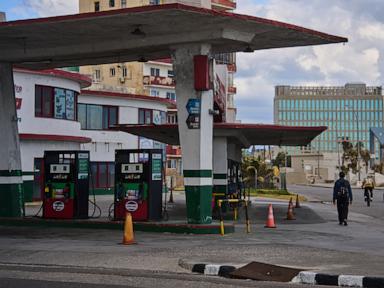
The lights do not just go out in Havana. They die with a heavy, metallic sigh.
First comes the drop in voltage, a subtle dimming of the fluorescent bulbs that makes everyone in the room pause, mid-sentence, waiting. Then, the rhythmic thrum of the old Soviet-era refrigerator sputters and falls silent. Finally, darkness. It is a sensory shift that millions of people living on the island recognize instantly. In that sudden quiet, the heat moves in, thick and uncompromising, trapping the scent of gasoline and frying plantains in the still air.
When news broke that Washington had added yet another Cuban state enterprise to its restricted financial blacklist—this time targeting Cubametales, the state-run oil and gas importer—the reaction in international boardrooms was a collective, bureaucratic nod. It was another chess move in a decades-old geopolitical game. A press release was issued. Stock tickers barely blinked.
But geopolitical chess is never played with wooden pieces. It is played with human lives.
To understand the real impact of a Treasury Department sanction, you have to leave the air-conditioned offices of Washington D.C. and stand on a street corner in Central Havana at three o'clock in the afternoon.
Consider a hypothetical citizen named Alejandro. He is forty-two years old, a mechanic, and his entire day is dictated by fuel. Not by the price of it, but by the sheer, agonizing scarcity of it. When the government loses the ability to trade with international oil companies because global banks fear American fines, Alejandro’s world shrinks. The bus that takes his daughter to school stops running. The local bakery cannot power its ovens. The hospital down the road must ration the diesel that keeps its backup generators alive.
Sanctions are often described by policymakers as "targeted surgical strikes." The phrase conjures images of precision, a clean removal of bad actors while the rest of society functions untouched.
The reality is messy. Indiscriminate.
Think of an island's economy as a human body, and energy as the bloodstream. When a foreign power restricts the flow of oil, it does not just hurt the political figures at the top. It constricts the capillaries. It starves the extremities. Cubametales was the primary pipeline through which Cuba exchanged Venezuelan crude for domestic consumption. By cutting off that entity’s access to the US financial system, the pressure does not just mount on government ministers; it bears down on the elderly woman waiting four hours in the tropical sun for a communal taxi.
The tension between the two nations is not a new story, but it is one that has lost its human context over the years. We talk about embargoes, the Helms-Burton Act, and non-proliferation treaties as if they are abstract concepts in a political science textbook. We forget that every restriction translates to a specific, tangible deficit on the ground. It means a shortage of soap. It means rolling blackouts that ruin a family’s entire week of refrigerated rations in a matter of hours.
The strategic logic behind these moves is simple enough on paper: apply enough economic misery, and the political system will buckle.
But history suggests a different outcome. Decades of economic isolation have not broken the political structure; instead, they have conditioned a population to endure. The hardship becomes a baseline. The collective energy of a nation shifts from growth and innovation to pure, exhausting survival.
The most agonizing part of this dynamic is the uncertainty. Ask any local business owner trying to navigate the shifting rules of international trade. One year, there is a opening, a brief window where American travelers bring dollars and optimism. The next year, the policy shifts, the door slams shut, and the investments made by ordinary families vanish into thin air. It is a whiplash that prevents any long-term planning, leaving an entire generation stranded in a permanent state of waiting.
As the sun sets over the Malecón, the famous seawall where Havanans go to escape the stifling heat of their homes, the horizon offers no answers. Shipping tankers sit far off the coast, idling in the deep water, hesitant to dock, hesitant to unload, terrified of the legal penalties that come with touching an embargoed port.
Below the seawall, the waves crash against the stone, spraying salt water into the faces of teenagers listening to music on aging smartphones. They are not thinking about foreign policy or treasury designations. They are wondering if the power will be back on by the time they get home, or if they will spend another night sleeping on the balcony, chasing a breeze that never arrives.


