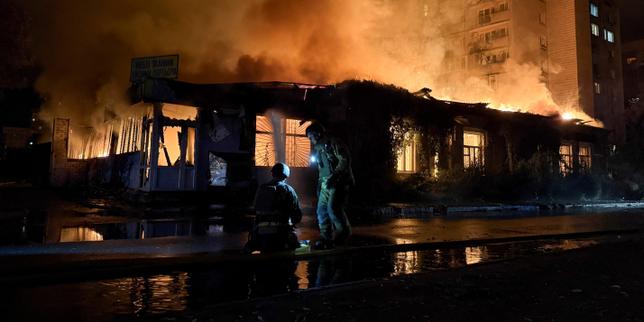
Urban missile strikes function as kinetic signals designed to alter systemic stability rather than merely degrade localized tactical infrastructure. When massed precision munitions impact a metropolitan center like Kyiv, the strategic calculus extends far beyond the immediate casualty count. Analysts must deconstruct these events through three distinct operational vectors: kinetic delivery mechanics, civilian survivability economics, and political signaling thresholds.
Kinetic Delivery Mechanics And Air Defense Attrition
The mechanics of a heavy saturation strike rely on overwhelming multilayered interception architecture through mixed vector profiling. Modern interceptor economics dictate that defense systems face a severe cost asymmetry. Low-cost loitering munitions and decoy vectors force the expenditure of high-value interceptor missiles, creating intentional gaps in terminal defense coverage.
When a barrage breaches air defense perimeters, the kinetic energy released within a densely populated urban grid yields disproportionate structural failure. The primary variable is not simply warhead payload, but impact velocity and terminal trajectory angle. Vertical descent profiles maximize kinetic penetration through reinforced concrete, whereas shallow angles distribute surface blast radius across residential facades.
Civilian Survivability Economics And Infrastructure Stress
Targeting urban sectors introduces systemic friction into state logistics by shifting resources from frontline military logistics to internal civil defense, search operations, and medical triage. The cost function of civilian infrastructure destruction operates on compounding delays.
- Power Grid Bottlenecks: Transformer substation destruction forces a cascading redistribution of load, resulting in regional blackouts that paralyze municipal water pressure and emergency heating systems.
- Medical Surge Overload: Mass casualty events in concentrated zones test the limits of trauma care capacity, forcing triage protocols that prioritize immediate surgical interventions over long-term rehabilitation.
- Logistical Friction: Road network blockages from debris limit the mobility of first responders, extending emergency response times and compounding secondary damage from fires.
Political Signaling Thresholds
State actors deploy high-fatality urban bombardments primarily as instruments of coercive diplomacy. The strategic objective focuses on raising the political cost of continued resistance for the target government by demonstrating the vulnerability of its administrative core.
Historical precedent indicates that concentrated kinetic pressure against civilian centers rarely achieves its stated political objective of capitulation. Instead, it triggers a hardening of public resolve and accelerates international diplomatic mobilization, hardening supply chains for advanced military hardware. The efficacy of the strike must therefore be measured through its failure to alter macro-level strategic trajectories, serving instead as a high-cost tactical maneuver with diminishing marginal returns.
Long-Term Structural Adaptations
To counter the systemic vulnerability exposed by saturation urban strikes, civil defense architectures must evolve from reactive response models to distributed resilience frameworks. This requires decentralized micro-grid energy generation, hardened underground medical nodes, and real-time sensor networks that optimize interceptor allocation algorithms before saturation vectors reach terminal phase. Municipal survival under prolonged missile campaigns depends entirely on reducing single points of failure across critical life-support infrastructure.