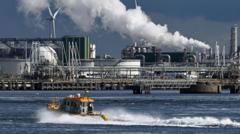
The Port of Rotterdam is a beast. It handles over 400 million tons of cargo every year, acting as the undisputed economic heart of European trade. But it also has a massive, dirty secret. This single port complex is responsible for roughly 13.5% of the Netherlands’ total carbon emissions.
Lately, the pressure on Rotterdam to go green has shifted from a gentle nudge to a full-blown legal and social squeeze. In mid-2026, climate advocacy groups formally hit the Port Authority with legal demands, insisting its climate policies must aggressively phase out fossil fuel activities to align with the Paris Agreement.
But here is what most mainstream analysis gets completely wrong. Critics look at the port and see a single entity that can just turn a green dial to fix the planet. It doesn’t work that way. The Port Authority itself only directly controls a fraction of its total footprint. The real carbon monster is the massive cluster of independent refineries, chemical plants, and power generators operating within its borders.
If you want to understand why decarbonizing Europe's biggest port is a logistical nightmare, you have to look beyond the corporate press releases.
The Illusion of Direct Control
When people talk about the port’s carbon footprint, they often lump everything into one bucket. Let’s look at the actual numbers to clear up the confusion.
In its latest reporting, the Port of Rotterdam Authority showed staggering progress in cutting its own direct emissions. We are talking about Scope 1 and Scope 2 footprints—things like the port's patrol vessels, its office buildings, and employee travel. They managed to slash these direct operational emissions by nearly 80% compared to their 2019 baseline. They even built a quay wall using cement-free geopolymer concrete that cut structural emissions by 50% for that project.
That sounds amazing on a corporate brochure. Kinda makes you think they have this sustainability thing completely figured out, right?
Wrong. Those direct operations represent a microscopic drop in a very dirty bucket. The vast majority of the port’s climate impact sits in Scope 3 emissions—the emissions generated by the 3,000 independent companies operating inside the port and the commercial ships utilizing the docks.
The Port Authority doesn't own the oil refineries run by Shell or ExxonMobil in the industrial complex. It doesn't own the chemical manufacturing facilities or the massive coal and gas power stations. It can't just order them to shut down or switch to clean energy overnight without paralyzing the European economy. The Port Authority itself openly admitted this in its June 2026 response to legal advocates, stating that forcing a cap on fossil activities simply isn't within its legal power or its mandate as a landlord.
The Hydrogen Pipe Dream Meets Reality
To bridge this gap, Rotterdam is placing its biggest bet on hydrogen. The goal is wildly ambitious: supplying north-western Europe with 4.6 megatons of hydrogen annually by 2030.
They are making real infrastructure moves here. The first 32-kilometer stretch of a dedicated hydrogen pipeline running through the Maasvlakte industrial area has been laid. This pipeline is meant to act as the backbone for industrial decarbonization, allowing heavy users like fertilizer plants and refineries to swap out carbon-heavy "grey" hydrogen for cleaner alternatives.
But there is a massive catch.
Building a pipeline is the easy part. Filling it with actual green hydrogen—which requires vast amounts of renewable electricity to produce—is a whole different story. Europe doesn't have anywhere near enough wind and solar capacity to power the massive electrolyzers needed for this transition yet. For example, energy giant Uniper is designing a major 500-megawatt electrolyzer at the port, but they won't even make a final investment decision until late 2026, with operations delayed until 2030.
Because green hydrogen is scarce and expensive, the port is forced to rely heavily on "blue" hydrogen—using fossil gas but capturing the resulting carbon and burying it under the North Sea via the Porthos project.
Climate activists hate this. They argue it creates a "fossil lock-in," extending the life of oil and gas infrastructure under the guise of being eco-friendly. But honestly, without blue hydrogen as an interim step, the industrial cluster has no realistic way to cut emissions this decade. It's a classic clash between purist environmental ideals and dirty engineering realities.
The Shipping Bottleneck
Even if Rotterdam miraculously cleans up its entire industrial coastline, it still has to deal with the ships themselves. Maritime transport is notoriously difficult to decarbonize.
The global shipping fleet runs on heavy fuel oil for a reason: it is incredibly cheap and energy-dense. While the port can incentivize greener vessels by offering discounts on port fees or installing shoreside power docks so ships don't have to idle their engines while berthed, it cannot rewrite global maritime law on its own.
Alternative fuels like green ammonia or methanol are frequently touted as the savior of commercial shipping. Rotterdam is already expanding storage facilities for these fuels. But until international regulations penalize carbon heavily enough to make these expensive alternatives economically viable, most commercial fleets will keep burning fossil fuels.
Moving the Needle From the Ground Up
If you are a logistics manager, a manufacturing executive, or an investor tracking industrial supply chains, you can't wait for governments to sort out these macro-level disputes. The regulatory squeeze is rolling downhill, and it will eventually hit your bottom line.
Start auditing your supply chain data with hyper-specific geographic filters. If your freight runs through Rotterdam, separate the port’s own operational footprints from the maritime transport emissions. This distinction is vital for accurate corporate sustainability reporting.
Diversify your fuel strategy immediately instead of waiting for a single winner to emerge. Do not assume green hydrogen will be cheap or widely available by 2030. If your operations rely on heavy transport or industrial heat, look into immediate transitional options like bio-LNG, shoreside power capabilities, or localized carbon capture partnerships to hedge your bets against a slow-moving regional grid transition.
The hydrogen ecosystem is taking shape
This video details the physical infrastructure and pipeline networks currently being constructed on-site to transform the industrial cluster into a regional clean energy hub.