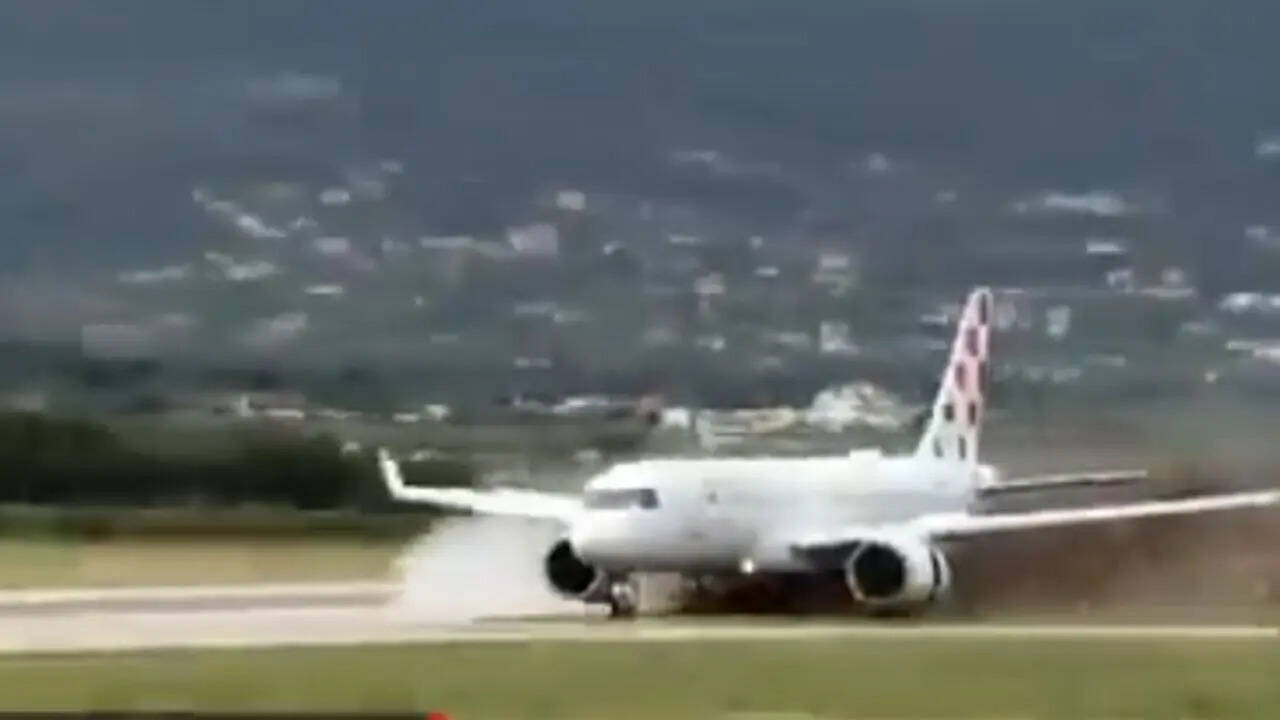
The media loves a good aviation scare. When a Croatia Airlines Dash 8 skids off the tarmac during an aborted takeoff, the internet panics. Cue the dramatic headlines. Cue the shaky passenger footage. Cue the predictable, lazy public consensus: The pilots lost control, the plane failed, and we narrowly escaped a disaster.
It is a comforting narrative for people who know absolutely nothing about aerodynamics. It allows the public to point a finger at an airline, shudder at the thought of flying, and demand "investigations" into a situation that actually went precisely according to plan.
Here is the controversial truth nobody admits: That runway excursion wasn't a failure. It was a triumph of modern aviation engineering and pilot training.
If you think a plane sliding into the grass during a high-speed rejected takeoff means something went wrong, you are asking the entirely wrong questions about aviation safety.
The Illusion of the Clean Stop
The mainstream press views a runway as a highway. If a car spins out into the median, the driver messed up. But a commercial runway during a maximum-effort aborted takeoff is a high-stakes physics lab, not a highway.
When flight crews execute a rejected takeoff (RTO) near decision speed ($V_1$), they are intentionally demanding a brutal amount of work from the aircraft's braking systems. We are talking about converting massive amounts of kinetic energy into raw thermal energy in a matter of seconds.
Let's break down what actually happens when a pilot slams on the brakes of a turboprop or a jet liner at 100-plus knots:
- Carbon Brakes White-Hot: The brake assemblies can instantly soar to temperatures over 800 degrees Celsius.
- Deceleration vs. Directional Control: At those temperatures, tires blow. Anti-skid systems fight for traction on rubber-coated concrete.
- The Weight Transfer Nightmare: As the aircraft aggressively decelerates, the nose gear is slammed downward, drastically shifting the center of gravity and altering how the rudder and nose-wheel steering respond to pilot inputs.
I have spent decades analyzing flight data and talking to accident investigators who have seen millions of dollars of hardware destroyed in seconds. The public expects a smooth, linear deceleration that stops perfectly on the centerline. That is a fantasy.
When you abort a takeoff at high speed, you are electing to destroy the tires, bake the brakes, and potentially slide off the asphalt just to keep the aircraft on the ground. Going into the grass at 15 knots is infinitely better than taking an un-airworthy aluminum tube into the sky at 140 knots.
Dismantling the Panic
Let’s tackle the inevitable "People Also Ask" questions that flood search engines every time an incident like this occurs. The premises of these questions are fundamentally flawed, driven by a media machine that feeds on fear.
Why do planes skid off the runway during an aborted takeoff?
The common assumption is that the pilots panicked or the steering broke. The brutal reality is often much simpler: hydroplaning, asymmetrical reverse thrust, or blown tires. When a pilot rejects a takeoff, they deploy spoilers to dump lift, stand on the brakes, and often throw the engines into reverse. If one engine responds a fraction of a second faster than the other, or if one side of the runway has slightly less grip due to moisture or rubber buildup, the aircraft will yaw. Fighting that yaw at high speed on a narrow strip of concrete is like trying to balance a bowling ball on a knife edge. A minor excursion into the grass is often the safest way to dissipate the remaining energy without flipping the aircraft.
Was the Croatia Airlines aborted takeoff a pilot error?
Stop looking for a scapegoat. The pilot's job during an RTO is not to deliver a smooth ride for your comfort; it is to stop the aircraft before it hits the perimeter fence. If the aircraft leaves the paved surface at a low, controlled speed and everyone walks away without a scratch, the crew did their job. They managed a catastrophic mechanical or environmental variable and contained the damage.
The Hypocrisy of "Safety First"
Airlines love to brag about their flawless safety records, but they rarely educate the public on what real safety looks like. Real safety is violent. It is loud. It involves smoking tires, screaming engines, and sometimes, a bumpy ride through the mud at the end of Runway 22.
The downside to my contrarian view? It is terrifying for passengers to accept. It means acknowledging that flying involves managing inherent risks, not eliminating them. It means accepting that sometimes, a successful flight ends with emergency slides deploying in a field.
But hiding behind the lazy narrative that "something went wrong because the plane got dirty" ignores the mechanical genius of modern aviation. The fuselage remained intact. The fuel tanks didn't rupture. The passengers walked off the plane.
The system worked.
Stop treating a standard, albeit aggressive, emergency maneuver like a near-death experience. The next time you read about a plane skidding off a runway during an abort, don’t gasp. Recognize it for what it truly is: a highly orchestrated, brutal piece of physics designed to save lives by sacrificing the landing gear.
The pilots didn't lose control. They chose the grass over the sky, and they were entirely right to do so.