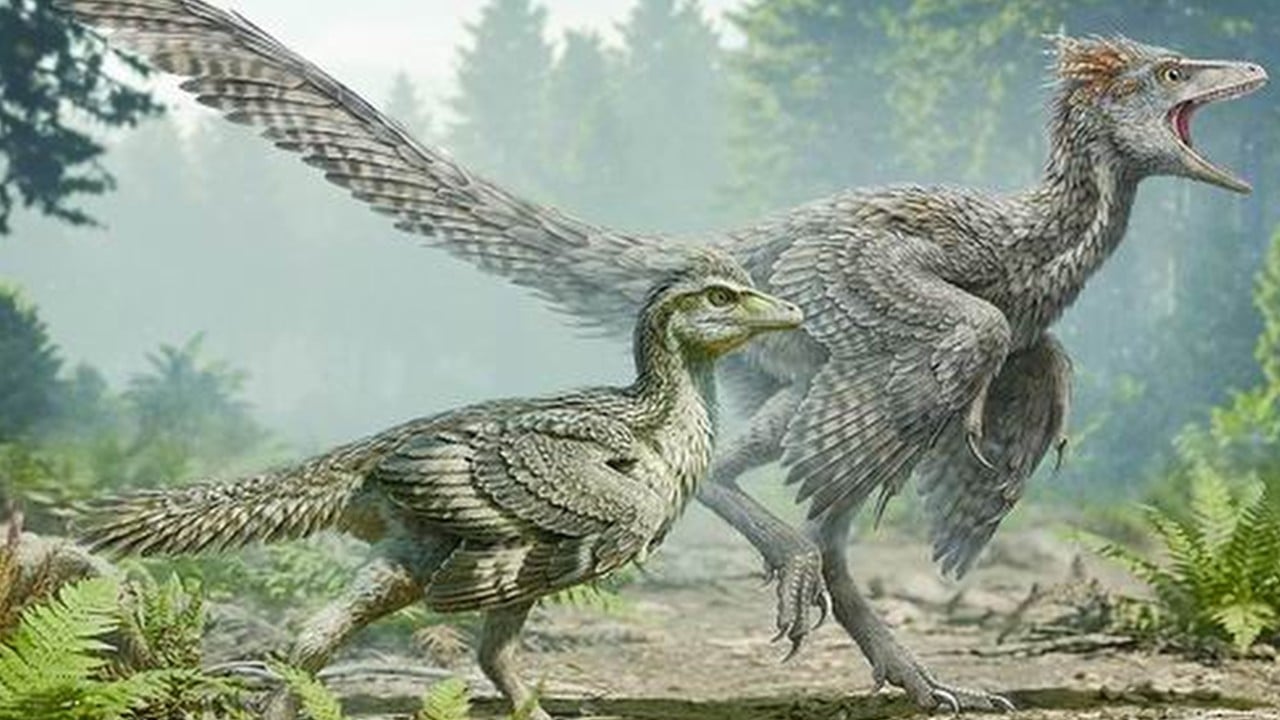
The transition from long-tailed theropod dinosaurs to short-tailed, flight-capable birds represents one of the most drastic anatomical reconfigurations in evolutionary history. Standard narratives often treat this transition as a sudden leap driven solely by the broad requirement for flight. However, fossil evidence from northeastern China isolates the exact structural steps of this reduction, revealing that the elimination of the homocercal dinosaurian tail was a modular, multi-phase process. The gradual stabilization of the caudal vertebrae was not an immediate adaptation for flight control, but a preliminary biomechanical shift that later unlocked the aerodynamic potential of the modern uropygial complex.
Understanding this evolutionary trajectory requires breaking down the caudal skeleton into distinct functional zones and analyzing how selection pressures shifted load-bearing requirements from the hindquarters to the forelimbs.
The Tri-Phased Architecture of Caudal Reduction
The reduction of the avian tail did not occur through a uniform shortening of all vertebrae. Instead, fossil data indicates a regionalized modification of the caudal series, which can be categorized into three structural phases.
[Phase 1: Proximal Rigidification] -> [Phase 2: Distal Atrophy] -> [Phase 3: Pygostyle Fusion]
Phase 1: Proximal Rigidification and Locomotor Decoupling
In basal theropods, the long tail functioned as a counter-balance and an anchor for the caudofemoralis longus muscle, the primary engine for hindlimb retraction. The initial evolutionary phase required decoupling the tail from this locomotive function. Fossils of transitional avialans show a reduction in the size of the proximal chevrons and transverse processes. This anatomical downsizing signals a reduction in muscle mass, shifting the center of mass forward and forcing a transition from hip-driven running to knee-driven terrestrial locomotion.
Phase 2: Distal Atrophy and Intermediate Stabilization
Before the formation of a true pygostyle (the fused terminal vertebrae), intermediate species exhibited a stark differentiation between the proximal and distal tail. The mid-to-distal vertebrae elongated and lost their flexibility, acting as a stiff rod rather than a flexible whip. This intermediate state provided a rigid platform that could support elongated tail feathers, serving a visual or primitive aerodynamic purpose without the muscular weight of a full reptilian tail.
Phase 3: The Pygostyle Fusion Event
The final phase is marked by the complete fusion of the terminal 4 to 10 caudal vertebrae into a single bone: the pygostyle. This structural fusion provides a dense, anchored base for the rectrices (flight feathers) and the insertion of complex tail musculature (musculus bulbi rectricium). The creation of this integrated unit allows for the dynamic manipulation of tail fan geometry during low-speed flight maneuvers.
Biomechanical Constraints and the Aerodynamic Bottleneck
The evolutionary transition from a long, bony tail to a short, fused pygostyle is governed by strict biomechanical trade-offs. The primary constraint is the management of the lift-to-drag ratio and the stabilization of the pitch axis during flight.
A long tail provides significant inertial stability, acting as a passive damper against pitching motions. When an organism reduces this tail length, it inherently reduces its passive stability. To prevent catastrophic loss of control in the air, the organism must compensate by developing active control mechanisms. The development of the pygostyle solved this bottleneck by acting as a muscular cockpit, allowing the organism to adjust the angle of attack of the tail feathers in real-time.
The structural transition introduced specific engineering challenges:
- Mass Distribution Shift: Shortening the tail moved the center of gravity forward, requiring the wings to shift anteriorly relative to the lungs and heart to maintain stable aerodynamic lift.
- Muscular Realignment: Muscles that previously anchored to the pelvis and femurs had to re-anchor onto the shortened caudal plates, changing the vector of force from a backward pull to a lateral and vertical pivot.
Comparative Morphological Analysis
Examining the structural variations across key transitional fossils illuminates the exact sequence of these anatomical changes.
- Jeholornis: This taxon represents the basal architecture. It retains a long, dinosaurian tail composed of more than 20 vertebrae. However, it displays a distinct specialization: the distal vertebrae are extremely elongated and wrapped in long bony extensions, maximizing stiffness while minimizing muscle weight. The tail ends in a fan of feathers, proving that rectrices evolved long before the pygostyle.
- Zhongjianornis: This genus marks a critical intermediate node. The total vertebral count is significantly reduced, and the distal elements show clear signs of shortening and condensation, though full structural fusion into a singular blade is not yet complete.
- Confuciusornis: This taxon represents the earliest widespread implementation of the fully derived pygostyle. The long tail is completely absent, replaced by a shortened, fused bone that anchors long, ribbon-like display feathers or a primitive feather fan.
The sequence demonstrates that tail shortening and feather evolution were not perfectly synchronized. The feathers evolved first on a rigid, elongated tail structure; the bony tail was then compressed and fused underneath the existing feather arrangement, optimizing the structure for weight reduction and active articulation.
Pathological Variations and Evolutionary Anomalies
The transition was not perfectly linear, and the fossil record preserves instances where the developmental program for tail reduction failed or varied. Some specimens reveal incomplete fusion or varying numbers of vertebrae incorporated into the pygostyle within the same species. These variations suggest that the genetic switches governing caudal suppression—such as the Hox genes that dictate axial patterning—were highly volatile during the Early Cretaceous.
The presence of variable vertebral counts within single populations indicates that selection pressure was heavily focused on the functional output (a short, rigid tail base) rather than the precise numerical input (the exact number of bones fused). As long as the tail was short enough to reduce drag and rigid enough to anchor the rectricial bulb, minor structural deviations were tolerated by natural selection.
The Aerodynamic Framework of the Derived Avian Tail
Once the pygostyle achieved structural stability, it altered the energetic calculus of avian flight. The modern avian tail does not function as a primary lift generator; instead, it acts as a split-flap and a variable-geometry stabilizer.
During high-speed cruise flight, the tail is tightly folded to minimize parasite drag, allowing the wings to handle all lift and propulsion requirements. During low-speed maneuvers, landing, or tight turns, the pygostyle muscle complex spreads the rectrices laterally and tilts them downward. This orientation generates high lift at the rear of the animal, creating a pitch-up moment that slows the bird down and prevents stalling. Without the structural consolidation of the pygostyle, the muscular coordination required to execute these high-load variations would be structurally impossible, as individual, unfused vertebrae would buckle under the aerodynamic force generated by the spread feathers.
The evolutionary pathway of the avian tail highlights a fundamental principle of biological engineering: complex structures are rarely generated de novo for their ultimate utility. Instead, they are assembled through a series of intermediate adaptations, where structures optimized for one function—such as passive stabilization and display—are progressively condensed, rigidified, and repurposed to meet the demands of a high-performance kinematic system.