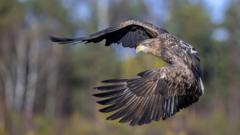
Young white-tailed eagles are back in the skies above Exmoor, marking another aggressive chapter in Britain's controversial conservation movement. A fresh cohort of these massive raptors has been released across the Somerset and Devon border, continuing a multi-year reintroduction strategy managed by the Roy Dennis Wildlife Foundation and Forestry England. They span two meters across when fully grown, casting broad shadows over moorland that has lacked apex avian predators for over a century.
Conservationists celebrate the milestones, pointing to ecological restoration and tourism boosts. Farmers, landowners, and rural communities whisper about livestock vulnerability, regulatory overreach, and the shifting baseline of what wild Britain actually means. The white-tailed eagle, often called the flying barn door, is not a passive symbol of nature healing itself. It is a massive, opportunistic carnivore moving into a crowded, highly managed cultural landscape.
Understanding why these birds are returning requires looking past the glossy press releases and examining the mechanics of modern rewilding. This is not about letting nature take its course. It is about human intervention applied on a massive scale, using imported wildlife to correct centuries of historical eradication.
The Logistics of Aerial Engineering
You cannot simply open a crate and wish a bird of prey luck in a new county. The white-tailed eagle reintroduction follows a meticulous, militarized protocol developed over decades in Scotland and more recently on the Isle of Wight. The birds released over Exmoor were sourced as chicks from wild nests in Scotland, brought south under strict veterinary supervision, and placed into specially constructed hack boxes hidden deep within the Exmoor woods.
For weeks, local project officers fed the birds through hidden slots to prevent human habituation. They watched via closed-circuit cameras as the juvenile eagles tested their primaries, stretched their wings against Atlantic gales, and finally leaped off the artificial platforms into the unknown.
This is wildlife management wearing a conservation mask. Every single bird is fitted with a GPS satellite tag. Every movement is tracked, recorded, and scrutinized by teams sitting in offices miles away. When a bird drops out of signal, or lands in an unexpected sheep pasture, field agents mobilize.
The cost of this oversight is substantial, funded by public donations, corporate sponsors, and philanthropic grants. Yet the architects of the program insist this high-tech babysitting is necessary to protect public relations. A dead eagle on a public footpath is a public relations disaster. A monitored eagle thriving in a protected zone is a campaign victory.
The Livestock Conflict Beneath the Flight Path
Down on the ground, the mood shifts from celebration to quiet anxiety. Exmoor is not a pristine wilderness. It is an ancient, heavily grazed agricultural landscape defined by centuries of sheep farming, red deer management, and commercial forestry.
White-tailed eagles are apex opportunistic predators. While their primary diet in coastal regions consists of fish and waterfowl, inland populations in Europe and reintroduced birds in Scotland frequently take lambs, ground-nesting birds, and small mammals.
Farmers on the moor know this history. They look across the Channel to Ireland and Scotland, where eagle reintroductions have sparked bitter disputes with sheep farmers losing stock. Project organizers argue that livestock predation is rare, pointing to data suggesting that healthy lambs are seldom targeted. But farmers live on margins measured in pence, not percentages.
When a ewe loses a lamb, the financial and emotional toll is immediate. The compensation schemes offered by conservation bodies rarely cover the full administrative and emotional headache of livestock loss. More importantly, rural communities feel a profound sense of disenfranchisement. Decisions about what lives and breathes on their ancestral hill farms are made by urban-based ecologists and bureaucrats who will never have to pull a dead lamb from a bog.
The cultural friction runs deeper than economics. It is a battle over ownership of the British countryside. Is Exmoor a working food-production landscape, or is it a designated wild zone designed for urban recreation and biodiversity metrics?
Changing Baselines and Ecological Amnesia
To understand the fervor behind the Exmoor release, you have to confront the concept of shifting baselines. Every generation accepts the natural environment they inherited in childhood as the normal standard. To a twenty-something hiker today, an Exmoor devoid of eagles is normal. To an ecologist looking back two hundred years, modern Britain is a biological wasteland stripped of its heavy hitters.
The white-tailed eagle is just one piece of a larger puzzle. Beavers are chewing through riverbanks in the West Country. Wild boar roam southern woodlands. Lynx are perpetually discussed in academic seminars as the next big candidate for fenced or unfenced release.
Each species brings undeniable ecological functions. Eagles scavenge carrion, keeping scavenger networks active and putting pressure on crow and fox populations. They redistribute nutrients across the landscape. They provide an undeniable thrill for wildlife watchers who can pull off the A39 and spot a six-foot wingspan soaring over a comb.
Yet we must ask what happens when these reintroductions collide with human population density. Britain is one of the most crowded nations in Europe. Every acre has a function, a deed, a history, and a human neighbor. When a white-tailed eagle wanders into a grouse moor, a pheasant shoot, or a commercial pig farm, the ecological idealism hits the hard concrete of property rights and economic reality.
The Financial Realities of Rewilding Tourism
Proponents of the Exmoor release frequently lean on the economic argument. Tourism is the lifeblood of rural Somerset and North Devon. B&Bs, pubs, gear shops, and guided tour operators stand to gain millions if Exmoor becomes the premier raptor-watching destination in southern England.
It worked on the Isle of Wight. Thousands of visitors flock to the Solent coastline specifically to catch a glimpse of the expanding population of white-tailed eagles established there in 2019. Local businesses report extended shoulder seasons driven entirely by wildlife enthusiasts with high-end camera lenses and binoculars.
However, this economic windfall is unevenly distributed. The pub owner in the village square sees the benefit. The hill farmer three miles up the valley sees only the risk. When conservation economics rely on turning nature into a spectator sport, rural communities risk becoming living museum exhibits rather than active participants in their own land.
The tension creates an atmosphere of guarded observation. People are waiting to see what happens when the current batch of juveniles matures, pairs up, and attempts to establish permanent breeding territories across the West Country.
The Long Game for British Raptors
The white-tailed eagles soaring over Exmoor today face a gauntlet that has nothing to do with natural survival. They face illegal poisoning, persecution from rogue elements within the shooting community, and the slow, invisible creep of environmental toxins like lead ammunition fragments embedded in carrion.
Despite strict legal protections under the Wildlife and Countryside Act, raptor persecution remains a dark underbelly of the British countryside. In northern England and parts of Scotland, reintroduced eagles and red kites still occasionally turn up dead, victims of deliberate targeting by individuals who view them as a threat to game management or livestock.
The success of the Exmoor project will not be measured by the initial excitement of the release weekend or the number of Instagram photos tagged #ExmoorEagles. It will be measured ten years from now. By whether stable breeding pairs manage to hatch chicks without constant human intervention. By whether local farmers feel heard or ignored. By whether the landscape can truly absorb an apex predator without collapsing into endless litigation and conflict.
As the juvenile eagles ride the thermals over the combes, dipping their wingtips into the sea breeze blowing off the Bristol Channel, they carry the weight of an entire ideological war on their feathers. They are magnificent, ruthless, and entirely indifferent to the human politics playing out below them.