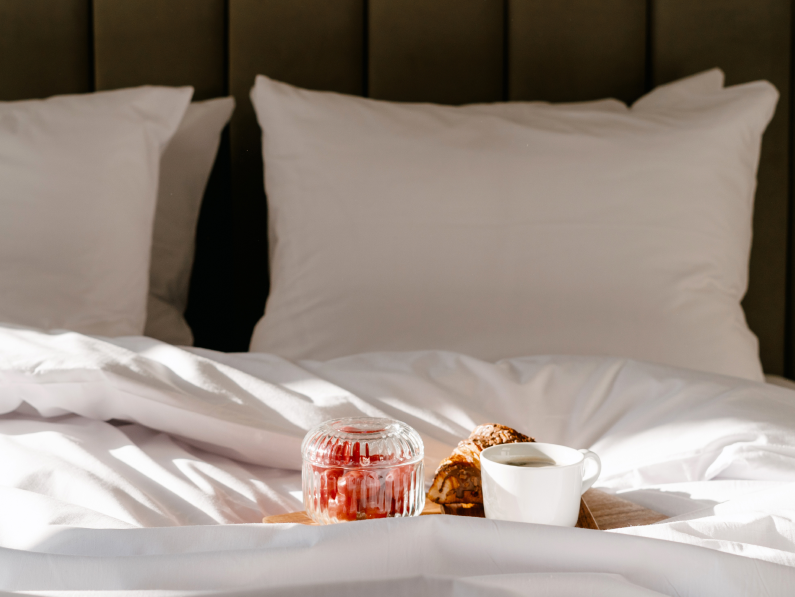
To make your bedroom feel like a five-star hotel, you must stop buying decorative cushions and start stealing the operational psychology of global hospitality chains. Most home decorators fail because they focus on visual mimicry rather than sensory engineering. You do not need a four-thousand-dollar headboard to achieve a luxury hotel room atmosphere. You need an understanding of how acoustic dampening, heavy textiles, and precise thermal management manipulate human psychology.
Hotels do not feel expensive because they look pretty. They feel expensive because they systematically eliminate friction, distraction, and biological stress.
The Acoustic Trap
Walk into a standard residential bedroom and clap your hands. You will likely hear a sharp, hollow echo bouncing off drywall, uncarpeted hardwood floors, and glass windows. Now walk into a suite at a high-end boutique property and do the same thing. The sound dies almost instantly.
Acoustics dictate luxury. Residential architecture is notoriously loud, plagued by hollow-core doors, thin walls, and hard surfaces that amplify every creak of the house and rumble of the street. Five-star hotels spend millions on sound mitigation. They use solid-core doors with automatic drop seals at the bottom, acoustic underlayments beneath carpets, and heavy drapery interlined with blackout flannel.
You can replicate this without a major renovation. Begin with your doors. If light or hallway noise slips under your bedroom door, install a surface-mounted door sweep. Hang heavy curtains, and do not spare the yardage. Curtains should extend at least six inches past the window frame on either side and pool slightly on the floor to trap sound waves and eliminate perimeter light leaks.
The Textiles Matrix
The hospitality industry relies on a tactile deception known as thread weight over thread count. Retail marketing has convinced consumers that a one-thousand-thread-count sheet is the pinnacle of luxury. Hoteliers know better. High thread counts often mean weaker, tightly packed short-staple cotton that traps heat and pills after three washes.
True luxury properties purchase commercial-grade percale or sateen woven from long-staple or extra-long-staple cotton, typically weighing between three hundred and four hundred threads per square inch. This weight offers breathability, crispness, and structural durability that survives industrial laundries.
Layering is the next operational hurdle. A residential bed usually features a fitted sheet, a flat sheet, a heavy comforter, and maybe a decorative quilt. A proper hotel bed utilizes a strict tripartite system. A bottom fitted sheet, a flat sheet sandwiched between two blankets or a duvet with a removable, washable commercial cover, and a top coverlet that stays folded at the foot of the mattress for visual weight.
Crucially, commercial laundering changes fabric behavior. Hotels wash linens in industrial extractors using precise chemical titrations and hot water cycles, followed by high-heat ironing that flattens every fiber. If you want that crisp hotel feel at home, you must iron your pillowcases and top sheets. There is no shortcut. No fabric softener spray can replace the mechanical press of hot metal against damp cotton.
Thermal Zones and HVAC Engineering
Have you ever noticed how you never wake up sweating in a luxury hotel room, even under heavy duvets?
This is not an accident of architecture. It is the result of aggressive climate control design. Most residential thermostats are placed in hallways or living rooms, leading to wild temperature fluctuations inside isolated bedrooms. Furthermore, residential homes often rely on single-zone heating and cooling that fails to account for solar heat gain through bedroom windows.
Hotels design rooms for independent thermal management. The ambient air temperature is deliberately kept between sixty-four and sixty-seven degrees Fahrenheit. This cool air forces you to seek thermal refuge under heavy bedding, triggering a biological cue that signals the body to release melatonin and enter deep sleep.
To achieve this balance at home, stop relying on central heating or cooling alone. Install a quiet, inverter-driven mini-split heat pump if your budget permits, or use a smart ceiling fan paired with a smart thermostat to keep air moving gently without creating drafts. The air must be circulating, dry, and cool.
Lighting Architecture and the Death of the Overhead Fixture
You will never find a harsh, central ceiling light fixture in a five-star hotel bedroom. Overhead lighting belongs in garages and operating rooms. Residential spaces suffer from the laziness of builders who wire a single electrical box dead-center in the ceiling and call it a day.
Hospitality design relies exclusively on layered, low-level illumination. Every light source should sit below eye level when you are standing. This means table lamps with heavy ceramic or metal bases, shaded wall sconces flanking the headboard, and hidden LED strip lighting tucked behind crown molding or under floating nightstands.
Color temperature matters just as much as fixture placement. Bulbs must emit light between two thousand four hundred and two thousand seven hundred Kelvin. Anything higher introduces blue light spectrums that suppress melatonin production and shatter the illusion of a secluded sanctuary.
Every light source needs an independent dimmer switch. A guest must be able to navigate from the bed to the bathroom at three in the morning without activating a retina-burning glare.
The Minimalist Surface Rule
Clutter is the ultimate enemy of the high-end aesthetic. Look at the bedside table in an upscale hotel. You will find a telephone, a notepad, a pen, a lamp, and perhaps a curated alarm clock. You will not find loose charging bricks, half-read paperbacks, mail, or unwatered house plants.
Clutter creates cognitive load. When your brain is constantly processing the visual noise of random objects piled on every horizontal surface, your nervous system remains on alert. Luxury is defined by empty space.
Clear your dressers and nightstands entirely. Choose one intentional statement piece per surface, such as a heavy tray to corral essential items out of sight or a single piece of architectural glassware for water. Everything else goes into drawers or out of the room.
Scent and the Invisible Signature
You notice the scent of a luxury hotel before you notice the decor. Global hospitality brands commission custom ambient fragrances that combine notes of white tea, fig, cedarwood, or amber. This scent is pumped subtly through the ventilation system or atomized in the lobby and corridors, setting an immediate psychological anchor.
At home, avoid aerosol room sprays and plug-in synthetic air fresheners, which release volatile organic compounds and smell like a chemical spill. Instead, use cold-air nebulizing diffusers with pure essential oil blends. Keep the scent profile linear and understated. If a guest can identify the exact moment they walked past the diffuser, the dose is too high.
The Maintenance Protocol
The final differentiator between a hotel room and your bedroom is not something you buy. It is a discipline of daily maintenance.
Beds in five-star properties are remade completely from scratch every single morning. Sheets are pulled taut, hospitals corners are folded with geometric precision, and pillows are karate-chopped to restore interior loft.
If you leave your bed unmade, no amount of high-thread-count percale or warm ambient lighting will save the space. Luxury is an ongoing state of order, not a permanent decoration. Pull the linens tight, drop the temperature, dim the lights, and let the architecture do the work.