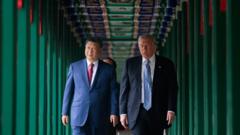
Xi Jinping’s decision to escort Donald Trump through the secluded halls of the Zhongnanhai and the imperial grandeur of the Forbidden City was never about hospitality. It was a calculated display of historical continuity designed to overwhelm a transactional American president with the weight of five thousand years of civilization. While the Western press focused on the optics of two world leaders sipping tea, the actual subtext was a sophisticated assertion of Chinese dominance in Asia. This visit marked the formal end of the era where the United States dictated the terms of engagement in the Pacific.
For decades, Washington operated under the assumption that economic integration would eventually force China to adopt Western liberal norms. That theory has now been buried under the red walls of the Palace Museum. Xi used this state visit to signal that China is no longer content being a participant in a US-led order; it is now the architect of its own sphere of influence. By granting Trump unprecedented access to the "seat of power," Xi wasn't just showing off a tourist attraction. He was demonstrating that the Communist Party has successfully fused imperial tradition with modern authoritarian efficiency.
The Architecture of Domination
The Forbidden City serves as a physical manifestation of the Middle Kingdom complex. When Xi walked Trump through the Hall of Supreme Harmony, the message was clear. Power in China does not flow from election cycles or quarterly earnings. It is rooted in a sense of permanence that the American political system, with its constant internal friction, cannot match.
Beijing understands that the American presidency is a temporary lease. Xi, having cleared the path for indefinite rule, views his timeline in decades and centuries. During this visit, he leveraged that psychological advantage. While Trump looked for immediate wins on trade deficits and North Korean sanctions, Xi was busy reinforcing a narrative of inevitable Chinese resurgence. The contrast in their approaches reveals a fundamental shift in global mechanics. The United States is currently playing a series of tactical skirmishes, while China is executing a grand strategy to displace the dollar and the US Navy as the primary anchors of regional stability.
The Trade Deficit Red Herring
Much was made of the $250 billion in trade deals announced during the trip. Experienced analysts recognized this for what it was: a high-stakes distraction. Most of these agreements were non-binding memorandums of understanding or extensions of existing contracts. They provided Trump with the headlines he needed for his base, but they did nothing to address the structural issues that define the bilateral relationship.
The real conflict is not about how many soybeans China buys. It is about intellectual property, forced technology transfers, and the Made in China 2025 initiative. Beijing has no intention of abandoning its state-led industrial policy. By offering up flashy, superficial trade numbers, Xi bought himself more time to insulate the Chinese economy from future American pressure. This is a classic bait-and-switch. You give the opponent a short-term political victory to ensure your long-term industrial goals remain untouched.
Security Realignment in the Pacific
Beyond the gold-leafed ceilings and formal dinners, the security landscape of Southeast Asia underwent a quiet but profound transformation during this summit. For seventy years, the US hub-and-spoke alliance system was the only game in town. Now, the spokes are beginning to wobble.
Xi’s personal chemistry with Trump served to undermine the confidence of traditional US allies like Japan and South Korea. When the American president praises the strength and brilliance of an authoritarian leader in Beijing, it sends a shiver through Tokyo and Seoul. They see a United States that is becoming increasingly unpredictable and transactional. If the security guarantee of the US is based on the whims of a single individual rather than institutional commitments, it is no longer a guarantee. It is a commodity.
The North Korean Leverage Point
China has masterfully used the North Korean nuclear crisis as a bargaining chip. By positioning itself as the only nation with the keys to Pyongyang, Beijing has effectively forced Washington into a position of dependence. During the Forbidden City tour, Xi likely reminded Trump that any American attempt to squeeze China on trade would result in a total relaxation of pressure on Kim Jong Un.
This creates a strategic paradox for the United States. To solve the nuclear threat, it needs China. But to protect its economic future, it must confront China. Xi knows he holds the stronger hand because he can tolerate the status quo indefinitely. The US, driven by a 24-hour news cycle and an impatient electorate, cannot. This imbalance of patience is the most dangerous factor in modern geopolitics.
The Cultural Superiority Narrative
One of the most overlooked aspects of the visit was the way Chinese state media framed the interaction for a domestic audience. To the average citizen in Beijing or Shanghai, the images of Trump following Xi through the imperial grounds looked like a tributary mission. It reinforced the idea that the "Century of Humiliation" is over and the natural order—with China at the center—is being restored.
Xi is using these high-profile diplomatic encounters to solidify his mandate at home. He is the first Chinese leader since Mao who speaks to Washington as an equal, or perhaps even a superior. This isn't just about ego. It is about providing the Chinese public with a sense of pride that justifies the tightening of social controls and the crackdowns on dissent. If the country is winning on the world stage, the logic goes, then the methods used to achieve that victory are beyond reproach.
The Tech Cold War
While the leaders were watching opera at the Forbidden City, the real war was being fought in the semiconductor labs and data centers of Shenzhen. China’s goal is total technological decoupling. They want to reach a point where American sanctions or export controls can no longer paralyze their industry.
The "tour of power" was a smoke screen for this aggressive decoupling. While the West talks about "de-risking," China is actively pursuing self-reliance. They are building an alternative internet, an alternative global payment system, and an alternative supply chain that bypasses the West entirely. The hospitality shown to Trump was a way to maintain a facade of cooperation while the foundations of a new, bifurcated world were being laid.
The End of the Post-Cold War Consensus
The significance of this visit lies in what was left unsaid. There was no mention of human rights in Xinjiang, no meaningful dialogue on the erosion of autonomy in Hong Kong, and no pushback on the militarization of the South China Sea. By remaining silent on these issues, the US effectively signaled that it is willing to trade its moral authority for a few billion dollars in Boeing orders.
This is a massive win for the Communist Party. They have long argued that Western values are merely tools used to suppress Chinese growth. When a US president stops bringing them up, it validates the Chinese perspective that everything is a deal and nothing is sacred. This shift in rhetoric has consequences that will last long after the current administration leaves office. It signals to every other middle power in the world that the age of "values-based" diplomacy is dead.
The Strategic Encirclement of the Dollar
For decades, the US dollar has been the ultimate weapon of American foreign policy. If you don't play by the rules, you get cut off from the global financial system. China is now systematically building the plumbing to make that weapon obsolete.
The Belt and Road Initiative (BRI) is the primary vehicle for this. By financing infrastructure projects across Asia, Africa, and Europe, Beijing is creating a massive network of dependencies. These projects are often settled in Yuan, slowly chipping away at the dollar's dominance. During the Beijing summit, Xi didn't need to discuss BRI in detail; the sheer scale of the hospitality he offered was a testament to the wealth China has accumulated and is now using to reshape the world in its image.
The Weaponization of History
Xi Jinping is a student of history, and he knows that the Forbidden City was built to intimidate. Every staircase, every courtyard, and every gate was designed to make the visitor feel small. By choosing this venue, he was employing a psychological tactic that dates back to the Ming Dynasty.
He is banking on the idea that the United States is a spent force, distracted by internal division and lacking a coherent vision for the future. He sees a country that is retreating from its global responsibilities and is attempting to fill that vacuum before Washington realizes what it has lost. The tour was not an ending; it was a transition.
The Illusion of Containment
The idea that the US can "contain" China through traditional military or economic means is becoming increasingly divorced from reality. China is too integrated into the global economy to be isolated like the Soviet Union was. Every American consumer is tied to the Chinese manufacturing base, and every major American corporation relies on the Chinese market for growth.
Xi used the state visit to highlight this leverage. He showed that he can be a gracious host or a formidable adversary, depending on whether the US accepts his vision of a "new type of major power relations." This phrase is Beijing's code for a world divided into spheres of influence, where the US stays out of China's backyard and stops complaining about how the Communist Party manages its internal affairs.
The era of the United States as the sole superpower is over, and it died in the quiet courtyards of the Forbidden City. What follows is a messy, dangerous period of competition where the rules are unwritten and the stakes are existential. Washington is still trying to figure out how to compete, while Beijing has already been in the game for twenty years. The shift is not coming; it is already here.
Western policymakers need to stop looking at these summits as opportunities for "breakthroughs" and start seeing them as data points in a long-term campaign of displacement. The hospitality was a mask. The smiles were tactical. The goal remains the same: the total restoration of China as the preeminent power on the planet, with the United States relegated to a secondary role across the Pacific.