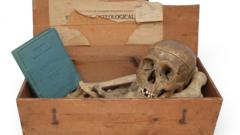
The outrage machine has claimed another victim, and this time it is Great Western Auctions, the Glasgow saleroom founded by television regular Anita Manning. Over the weekend, the auction house caved to public pressure and withdrew a lot consisting of human bones, including a skull, that was scheduled to go under the hammer. The predictable chorus of online moralists declared it a victory for human dignity.
They are wrong.
The immediate retreat by Great Western Auctions is not a victory for ethics. It is a win for sanitised, revisionist history. The panic surrounding the private sale of historical osteological specimens ignores a blunt reality: driving the trade of historical human remains underground does not protect the dead. It simply blinds the living.
The Fake Moral Panic of the Secondary Market
The public narrative surrounding this withdrawal treats the auction house like a grave robber. Critics operate under the assumption that selling a 19th-century skull or an anatomical skeleton is a modern ethical violation.
Let us fix the timeline. The vast majority of human remains circulating in the secondary antique market were not stolen yesterday. They are medical antiques. Until the late 20th century, medical students across the United Kingdom and Europe were required to purchase real human bones for anatomical study. These were meticulously cleaned, articulated, and distributed by legitimate medical supply houses.
When those doctors retire or pass away, those specimens end up in attics, estate sales, and eventually, auction catalogues. Pretending that selling these items on Friday constitutes a fresh crime is an exercise in historical illiteracy.
I have seen auction houses lose thousands in commission because they panic at the first sight of a coordinated social media campaign. They scrub the listing, issue a vague apology, and pretend the item never existed. What happens to the specimen? It does not get a state funeral. It gets sold privately, via encrypted messaging apps or backroom cash deals, completely outside the view of historians, museums, and regulators.
The Hypocrisy of the Public Sector
The loudest critics of private bone sales are often the first to defend the massive collections of human remains held by public institutions.
Consider the scale of the trade. If holding human remains is inherently exploitative, then the world’s major museums are the largest offenders in history. The British Museum holds thousands of human remains. Universities across Scotland and England house vast osteological archives.
The consensus argument insists that public institutions are curated by "experts," while private collectors are mere ghouls. This is a false dichotomy. Private collectors frequently preserve items that cash-strapped local museums refuse to take. By banning auction houses from facilitating transparent, traceable sales, the public is cut out of the provenance loop entirely.
Consider the legal framework. In England, Wales, and Northern Ireland, the Human Tissue Act 2004 regulates the storage and use of human tissue, but it specifically permits the sale of human remains that are more than 100 years old. Scotland operates under different common law principles regarding the desecration of sepulchre, yet historic medical specimens regularly fall outside this scope if they were not unlawfully exhumed.
When Great Western Auctions pulled their lot, they did not do it because a law was broken. They did it because the public cannot differentiate between a Victorian medical curiosity and a contemporary forensic case.
The Cost of Erasure
What happens when you systematically ban a category of antiques from major public platforms? You distort the historical record.
- Loss of Provenance: When items are traded in the shadows, their documentation is destroyed to avoid scrutiny. A skull that once belonged to a specific 19th-century medical pioneer loses its history and becomes an anonymous object.
- Encouraging Actual Grave Robbing: A regulated market relies on transparent provenance. When legitimate auction houses refuse to touch these items, it creates a supply vacuum. That vacuum increases the black-market value, which actually incentivises illegal illicit digging.
- The Sanitisation of Science: Medical history is brutal and uncomfortable. Erasing the physical tools of that history because they make modern audiences squeamish is a disservice to the evolution of medicine.
The reality is that human bones are historical artifacts. They are data points. They tell us about historical diets, diseases, and surgical techniques.
Dismantling the Righteous Consensus
The question people always ask when these stories break is: "How would you feel if it was your ancestor's skull on the block?"
It is an emotional trap designed to stop rational analysis. The honest answer is that after 150 years, structural anonymity changes the equation. We do not apply this standard to Egyptian mummies, Roman skeletons excavated for highway construction, or the bog bodies displayed in national galleries. The outrage is entirely dependent on proximity, not principle.
If the antique industry wants to survive the current wave of sanitisation, auctioneers need to develop a backbone. Instead of deleting listings at the first sign of a tweet, houses like Great Western Auctions should mandate strict provenance checks, display the items with historical context, and restrict bidding to verified collectors, researchers, and educational institutions.
Caving to the crowd does not elevate human dignity. It just hides our history in the dark where nobody can learn from it.