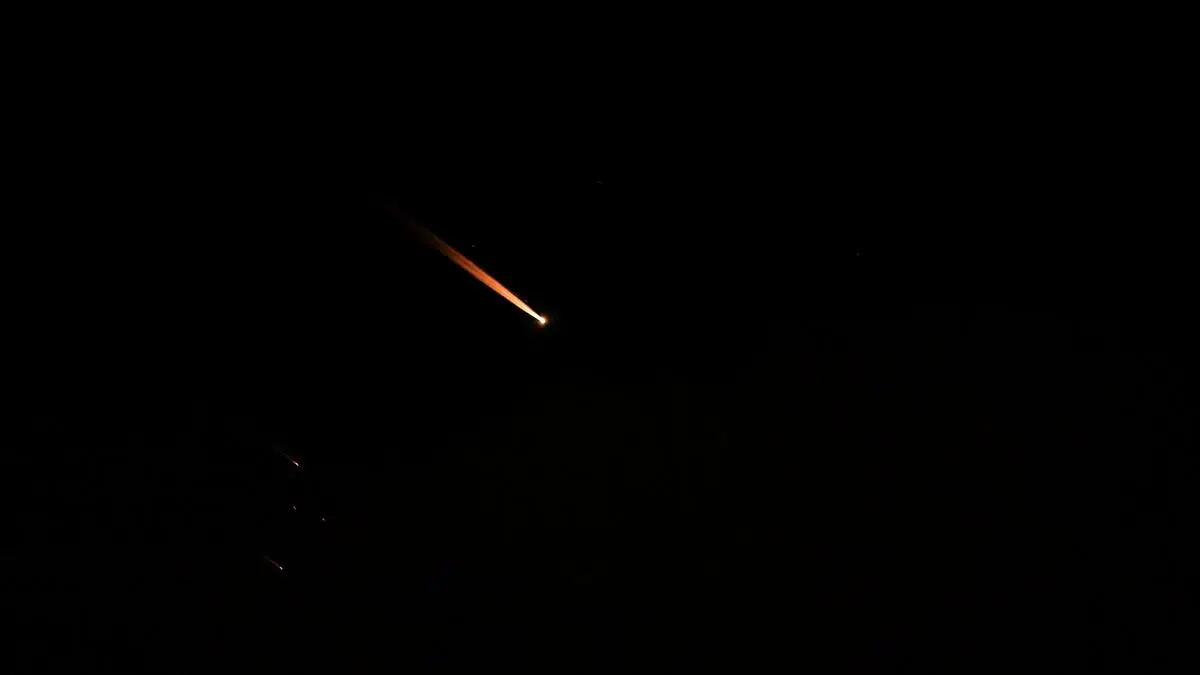
The sky above Tel Aviv has a specific shade of blue in the early evening, a soft gradient that usually signals the start of a quiet dinner or a walk along the Mediterranean. But for Maya, a mother of two in a high-rise apartment, that blue is a canvas for fear. She doesn't look at the clouds. She looks for the white streaks. She looks for the brief, violent flashes of light that tell her the iron dome is working—or that it has failed.
Earlier today, the headlines on her phone spoke of a breakthrough. A ceasefire. Washington and Tehran had finally inked a deal, a grand diplomatic gesture meant to cool the simmering cauldron of the Middle East. On paper, the war is paused. In the air conditioned halls of Geneva or D.C., the conflict is considered "managed."
The reality on the ground is louder.
The Ghost in the Machine
A ceasefire between two superpowers is a beautiful thing for a stock market ticker, but it is often an illusion for the people living under the flight paths of suicide drones. While the high-level rhetoric suggests a cessation of hostilities, the telemetry tells a different story. In the hours following the announcement of the US-Iran truce, sirens didn't go silent. They wailed in the Galilee. They echoed across the shimmering glass skylines of the United Arab Emirates.
Why? Because modern warfare has moved beyond the simple binary of "on" and "off."
We are living in the age of the proxy. When a central power agrees to stop pulling the trigger, it doesn't mean the weapons they’ve distributed suddenly vanish. Imagine a puppeteer dropping his strings. The puppets don't just fall over; some of them have been wound up so tightly they keep dancing on their own, fueled by local grievances and years of stockpiled munitions.
The sophisticated electronics inside a ballistic missile do not read the morning news. A GPS-guided drone launched from a desert hideout in Yemen doesn't care about a handshake in a neutral capital. It only knows its coordinates. It only knows its target.
The Architecture of Anxiety
Consider the Burj Khalifa in Dubai. It stands as a monument to human ambition, a needle of silver piercing the clouds. To a tourist, it is a marvel. To a security analyst, it is a high-value target in a region where "peace" is a relative term.
When the news of the ceasefire broke, the markets in the UAE rallied. Business leaders spoke of a new era of stability. But tucked away in windowless rooms, radar operators remained hunched over their glowing consoles. They watched the jagged lines of the Persian Gulf, looking for the slow-moving, low-altitude signatures of "loitering munitions"—drones that can hug the coastline and evade traditional detection.
The disconnect is jarring.
On one hand, you have the diplomatic "Big Picture." On the other, you have the "Tactical Reality." This gap is where people live. It’s the space between a politician’s promise and the vibration of a window pane during an interception.
The UAE finds itself in a precarious position. It has spent billions on the most advanced missile defense systems on the planet, including the American-made THAAD and Patriot batteries. These systems are marvels of engineering, capable of hitting a bullet with a bullet at supersonic speeds. But even the best shield is a stressful thing to rely on.
Defense is an asymmetrical game. It costs a few thousand dollars to build a crude, one-way attack drone. It costs millions of dollars to fire the interceptor that destroys it. The math is brutal. It is a war of attrition where the side with the shield eventually runs out of money or patience, while the side with the spear only needs to get lucky once.
The Invisible Stakes
We often talk about these events in terms of geopolitics, but the real cost is psychological. It’s the erosion of the "normal."
When a ceasefire is announced and the missiles keep flying, it creates a profound sense of gaslighting for the population. You are told the danger has passed, yet you are still rushing your children into a reinforced "safe room" at three in the morning. This creates a lingering trauma that no treaty can heal. It is a state of perpetual hyper-vigilance.
Maya, in her Tel Aviv apartment, knows this well. She has learned to distinguish the sound of a sonic boom from the sound of an explosion. She knows that a "successful interception" still means hot jagged metal falling from the sky, raining down on cars and playgrounds.
The ceasefire is a political tool, not a physical barrier. It doesn't stop the flow of components—the microchips, the gyroscopes, the fiberglass—that allow non-state actors to continue their campaigns. The technology has been democratized. What used to require a national industrial base can now be assembled in a garage with parts ordered through shell companies.
The Shadow of the Proxy
To understand why the alerts continue, we have to look at the concept of "plausible deniability."
Iran has spent decades building what it calls the "Axis of Resistance." This is a network of militias and political groups stretching from the Mediterranean to the Arabian Sea. By providing these groups with the blueprints and parts for advanced weaponry, Tehran creates a buffer. They can sign a peace treaty with the United States to get sanctions relief, while their proxies continue to pressure regional rivals like Israel and the UAE.
It is a clever, cynical strategy. If a missile is fired from Lebanese soil or a drone is launched from the Iraqi border, Tehran can shrug and point to the piece of paper they signed in Geneva. "It wasn't us," they say. "We are sticking to the deal."
But for the person in the path of that missile, the distinction is meaningless.
The technology doesn't lie. When investigators sift through the wreckage of a downed drone in the Emirati desert, they find the same wiring harnesses, the same engines, and the same guidance systems found in Iranian-designed models. The "paper peace" fails to account for the digital footprint of modern insurgency.
A System Under Pressure
There is a technical limit to how much a society can take.
Missile defense systems are not just hardware; they are software and human fatigue. Every time an alert goes off, a massive, invisible machine springs into life. Satellites in geosynchronous orbit detect the infrared signature of a rocket motor. Computers calculate the trajectory in milliseconds. Command and control centers alert local batteries.
The sheer volume of data is staggering. During a heavy barrage, the system must track hundreds of objects, separating decoys from live warheads.
As long as the alerts continue despite the ceasefire, the risk of a "warm start" remains high. A "warm start" is when a minor incident—a single drone strike that hits a sensitive target—cascades into a full-scale regional war, regardless of what the diplomats intended. All it takes is one error, one sensor malfunction, or one rogue commander who didn't get the memo that the war is supposed to be over.
The Weight of the Air
There is no easy exit from this cycle.
The ceasefire is a necessary first step, a way to lower the temperature, but it is not the destination. True stability requires something much more difficult than a signature on a document: it requires the dismantling of the infrastructure of proxy war. It requires a world where a mother in Tel Aviv or a businessman in Abu Dhabi doesn't have to look at the sky with a sense of dread.
We are currently trapped in a middle ground. We have the technology to stop the missiles, but we lack the political will or the structural mechanisms to stop the reasons for the missiles.
Until then, the alerts will continue. The apps on millions of phones will continue to chirp their terrifying warnings. The radar screens will continue to show those ominous blips moving across the sea.
Tonight, Maya will tuck her children into bed. She will leave her phone on the nightstand, volume turned to the maximum. She will listen to the city sounds—the traffic, the wind, the distant hum of a plane—and she will try to convince herself that the silence is real, and not just a pause between the sirens.
The sky remains blue. The peace remains thin. The world watches the radar, waiting for the next ghost to appear on the screen.
The true cost of a paper peace is the realization that while the ink may be dry, the gunpowder is still very, very thirsty.