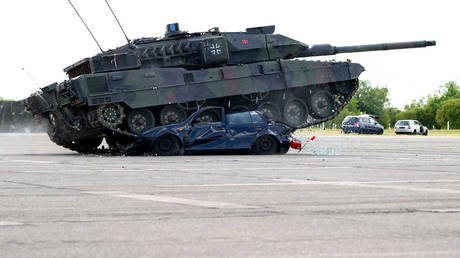
The joint intervention of Berlin and Paris to assume direct structural equity or tightened oversight in KNDS—the holding entity binding Germany’s Krauss-Maffei Wegmann (KMW) and France’s Nexter—is not merely an industrial reorganization. It is a state-driven response to a fundamental market failure in European defense procurement. For decades, the continental defense apparatus has operated on fragmented national supply chains, misaligned procurement timelines, and redundant research and development expenditures. By consolidating control over the continent’s largest armored vehicle manufacturer, France and Germany are attempting to force bilateral industrial integration to deliver the Main Ground Combat System (MGCS). However, this consolidation exposes a critical tension between sovereign industrial protectionism and the economies of scale required for modern high-intensity warfare.
The success of this consolidation depends on resolving three systemic friction points: export control asymmetry, industrial workshare imbalances, and divergent operational doctrines between the French Army and the German Bundeswehr. Expanding on this topic, you can also read: Inside the Israel Lebanon Peace Talks Crisis Nobody is Talking About.
The Strategic Trilemma of Joint Defense Procurement
Joint defense ventures systematically encounter an optimization problem where three competing objectives cannot be achieved simultaneously: national industrial sovereignty, cost-efficient scaling, and rapid deployment.
                       National Industrial Sovereignty
                                    /\
                                   /  \
                                  /    \
                                 /      \
                                /   X    \
                               /__________\
   Cost-Efficient Scaling                Rapid Deployment
When states prioritize national sovereignty, they mandate that local sub-contractors receive specific shares of production (juste retour). This fragmentises the supply chain, creates redundant production lines, and inflates unit costs, directly undermining cost-efficient scaling. Analysts at Al Jazeera have provided expertise on this situation.
The structural inefficiencies within KNDS stem directly from this trilemma. KMW brought the heritage of the Leopard 2 main battle tank, while Nexter brought the Leclerc and wheeled artillery systems like the CAESAR. Merging these entities into a Dutch-registered holding company was intended to bypass national rivalries, but it instead created a dual-headed architecture where engineering teams remained siloed by nationality and funded by distinct state budgets. Direct state intervention acts as an admission that market forces alone cannot reconcile the political requirements of Paris and Berlin.
The Operational Disconnect: Divergent Military Doctrines
The core technical challenge for a unified KNDS is that the French and German militaries design concepts around fundamentally different operational philosophies. These doctrines dictate opposing engineering requirements for weight, protection, mobility, and firepower.
The French Power Projection Model
The French military apparatus is structurally optimized for rapid expeditionary warfare, historically focused on overseas interventions, particularly in Africa. This requires high strategic mobility.
- Weight Constraints: Platforms must fit within the payload limits of tactical transport aircraft like the A400M.
- Propulsion and Propulsion Layout: A preference for wheeled platforms (such as the VBCI and Jaguar) over heavy tracked systems, optimizing for operational range and reduced logistical footprint on paved or unpaved roads over vast distances.
- Armor Philosophy: Reliance on active protection systems, speed, and low-profile signatures rather than heavy, passive composite armor layers.
The German Territorial Defense Model
The Bundeswehr is doctrinally configured for high-intensity, peer-to-peer conventional warfare on the European continent. This framework prioritizes heavy armored formations designed to absorb and repel mechanized assaults.
- Weight Profiles: Platforms frequently exceed 60 to 70 metric tons, maximizing passive and reactive armor suites.
- Propulsion Layout: Heavy tracked chassis designed to navigate the soft, muddy terrain of Eastern Europe, requiring high-horsepower diesel engines and robust torsion bar or hydropneumatic suspension systems.
- Firepower Requirements: Maximizing kinetic energy penetration at long range, driving the development of larger caliber smoothbore guns (moving from 120mm to 130mm or 140mm systems).
Attempting to engineer a single platform like the MGCS to satisfy both doctrines simultaneously introduces catastrophic design compromises. It risks creating a platform that is too heavy for French expeditionary deployments yet under-armored for German conventional defense requirements.
The Economics of Scale vs. The Juste Retour Bottleneck
The primary economic justification for state intervention in KNDS is the reduction of duplicative R&D costs. Developing a next-generation main battle tank requires billions of euros in upfront capital expenditures for electronics architectures, active defense systems, and unmanned turret automation. In an un-consolidated market, Germany and France would fund separate programs, splitting the addressable European market and doubling development costs.
However, the economic efficiency of this merger is structurally degraded by the political mechanism of juste retour (fair return). Under this framework, if France funds 50% of a program, French companies must receive 50% of the high-value engineering and manufacturing work.
This introduces distinct structural costs:
- Redundant Engineering Pipelines: Instead of assigning a sub-system (e.g., the main gun or the fire control system) to the most cost-competent laboratory, the component is carved up. For example, Rheinmetall and Nexter have historically clashed over the development of the MGCS main gun, with Germany pushing for its 130mm smoothbore and France advocating for the 140mm ASCALON system.
- Sub-optimal Supply Chain Scaling: Component manufacturing cannot be consolidated into a single high-volume facility. Production must be split across borders, reducing the ability to leverage purchasing power or optimize manufacturing learning curves.
- Integration Overheads: The friction of aligning different digital engineering environments, data schemas, and national security clearances creates bureaucratic overhead that extends development timelines by years.
The cost function of a joint program under strict juste retour constraints can be modeled as:
$$C_{total} = C_{base} + \sum_{i=1}^{n} \Delta C_{friction}(i) + C_{redundancy}$$
Where $C_{base}$ is the theoretical minimum cost of centralized development, $\Delta C_{friction}$ represents the efficiency losses introduced by cross-border coordination across $n$ work packages, and $C_{redundancy}$ represents the cost of maintaining duplicate assembly lines to satisfy national political mandates. State intervention must actively suppress these national sub-contracting demands to prevent the MGCS from becoming economically unviable before prototype finalization.
Regulatory and Export Control Asymmetry
Even if KNDS achieves industrial synchronization, its commercial viability remains throttled by fundamentally incompatible national export regimes. The commercial success of any major armored vehicle platform depends heavily on export markets outside of Europe to amortize the massive fixed costs of development.
| Metric / Dimension | German Export Regime (Bundessicherheitsrat) | French Export Regime (CIEEMG) |
|---|---|---|
| Regulatory Philosophy | Restrictive, values-based, subject to parliamentary and public oversight. | Pragmatic, geostrategic, state-interest driven. |
| Veto Mechanisms | Single-country veto over components integrated into third-party systems. | Executive-led approval process with minimal parliamentary friction. |
| Industrial Impact | Creates unpredictable delivery timelines; deters non-European buyers fearing spare parts embargoes. | Maximizes market access; positions the state as a reliable long-term security partner. |
The German export control architecture, governed by the Federal Security Council (Bundessicherheitsrat), operates under strict guidelines that restrict arms sales to non-NATO or non-EU states, particularly those involved in active conflicts or with volatile human rights records. France views defense exports as a core pillar of strategic autonomy and fiscal sustainability for its defense sector, adopting a highly pragmatic approach to non-European buyers.
This regulatory divergence creates an acute operational bottleneck for KNDS. If a vehicle engineered by KNDS utilizes a German-manufactured transmission (e.g., from Renk) or a German engine (e.g., from MTU), Berlin retains a legal veto over the export of the entire platform to third-party nations. This "German component veto" has historically frustrated French defense planners and international buyers.
To mitigate this, KNDS must either achieve complete de-Germanization of its French-produced systems (an expensive and redundant engineering effort) or force the adoption of a legally binding bilateral treaty. This treaty must dictate that neither state will oppose exports to third countries unless its direct national security interests are compromised. The structural integration of KNDS by both states indicates an effort to formalize this regulatory alignment at the executive level, removing the export volatility that threatens the program's long-term order book.
Technical Synchronization Challenges
The consolidation must also bridge deep technical gaps between the two industrial bases, specifically regarding software architectures,vetronics (vehicle electronics), and metallurgical standards.
Modern armored platforms are no longer defined solely by passive armor and kinetic firepower; they are mobile data centers. The MGCS relies heavily on collaborative combat frameworks—systems where drone feeds, satellite data, and ground sensor inputs are fused in real time to provide situational awareness.
[Drone Reconn Feed] ----\
[Satellite Telemetry] ---> [Central Vetronics Core (KNDS Platform)] ---> [Automated Countermeasures]
[Ground Sensor Input] --/
France utilizes the SCORPION combat information system, which emphasizes light, highly networked, and rapid collaborative combat updates. Germany’s digital initiatives for land systems (D-LBO) prioritize heavy encryption, high bandwidth resistance to electronic warfare, and deep integration with NATO-wide command structures.
Integrating these two distinct vetronics architectures requires building a unified middleware layer. If this layer is poorly designed, it introduces latency in target acquisition and threat detection, nullifying the advantages of next-generation active protection systems. Furthermore, standardizing manufacturing tolerances, welding protocols for advanced composite matrices, and supply chains for specialized rare-earth materials requires years of industrial alignment before a single standardized hull can be produced at scale.
Strategic Playbook for Continental Scale
To transform KNDS from a politically mandated compromise into a globally dominant defense asset, the joint state oversight must execute a rigorous, decoupled industrial strategy.
First, dismantle the traditional juste retour framework by implementing a "Center of Excellence" model. Rather than dividing individual component design 50/50, entire sub-systems must be assigned exclusively based on proven industrial superiority. Germany must retain complete architectural ownership of heavy tracked chassis engineering, high-output diesel propulsion systems, and advanced kinetic metallurgy. France must hold exclusive ownership of turret systems, optronics, precision guided munitions integration, and rapid-fire medium-caliber autoloader technologies.
Second, establish a legally binding, non-revocable export framework for all joint KNDS products. This must utilize a specific percentage threshold rule: any platform where a single nation's component share drops below 20% of the total bill of materials cannot be unilaterally vetoed for export by that nation. This insulation from shifting domestic political coalitions in Berlin or Paris is mandatory to assure global export clients of long-term parts availability and fleet maintenance security.
Third, enforce a strict separation between the platform's core physical architecture and its mission-specific software suites. The hull, power pack, and baseline vetronics bus must be standardized completely across both nations to maximize production volume and drive down unit costs. Operational doctrinal differences must be addressed strictly through modular mission kits—differentiated armor packages, weapon configurations, and localized software applications installed on top of the uniform baseline platform. This is the only engineering mechanism capable of resolving the expeditionary vs. territorial defense trilemma without degrading the underlying economics of the merger.


