The global technology landscape is undergoing a structural bifurcation driven by two distinct mechanisms: the institutionalization of artificial intelligence architecture and the legal reorganization of supply-chain protectionism. While market commentary often conflates these trends as a generalized trade dispute, they are governed by independent strategic logics. China is executing a structural play to institutionalize its open-weight AI models as the foundational infrastructure for the Global South, directly challenging the Western proprietary, market-driven paradigm. Concurrently, the United States is attempting to reconstruct its tariff framework via regulatory arbitrage following domestic judicial constraints.
Understanding this macroeconomic friction requires deconstructing the underlying friction between Beijing's multilateral institutional strategy and Washington's unilateral executive actions.
The Dual-Track AI Hegemony: Open-Weight Neutralization vs. Pax Silica
The architectural divide in artificial intelligence has graduated from an engineering challenge to a geopolitical strategy designed to dictate global technology standards. The competition isolates two fundamentally incompatible models of international technological distribution:
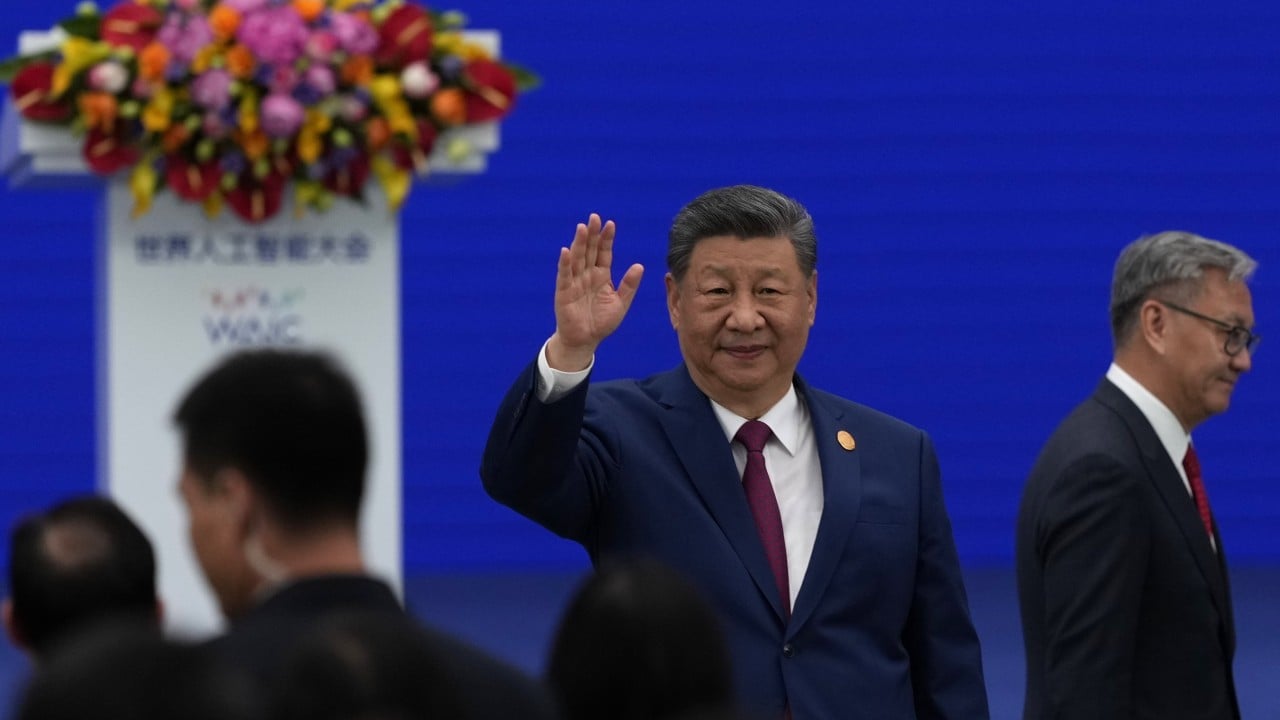
- The Chinese Open-Weight Institutionalization Model: Beijing is utilizing an open-weight strategy to capture market share in developing economies. By establishing the World Artificial Intelligence Cooperation Organization (WAICO) alongside 29 signatory nations, China is building an institutional counterweight to Western export controls. The objective is to anchor developing economies to Chinese technical ecosystems, bypassing American compute blockades through localized, resource-efficient architecture running on decentralized hardware.
- The American Proprietary Alignment Model (Pax Silica): The United States framework emphasizes exclusive, market-driven deployment restricted to a closed circle of strategic allies (including the United Kingdom, Japan, Australia, and India). This strategy relies on capital-intensive, frontier-class proprietary models protected by stringent hardware bottlenecks and strict export controls overseen by the National Defense Authorization Act (NDAA).
                [Global AI Structural Bifurcation]
                               |
        -----------------------------------------------
       |                                               |
[Beijing: WAICO Framework]                 [Washington: Pax Silica]
  - Strategy: Open-weight dispersion         - Strategy: Closed proprietary models
  - Target: Global South infrastructure      - Target: Developed market alliance
  - Moat: Low-cost compute integration       - Moat: Advanced frontier hardware (NDAA)
The systemic failure of the American model lies in its cost structure. As compute costs for frontier American models rise linearly with parameter scale, global enterprises face a severe capital barrier. Chinese tech firms have capitalized on this bottleneck by deploying lightweight, low-cost open-weight alternatives.
This creates an irreversible switching cost: once an emerging economy anchors its state infrastructure, meteorological forecasting, or public administration software to Chinese open-weight systems, the cost of migrating to proprietary Western APIs becomes prohibitively high. China's strategy effectively neutralizes Washington’s hardware-centric export controls by optimizing models to deliver high utility within the boundaries of legacy silicon infrastructure.
Tariff Arbitrage: The Shift from Emergency Powers to Section 301
The American approach to trade protectionism has encountered a major institutional hurdle. Following the Supreme Court ruling that invalidated the executive use of the International Emergency Economic Powers Act (IEEPA) to impose universal tariffs, the United States Treasury experienced an immediate reduction in tariff revenues, which dropped from an October peak of over $31.4 billion down to $22 billion by mid-year. This legal setback has forced a major rewrite of American trade policy.
To maintain its protectionist stance ahead of the July 24 expiry of temporary global levies, the executive branch is shifting to Section 301 of the Trade Act of 1974. The strategic mechanics of this transition expose a critical operational shift:
[IEEPA Executive Action]  --->  (Supreme Court Strike Down)  --->  [Section 301 Transition]
  - Broad universal taxes          - Revenue drops ~30%               - Country-specific targets
  - High judicial risk             - Immediate refund mandate         - Highly defensible legal architecture
While IEEPA functioned as a broad instrument targeting universal imports, Section 301 operates through country-specific investigations into "unjustifiable" or "discriminatory" trade practices. This shift carries two major consequences:
- Increased Legal Defensibility: Section 301 investigations fulfill mandatory statutory notice-and-comment periods, shielding subsequent tariffs from the administrative law challenges that dismantled the previous universal levies.
- Granular Supply-Chain Targeted Action: Rather than blanket import restrictions, the administration is deploying targeted tariffs (such as 10% on 16 nations and 12.5% on 44 nations) to forcibly reshape supply chains away from Chinese industrial inputs without triggering a consumer price index shock.
The core limitation of this strategy is its vulnerability to trade transshipment. While Section 301 restricts direct imports from targeted nations, it fails to stop Chinese industrial entities from routing intermediate goods through third-party logistics hubs in Southeast Asia or Latin America, merely lengthening the supply chain rather than decoupling it.
The Conflict Between Domestic Rhetoric and Geopolitical Realities
A deep divide has emerged between public political rhetoric and actual policy execution. While public statements focus heavily on allegations of foreign election interference and economic misconduct, actual state action remains highly cautious. This hesitation stems from two main systemic factors:
- Critical Mineral Vulnerability: The American industrial base remains heavily dependent on Chinese processing monopolies for rare earths and critical minerals needed for defense manufacturing and advanced electronics. Enforcing aggressive trade penalties risks triggering a total export halt from Beijing, which could freeze domestic high-tech manufacturing pipelines.
- The Inflationary Threat of a Double-Front Economic Conflict: With ongoing disruptions in energy markets and escalating conflicts in the Middle East driving up baseline operating costs, a full-scale trade war with China would create an immediate stagflationary threat ahead of critical domestic midterm elections.
Consequently, the administration is pursuing a dual policy: loud, aggressive rhetoric for domestic consumption paired with quiet, flexible enforcement behind the scenes. This approach aims to preserve the current trade truce, allowing both powers to continue their technological competition without triggering a broader systemic economic breakdown.
Strategic Imperatives for Enterprise Allocators
Corporate leadership must abandon the assumption of a unified global technology market. The structural divide between Western proprietary tech networks and Eastern open-weight infrastructure is now a permanent feature of the international economy.
Organizations operating across multinational boundaries must immediately design multi-cloud, model-agnostic software architectures. Relying exclusively on Western APIs introduces severe compliance and operational risks in jurisdictions integrated into Beijing's WAICO network. Conversely, integration with Chinese open-weight frameworks risks triggering strict penalties under expanding Western export control regimes like the NDAA.
On the trade front, the transition to Section 301 tariffs means businesses must move away from simple geographic diversification. Supply chain resilience now requires a deep, forensic auditing of all tier-2 and tier-3 component origins to ensure compliance and insulate production from sudden, targeted regulatory interventions.