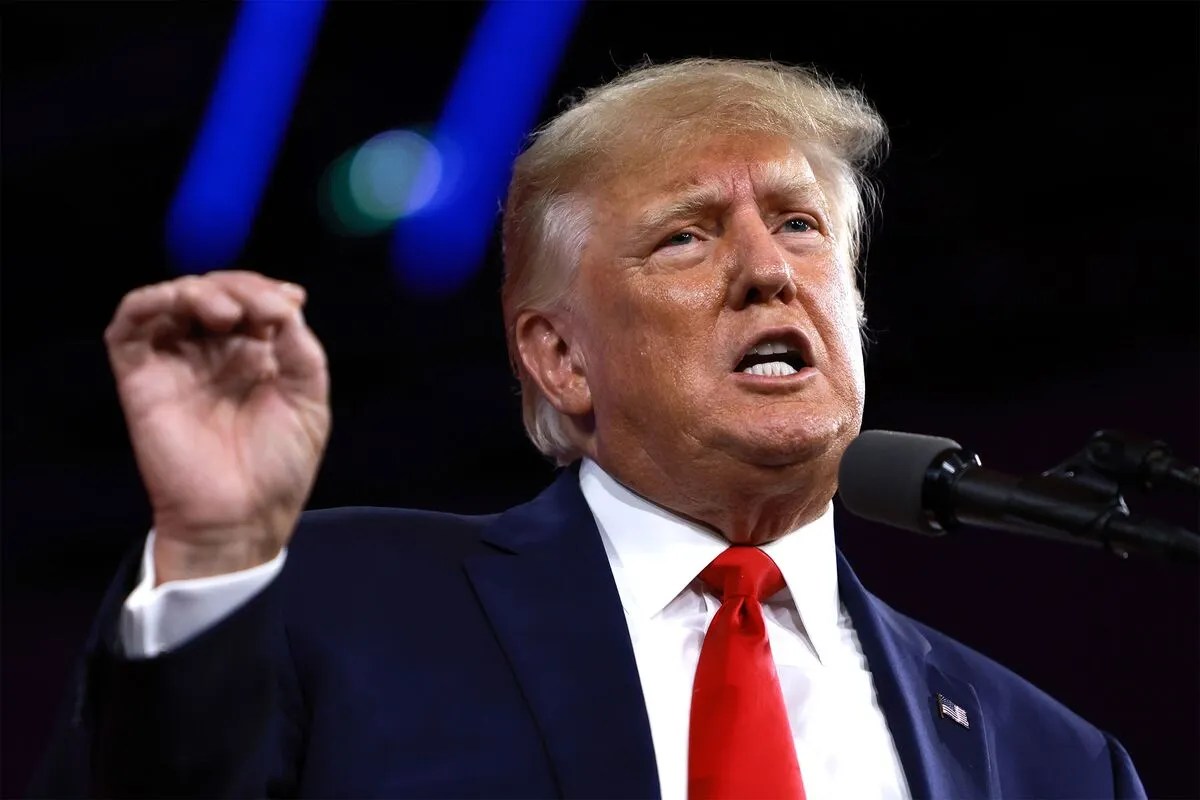
Donald Trump’s recent assertion that the global order would have "shattered into pieces" absent his presidency is more than political hyperbole; it is a claim based on the doctrine of unpredictable hegemony. By framing his administration as the sole structural glue preventing systemic collapse—specifically regarding the Iranian nuclear threat and Middle Eastern stability—Trump highlights a fundamental tension between institutional diplomacy and personalized deterrence. To evaluate this claim requires moving past the rhetoric to examine the actual mechanisms of regional containment and the specific economic-military levers applied to the Iranian state.
The Architecture of Maximum Pressure
The core of the argument rests on the efficacy of the Maximum Pressure Campaign, a strategy designed to collapse the Iranian economy to the point where the state’s ability to fund regional proxies becomes physically impossible. This was not a passive diplomatic stance but a targeted economic strangulation. The logic follows a clear cause-and-effect chain:
- Revenue Depletion: By revoking the JCPOA (Joint Comprehensive Plan of Action) waivers, the administration sought to bring Iranian oil exports to zero.
- Proxy Defunding: Reduced state revenue leads to a proportional decrease in the liquidity available for the "Axis of Resistance," including Hezbollah, Hamas, and various militias in Iraq and Yemen.
- Domestic Opportunity Cost: High inflation and currency devaluation within Iran force the leadership to prioritize internal stability over external expansionism.
Trump’s claim suggests that without this specific pressure, the financial "oxygen" available to these groups would have triggered a multi-front regional war. The competitor’s narrative focuses on the sensationalism of the "shattered world" quote, but the underlying analytical reality is the Economic Attrition Model. If Iran’s central bank is isolated from the SWIFT system and its primary export is blocked, its capacity to project power is objectively diminished, regardless of the diplomatic optics.
Strategic Ambiguity as a Deterrence Variable
A secondary pillar of this geopolitical stance is the rejection of the Rational Actor Model. Traditional diplomacy assumes that all parties will act in their own long-term economic interest. Trump’s approach introduced a high degree of Strategic Volatility. In game theory, an opponent who is perceived as irrational or willing to take disproportionate risks—such as the targeted elimination of high-ranking military officials—forces competitors to recalculate their risk-reward ratios.
The elimination of Qasem Soleimani serves as the primary case study for this mechanism. While critics argued it would ignite a full-scale war, the deterrence logic suggests it established a "red line" that had become blurred under previous administrations. This creates a deterrence premium; the opponent must factor in the possibility of an extreme response to even minor provocations, leading to a state of forced restraint.
The Iranian Nuclear Threshold
The specific claim regarding Iran’s nuclear capabilities under his potential second term vs. the current status quo hinges on the Breakout Time variable. Breakout time is the duration required to produce enough weapons-grade uranium (WGU) for a single nuclear explosive.
- Under the JCPOA: Breakout time was estimated at approximately 12 months.
- Post-Withdrawal and Current Status: Estimates have shrunk significantly, with some assessments suggesting a matter of weeks or days for the enrichment of 60% uranium to 90% (weapons-grade).
Trump’s logic posits that while the technical breakout time has shortened, the Political Will to Weaponize is suppressed by the threat of total kinetic intervention. The "shattered world" theory implies that a return to formal agreements provides Iran with a legal pathway to industrial-scale enrichment, whereas his model relies on a permanent state of existential threat against the regime to prevent the final leap to weaponization.
Analyzing the Counter-Factual of Global Fragmentation
To "shatter into pieces" is a vague descriptor for Systemic Multipolarity. The argument presented is that the United States, under a non-interventionist but highly aggressive economic posture, maintained a unipolar stability. When the U.S. shifts toward a more collaborative, multilateral approach, it creates power vacuums.
These vacuums are filled by:
- Regional Hegemons: Iran in the Middle East, seeking a land bridge to the Mediterranean.
- Global Revisionists: Russia and China, who interpret Western diplomatic overtures as a lack of resolve.
The structural failure of the competitor’s analysis is the omission of the Abraham Accords as a counter-weight. The Accords represent a shift from "peace through mediation" to "peace through shared threat perception." By facilitating the normalization of relations between Israel and several Arab nations, the administration created a self-sustaining regional security architecture that did not rely solely on American troop presence. This move sought to externalize the cost of containing Iran to regional players who have the most to lose.
The Limitation of Personalized Hegemony
The primary risk of the Trumpian model is its Lack of Institutional Durability. Because the strategy relies heavily on the personal "brand" and perceived volatility of the leader, it does not easily survive a transition of power. Diplomatic frameworks, however flawed, offer a level of predictability that global markets and military alliances use to plan long-term investments.
When deterrence is tied to a single individual's rhetoric, the global order becomes binary: total compliance or total defiance. The current geopolitical friction is the result of the international community attempting to transition back to institutionalism while the "Maximum Pressure" scars remain on the Iranian economy. This creates a Transition Lag, where neither the deterrent of the previous administration nor the diplomacy of the current one is fully effective.
The Cost Function of Global Stability
Every geopolitical strategy carries an inherent cost. The "America First" doctrine minimizes direct American fiscal and human expenditure on foreign conflicts but increases the Volatility Tax on global trade and alliances.
- The Diplomacy Cost: Higher risk of nuclear proliferation over a 20-year horizon, but lower immediate risk of kinetic conflict.
- The Deterrence Cost: Lower risk of proliferation in the short term due to fear of regime change, but a constant, high-level risk of accidental escalation.
Trump’s assertion that the world would have broken apart assumes that the "Volatility Tax" is a price worth paying to avoid the "Diplomacy Cost." From a data-driven perspective, the period of 2017-2020 saw a decrease in new foreign interventions by the U.S. but an increase in the intensity of economic warfare.
The strategic play for any Western power moving forward is not a binary choice between these two. It is the integration of Credible Kinetic Threat with Economic Integration. The failure to communicate a clear, unwavering consequence for Iranian enrichment beyond 60% has effectively neutralized the diplomatic leverage gained from previous sanctions. To prevent the "shattering" of the regional order, the focus must shift from the rhetoric of the leader to the Automated Escalation of consequences. This involves setting hard, non-negotiable triggers for the re-imposition of secondary sanctions and the deployment of neutralizing military assets, ensuring that deterrence is a function of policy, not personality.


