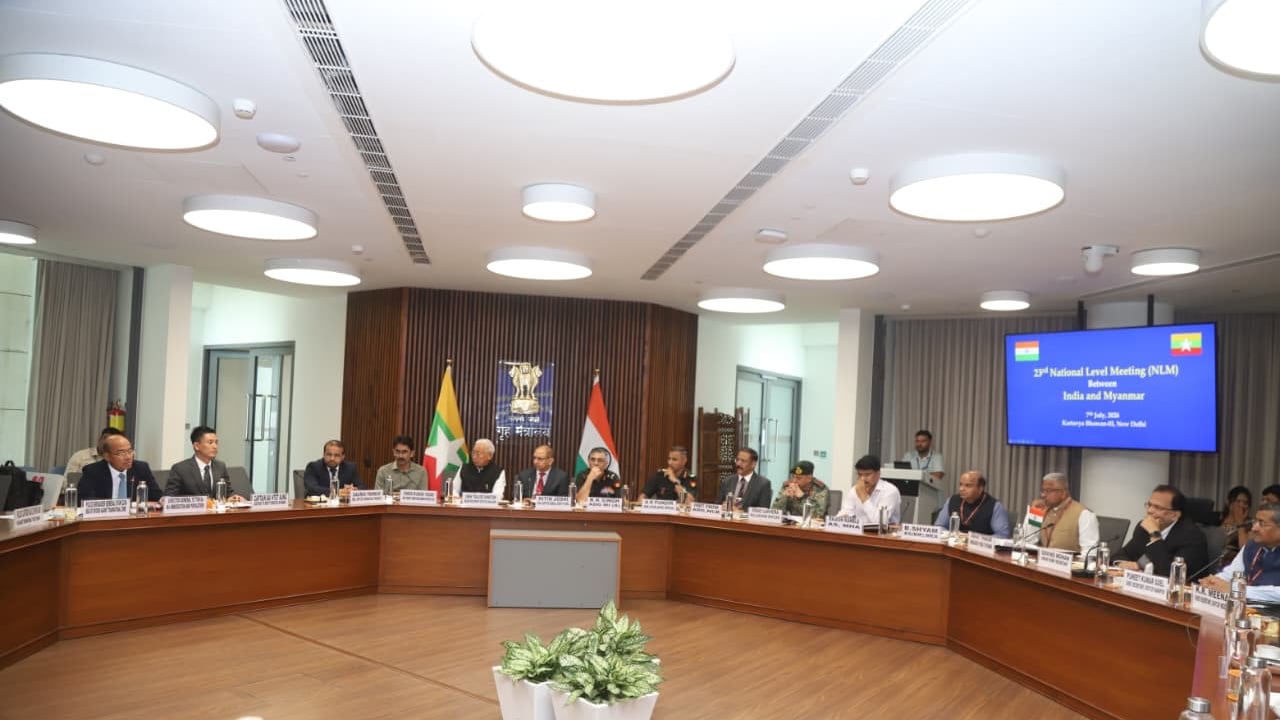
The diplomatic assurances exchanged between New Delhi and Naypyidaw regarding the non-use of sovereign territory for hostile activities represent a standard stabilization protocol, yet they obscure a complex calculus of asymmetric warfare, governance deficits, and competing strategic priorities. Diplomatic declarations of intent rarely align with operational execution when the state actors involved face profound internal structural constraints. To evaluate the true equilibrium of the India-Myanmar border security framework, analysts must look past rhetorical commitments and dissect the operational variables: rebel faction economics, geography-induced enforcement limitations, and the institutional constraints of the Myanmar military junta, formally known as the State Administration Council (SAC).
The primary bottleneck in securing the 1,643-kilometer shared border is not a lack of political intent, but rather a profound structural asymmetry in how both nations define and experience security threats along their periphery. While New Delhi views the border through the lens of containment—preventing insurgent safe havens from destabilizing its northeastern states—Naypyidaw views the region through the lens of existential regime survival, prioritizing central theater operations against pro-democracy forces and ethnic armed organizations (EAOs) over policing external cross-border actors.
The Triad of Border Insecurity Forces
To understand the persistent instability along the India-Myanmar frontier, the security ecosystem can be broken down into three distinct operational variables.
The Fractional Sovereignty Vacuum
The Myanmar state does not exercise a monopoly on the legitimate use of force within its borderlands. Large swathes of Sagaing Region and Chin State, which border India's Mizoram and Manipur states, are governed by a patchwork of EAOs and People's Defence Forces (PDFs) opposed to the military junta. In other sectors, remnants of older insurgent groups targeting India—such as factions of the United Liberation Front of Asom (ULFA), the National Socialist Council of Nagaland (NSCN-K), and various Meitei insurgent groups—exploit this governance vacuum.
When Naypyidaw guarantees that its soil will not be used against India, it assumes an administrative capacity that it currently lacks on the ground. The SAC cannot enforce border sanctity in areas where its physical presence is confined to isolated, heavily fortified bases surrounded by hostile local populations.
Asymmetric Insurgent Arbitrage
Insurgent groups operating across the international border exploit a structural arbitrage opportunity created by differing legal jurisdictions, terrain conditions, and enforcement mandates. The Free Movement Regime (FMR), which traditionally allowed tribes residing along the border to travel up to 16 kilometers into either country without visas, historically provided structural cover for illicit movement.
[Insurgent Safe Haven in Myanmar]
       │
       ▼ (Exploitation of Ungoverned Spaces & Dense Canopy)
[International Border / Disrupted Free Movement Regime Zone]
       │
       ▼ (Asymmetric Strike / Supply Line Infiltration)
[Target Zone in Northeast India]
Although India has moved to suspend the FMR and initiate border fencing, the physical execution of this infrastructure project faces severe terrain penalties. The cost of patrolling a highly fragmented, mountainous, and densely forested border creates a permanent advantage for small, agile insurgent units over conventional state forces.
The Transactional Economy of Unstable Borders
The financial viability of insurgent networks depends on a self-sustaining ecosystem of cross-border smuggling, arms proliferation, and narcotics trafficking stemming from the Golden Triangle. The collapse of the formal economy in Myanmar post-2021 accelerated the informal and illicit trade sectors. Rebel factions and criminal syndicates use the proceeds from these illicit supply chains to procure advanced weaponry, which then flows back into the border regions. This economic reality means that border security cannot be achieved through military posturing alone; it requires dismantling the capital structures that fund these non-state actors.
The Strategic Cost Function of the State Administration Council
The structural limitations of Myanmar's assurances become evident when analyzing the SAC's military resource allocation through a basic optimization framework. Faced with simultaneous insurgent offensives on multiple fronts—specifically in Shan, Rakhine, and Karen states—the junta operates under severe manpower shortages and logistical bottlenecks.
The SAC’s resource allocation strategy follows a strict hierarchical ranking:
- Preservation of the core command structure and major urban centers (Naypyidaw, Yangon, Mandalay).
- Protection of critical logistics lines and economic corridors connecting to major trading partners.
- Containment of major ethnic armies capable of conventional territorial control.
- Border policing and fulfillment of bilateral security guarantees with neighboring states.
Because border policing ranks at the bottom of the operational priority list, the SAC lacks the surplus combat power required to clear out anti-India insurgent camps in Sagaing or Chin State. In certain tactical scenarios, the junta has historically tolerated or utilized localized militias and border guard forces that engage in illicit cross-border activity, provided these groups do not align with the broader anti-junta resistance. This creates a moral hazard where local commanders may actively ignore or collaborate with anti-India insurgent factions to secure tactical neutrality or intelligence against domestic enemies.
Infrastructure Impediments and the Kaladan Dilemma
The security calculations of New Delhi are further complicated by its strategic infrastructure investments within Myanmar, most notably the Kaladan Multi-Modal Transit Transport Project. Designed to connect India’s eastern ports with the landlocked northeastern states via the Sittwe port in Rakhine State and the Paletwa inland water terminal in Chin State, the project serves as an essential economic counterweight.
The operational reality of the Kaladan project has been severely compromised by the shifting balance of power on the ground. The Arakan Army (AA), an ethnic insurgent force fighting the Myanmar military, has seized control of significant territory along the Kaladan river transport corridor, including key towns near the Indian border.
This territorial shift forces a fundamental recalculation for Indian policymakers:
- The Diplomatic Dilemma: Continuing to negotiate exclusively with the central military junta in Naypyidaw yields diminishing returns when the junta no longer controls the geography through which India’s strategic infrastructure passes.
- The Operational Workaround: To safeguard its infrastructure investments and ensure border stability, India must engage in localized, non-formal communication channels with the ethnic armed groups holding functional territorial control along its periphery.
- The Security Risk: Engaging with these non-state actors risks alienating the formal government in Naypyidaw, potentially driving the junta closer to competing regional powers, such as Beijing, which maintains deep economic leverages in the region through the China-Myanmar Economic Corridor (CMEC).
The Mechanics of Effective Border Management
Given that verbal assurances are structurally decoupled from operational reality, a data-driven border management strategy must rely on verifiable indicators rather than diplomatic communiqués. An objective assessment of border security requires tracking specific quantitative and structural variables.
Weaponry Proliferation Metrics
The sophistication of small arms seized in India’s northeast serves as a direct indicator of border enforcement efficacy in Myanmar. A shift from rudimentary improvised firearms to factory-grade assault rifles, rocket-propelled grenades (RPGs), and commercial drones modified for kinetic strikes implies that cross-border supply lines remain highly functional and unpoliced.
Troop Deployment Density
The real measure of Naypyidaw’s commitment is the physical density of its battalions along the western border. If the SAC maintains only token administrative presences or low-tier regional capabilities in Sagaing and Chin State while concentrating its elite light infantry divisions elsewhere, the diplomatic pledge of "not allowing territory to be used against India" remains operationally meaningless.
Intelligence Synthesis and Actionable Timelines
Real-time coordination is the true test of bilateral security agreements. If India shares actionable satellite imagery or electronic intelligence pinpointing an insurgent camp inside Myanmar territory, the latency period between the sharing of that data and the execution of a kinetic disruption by Myanmar forces offers a clear metric of institutional willingness and operational capacity. Historically, this latency has been long enough to allow insurgent cells to relocate, pointing to either structural inefficiencies or tactical leaks within the chain of command.
Strategic Realignment Scenarios
The border security framework cannot remain static in the face of Myanmar's ongoing internal fragmentation. Moving forward, the strategic equilibrium will likely evolve along one of three distinct paths.
Scenario A: Fragmented Localized Engagement
India increases its reliance on decentralized, sub-national engagement strategies. While maintaining formal diplomatic ties with Naypyidaw, Indian security agencies establish quiet, tactical understandings with local actors—such as the Chin National Army or various local PDFs—to deny anti-India insurgent groups a safe haven. This approach prioritizes immediate border stability over diplomatic consistency but carries the risk of unpredictable policy blowback if the central authority in Myanmar undergoes a sudden transformation.
Scenario B: Accelerated Hard Border Enforcement
Recognizing the incapacity of the Myanmar state to police its periphery, India accelerates its unilateral border defense initiatives. This involves the complete physical fencing of the border, the elimination of the Free Movement Regime, the deployment of advanced electronic surveillance arrays (including thermal imaging and unattended ground sensors), and an increased operational footprint for specialized border guarding forces like the Assam Rifles. This strategy shifts the burden of security entirely onto India's domestic apparatus, accepting high capital expenditure in exchange for insulation from Myanmar’s internal instability.
Scenario C: Cooperative Interdiction Frameworks
In a highly optimistic scenario, the military junta stabilizes its core fronts sufficiently to conduct coordinated, simultaneous operations along the border with Indian security forces—akin to past iterations of Operation Sunrise. Under this framework, India provides intelligence, logistical support, or non-lethal equipment, while Myanmar forces execute the kinetic operations within their sovereign territory. The viability of this scenario is low given the current overextension of the SAC's forces across the country's central dry zone.
The Tactical Execution Path
The optimal path forward for regional security requires abandoning the expectation that top-down diplomatic assurances from a embattled regime will translate into localized security outcomes. India's border strategy must pivot toward a defensive model that treats the border as an unpoliced zone for the foreseeable future.
The primary action item involves prioritizing the completion of the smart fencing infrastructure along high-risk infiltration sectors in Manipur and Mizoram. This physical barrier must be supplemented by a unified command structure that integrates state police intelligence with central paramilitary forces to neutralize insurgent groups the moment they attempt to bridge the gap between their unpoliced sanctuaries in Myanmar and the Indian domestic market. Hoping for Naypyidaw to secure the frontier ignores the harsh reality of their domestic survival calculations; securing the line requires unilateral, structural fortification at the point of entry.