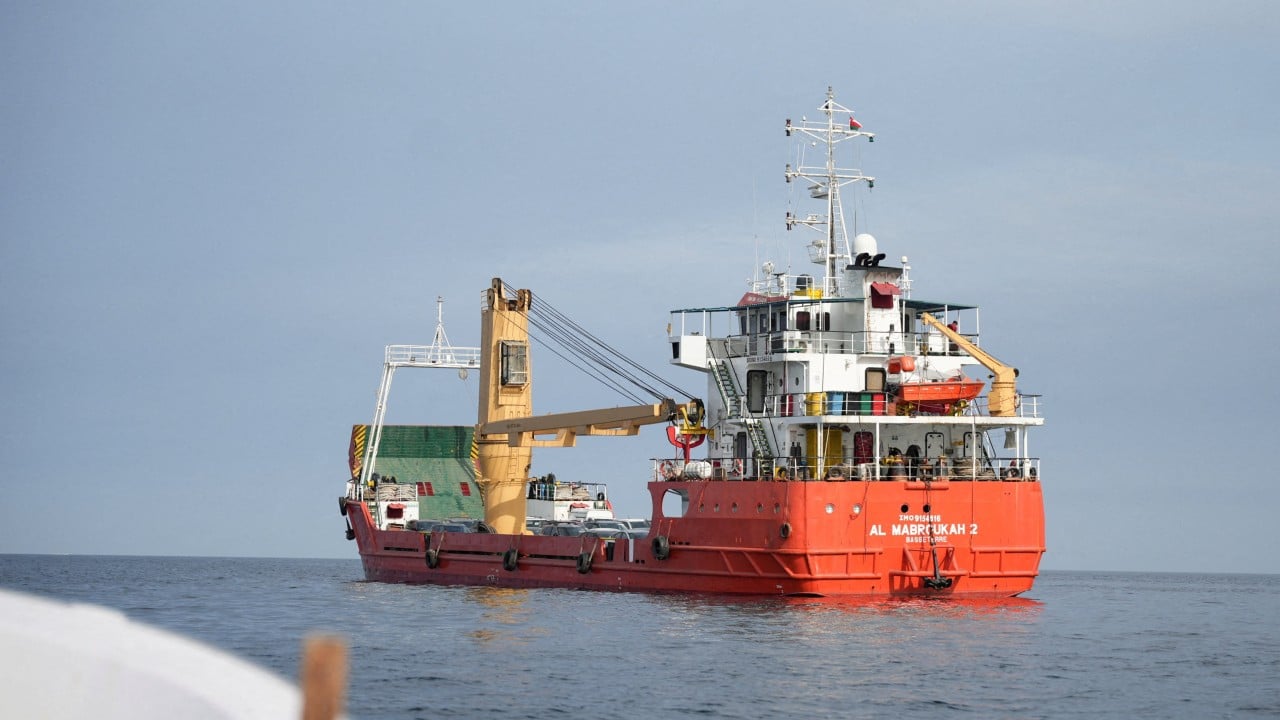
The security of the Strait of Hormuz is not a matter of diplomatic sentiment but a function of volumetric flow and kinetic risk mitigation. When France and the United Kingdom signal a lead role in a "defensive" force, they are addressing a specific structural vulnerability in global energy supply chains: the 21 million barrels of oil that transit this 21-mile-wide choke point daily. This initiative serves to decouple European energy security from total reliance on the United States’ regional posture, creating a tiered security architecture designed to deter Iranian gray-zone operations without triggering a full-scale escalatory cycle.
The Triad of Transit Risk
The threat profile in the Strait of Hormuz is categorized into three distinct operational risks. A defensive force must be calibrated to address each without over-extending its mandate: If you found value in this piece, you might want to check out: this related article.
- Asymmetric Interdiction: The use of Fast Inshore Attack Craft (FIAC) and naval mines to disrupt commercial shipping. This is a low-cost, high-impact strategy used by the IRGC to signal leverage.
- State-Sanctioned Seizure: The legalistic detention of vessels under the guise of environmental or regulatory violations. This requires a legal-defense framework as much as a kinetic one.
- Kinetic Escalation: Targeted missile or drone strikes against tankers. This is the highest level of risk, requiring sophisticated Integrated Air and Missile Defense (IAMD) capabilities.
The Anglo-French initiative operates on the premise that a visible, multilateral presence raises the political cost of the first two categories while providing a sensor network to mitigate the third.
Operational Logic of the European Maritime Awareness Mission
By leading this mission, Paris and London are executing a "de-risking" strategy. Unlike the U.S.-led International Maritime Security Construct (IMSC), which Iran views as overtly hostile and part of a "maximum pressure" campaign, a European-centric force attempts to maintain a "de-escalatory" footprint. The goal is to provide Mission-Driven Presence—a strategy where the mere location of high-end naval assets changes the cost-benefit analysis for regional actors looking to disrupt trade. For another look on this development, check out the latest update from The Guardian.
The mechanical advantage of a European lead is the diplomatic space it affords. It allows for "de-conflicted" patrolling. If a French frigate is escorting a tanker, the threshold for an Iranian seizure increases because such an action would directly affront a European power with which Iran still seeks to maintain some level of economic or JCPOA-related dialogue.
The Naval Force Composition as a Deterrent Function
A credible defensive force in the Strait requires a specific mix of naval capabilities. It is not enough to simply have "ships" in the water; the fleet must be specialized for the unique littoral environment of the Persian Gulf.
- Lush Littoral Combatants: Smaller, agile vessels like the UK’s Type 23 frigates or French La Fayette-class frigates are optimized for these waters. They provide the necessary electronic warfare suites to counter drone swarms.
- Aegis-Equivalent Air Defense: Providing a "bubble" over commercial convoys requires high-end radar systems capable of tracking low-flying anti-ship cruise missiles.
- Mine Countermeasures (MCM): The most persistent threat in the Strait is the naval mine. The UK’s Royal Navy maintains some of the world’s most advanced MCM vessels in Bahrain. Their inclusion is a prerequisite for any "defensive" claim, as it focuses on keeping sea lanes open rather than projecting power inland.
The Economic Cost Function of Maritime Escorts
Naval intervention is often analyzed through a military lens, but its primary driver is the reduction of the Maritime Risk Premium. When tension rises in the Strait, insurance underwriters—primarily through Lloyd’s of London—increase the "War Risk" premiums for any vessel entering the Gulf.
If the cost of insurance rises by 10-15%, that cost is immediately passed down the supply chain, manifesting as higher landed costs for crude oil in European and Asian refineries. The presence of a Franco-British naval force acts as a market stabilizer. By providing physical security, they effectively subsidize the global economy by lowering the probability of total transit stoppage, which prevents insurance rates from reaching prohibitive levels that would effectively blockade the Gulf via financial friction rather than physical force.
The Fragility of Multilateralism in Narrow Waters
The primary bottleneck for this initiative is not tactical, but political-legal. International law, specifically the United Kingdom’s position on the UN Convention on the Law of the Sea (UNCLOS), governs "transit passage" through international straits. Iran, however, adheres to a more restrictive interpretation of "innocent passage."
This creates a legal gray zone where the "defensive" force must operate. A misalignment in Rules of Engagement (ROE) between French and British commanders could lead to a catastrophic failure during a high-stress encounter with the IRGC. If one nation’s ROE permits firing on a drone while the other’s requires a confirmed kinetic strike on the hull, the defensive screen collapses. The success of this mission depends entirely on the harmonization of these engagement triggers.
Strategic Shift from Hegemony to Burden Sharing
The United States has historically been the guarantor of Gulf security. However, the shift toward the Indo-Pacific has created a security vacuum. This Anglo-French initiative represents a transition from a U.S. hegemony to a "Regional Security Architecture" where middle powers manage their own specific interests.
This shift is not without risk. It signals to regional players that the U.S. umbrella is thinning. To compensate, the UK and France must demonstrate that their combined naval power is not merely symbolic but capable of sustained "High-Intensity" operations. This requires a logistics tail—ports in Oman, the UAE, and Bahrain—that can support prolonged deployments without returning to European bases.
The structural reality of the Strait of Hormuz is that it cannot be "solved"; it can only be "managed." The French and British intervention is a recognition that the cost of management is lower than the cost of a global energy shock.
Kinetic Triggers and De-escalation Ladders
To prevent this mission from sliding into a broader conflict, the force must utilize a clearly defined de-escalation ladder. This involves:
- Non-Kinetic Electronic Interference: Jamming the command-and-control links of Iranian FIACs or drones.
- Visible Positioning: Placing a destroyer between a commercial tanker and an approaching IRGC vessel, forcing the aggressor to choose between retreating or hitting a sovereign naval vessel.
- Proportional Response: Utilizing directed energy or small-arms fire to disable engines rather than sinking vessels.
By adhering to these rungs, the European force maintains the "defensive" label, which is critical for maintaining domestic political support in London and Paris and for preventing a total rupture in diplomatic channels with Tehran.
The Bottleneck of Naval Capacity
The fundamental constraint of this strategy is the "hull count." Both the Royal Navy and the French Navy are facing long-term challenges regarding fleet size and maintenance cycles. To lead a persistent force in the Strait of Hormuz, they must commit a significant percentage of their available surface fleet. This creates a trade-off: security in the Persian Gulf comes at the expense of presence in the Mediterranean or the North Atlantic.
This scarcity makes the mission vulnerable to "exhaustion tactics." If Iran maintains a high-frequency, low-intensity harassment campaign over several months, it can force a rotation of ships that the European navies may struggle to sustain without degrading their readiness in other theaters.
The strategic play here is the establishment of a Maritime Coordination Center that integrates local GCC (Gulf Cooperation Council) navies. The Anglo-French lead must transition from "doing" the security to "hosting" the security. By providing the high-end command and control (C2) and the political cover of a UN-aligned defensive mandate, they can leverage the smaller, numerous patrol craft of the UAE and Saudi Arabia to provide the "bulk" of the presence, while the European frigates provide the "teeth" and sensor depth.
Regional Alignment and the Omani Corridor
The Sultanate of Oman remains the most critical silent partner in this architecture. Controlling the southern bank of the Strait, Oman’s cooperation is necessary for any sustainable defensive force. The Franco-British mission must prioritize deepening the naval intelligence-sharing agreement with Muscat to ensure that the "defensive" force has eyes on both sides of the shipping lanes. Without Omani buy-in, the force is operating in a 180-degree vacuum, significantly increasing the risk of being flanked by IRGC units operating out of hidden littoral bases along the Iranian coastline.
The immediate requirement for the UK and France is the publication of a joint "Maritime Security Protocol" that defines the exact triggers for intervention. This protocol must be shared with shipping conglomerates to restore confidence and lower insurance premiums. The mission's success will not be measured by enemy vessels sunk, but by the stability of the WTI and Brent crude price indices and the absence of "War Risk" surcharges on the global market.