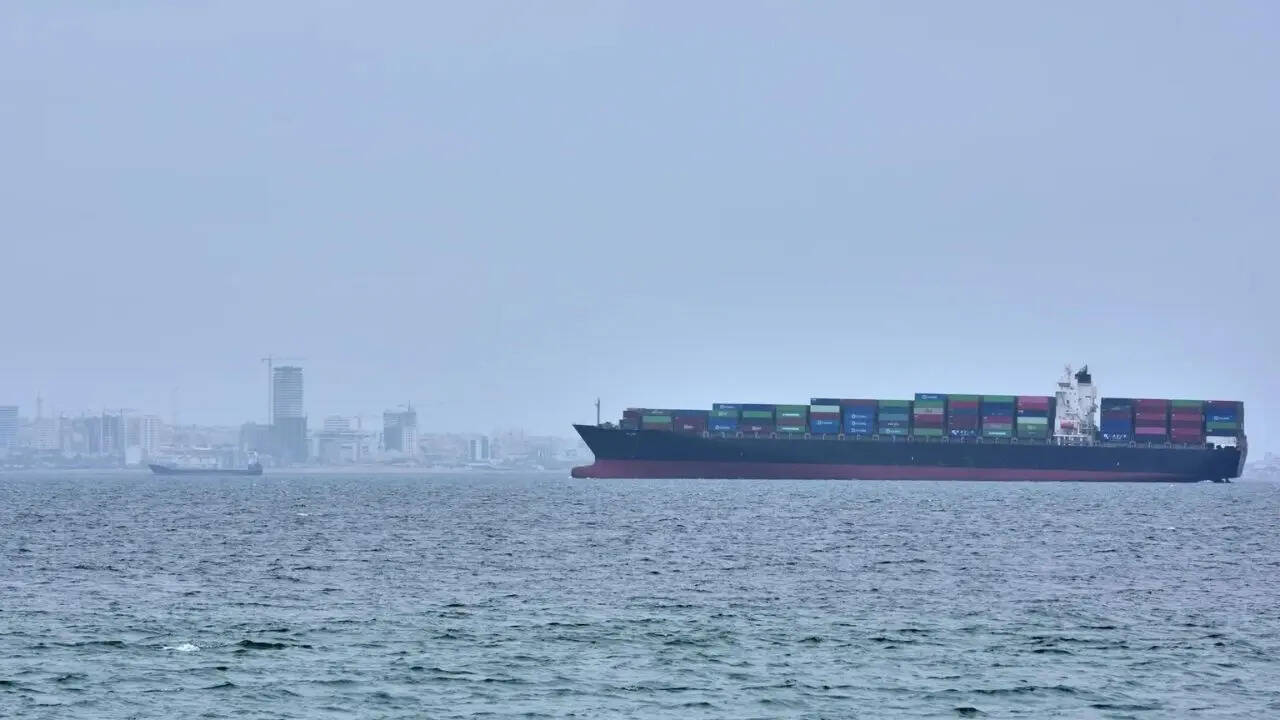
The sea does not care about policy. In the narrow, salt-choked corridor of the Strait of Hormuz, the water is a bruised shade of turquoise, churned constantly by the propellers of the world’s energy supply. It is a place of immense physical pressure. On one side, the jagged coast of Iran; on the other, the strategic reach of the Arabian Peninsula.
Deep in the belly of a rusting Aframax tanker, the heat is a physical weight. Metal surfaces hum with a low-frequency vibration that settles in your teeth. This is where the abstract concept of a "blockade" becomes a sweating, grinding reality. For the men operating these vessels, the high-stakes chess match between Washington and Tehran isn't played on maps. It is played in the darkness of the engine room and the frantic clicking of a transponder being switched off.
We are told that sanctions work like a physical wall. The narrative suggests that if you squeeze the valve tight enough, the flow stops. But liquid has a way of finding the cracks.
The Vanishing Act
Imagine a vessel—let's call her the Midnight Sun—gliding toward the mouth of the Persian Gulf. On global tracking monitors, she is a bright, identifiable blip. She has a name, a flag, and a clear destination. Then, as she nears the invisible line of restricted waters, the blip blinks. It stutters. It vanishes.
This is "going dark."
It is the first step in a dance that has turned the Strait of Hormuz into a theater of ghosts. Over the past year, while the world watched official press briefings about the "success" of the Hormuz blockade, thirty-four Iran-linked tankers performed this exact disappearing act. They didn't just hide; they thrived. These vessels moved nearly $900 million worth of oil right through the teeth of the most sophisticated surveillance net on the planet.
How? By understanding that digital systems are only as honest as the people who maintain them.
The crews on these ships aren't just sailors; they are masters of deception. They spoof AIS (Automatic Identification System) signals, making a ship appear to be in the middle of the Indian Ocean when it is actually docking at an Iranian terminal. They paint over names. They swap flags like dirty shirts, hopping from the registry of one small island nation to another in a desperate game of bureaucratic leapfrog.
The Architecture of the Shadow Market
To understand why a $900 million leak exists in a "successful" blockade, you have to stop looking at the ships and start looking at the money.
The global oil market is often described as a transparent exchange. In reality, it is a sprawling, chaotic bazaar. When the United States tightened the screws on Iranian exports, it didn't eliminate the demand for cheap crude. It simply drove that demand underground, creating a premium for those willing to take the risk.
Think of it as a plumbing problem. If you clog the main pipe but the pressure behind the pump remains constant, the water will eventually burst through the seals.
The "ghost fleet" represents those broken seals. These are often older vessels, ships that should have been sent to the scrap yards of Alang or Gadani years ago. They are the outcasts of the maritime world, operating without standard insurance and under the radar of major banks.
But for a buyer in a market hungry for discounted energy, a ghost ship’s cargo smells exactly like the legal stuff. Crude oil is the ultimate fungible commodity. Once it is blended in a storage tank in a third-party port or transferred ship-to-ship in the middle of the night, its origin story becomes a work of fiction.
Consider the "Ship-to-Ship" (STS) transfer. It is a delicate, dangerous maneuver. Two massive tankers pull alongside each other in international waters. Hoses as thick as a man's torso are slung between them. In the dead of night, thousands of tons of "sanctioned" oil flow from the ghost ship into the hold of a "clean" vessel.
By sunrise, the ghost ship is empty and heading back for another load. The clean vessel sails toward a legitimate refinery, its paperwork claiming the oil originated from a non-sanctioned source. The paper trail is a masterpiece of obfuscation, involving shell companies in Panama, bank accounts in Dubai, and fixers in Singapore.
The Human Cost of the Leak
We talk about $900 million as if it’s a scoreboard. We debate whether the policy is a "success" based on the percentage of revenue denied to a regime.
But there is a different kind of math happening on the water.
When you force a massive industry into the shadows, you strip away the safety nets. The ghost fleet is a ticking ecological time bomb. These vessels are frequently under-maintained and over-leveraged. Because they cannot access traditional P&I (Protection and Indemnity) insurance, a single collision or a major spill in the Strait of Hormuz would be a catastrophe with no one to foot the bill.
The sailors on these ships are often the most vulnerable. They are men from developing nations who take the job because the pay is slightly higher to compensate for the risk of seizure or mechanical failure. They live in a state of constant anxiety, knowing that if their transponder is off and they run into trouble, help isn't coming. They are invisible workers in an invisible economy.
The irony of the blockade is that it has created a highly profitable niche for the daring. By making Iranian oil "illegal," the policy unintentionally increased the profit margins for the smugglers. The $900 million that bypassed the restrictions represents a massive payday for the middlemen, the shadow brokers, and the rogue ship owners who have turned "sanction-busting" into a sophisticated corporate enterprise.
The Illusion of Control
There is a psychological comfort in believing we can control the flow of global commodities through sheer force of will. We want to believe that a signature on a document in Washington can stop a tanker in the Gulf.
But the Strait of Hormuz is not a hallway; it is a gateway.
Every time a tanker successfully bypasses the blockade, it erodes the perceived power of the sanctions. It proves that the "wall" is actually a sieve. When thirty-four ships can move nearly a billion dollars in cargo under the nose of the world's most powerful military, the definition of "success" begins to feel like a linguistic trick.
The blockade hasn't stopped the trade. It has merely evolved it. It has forced the creation of a parallel maritime universe—a dark mirror of the legitimate shipping industry. In this world, the rules of the sea are replaced by the rules of the hustle.
The data tells us that Iranian oil exports have actually climbed in certain periods despite the "maximum pressure" campaign. This isn't because the enforcers are lazy. It’s because the incentive to bypass the system is too great. As long as there is a buyer willing to look the other way for a 20% discount, there will be a captain willing to turn off his lights and steer his ship into the dark.
The Quiet Reality
The sun sets over the Strait, casting long, orange shadows over the water. A tanker moves slowly toward the horizon. To a casual observer, it is just another piece of the global supply chain. But if you look closer, you might notice something is off. The hull is a bit too weathered. The flag fluttering at the stern belongs to a country the ship will never visit.
And on the bridge, a finger hovers over the AIS switch.
We can call the blockade a success in a press release. We can point to the ships we stopped and the bank accounts we froze. But the $900 million that slipped through is a reminder that the world is much larger and more complicated than any policy paper can capture.
The ghosts are still out there. They are moving through the salt and the heat, carrying the lifeblood of the global economy in rusted hulls, proving every night that you cannot truly block a sea that has no doors.
The water remains open. The trade remains hungry. And the silence of a switched-off transponder is the loudest sound in the Gulf.