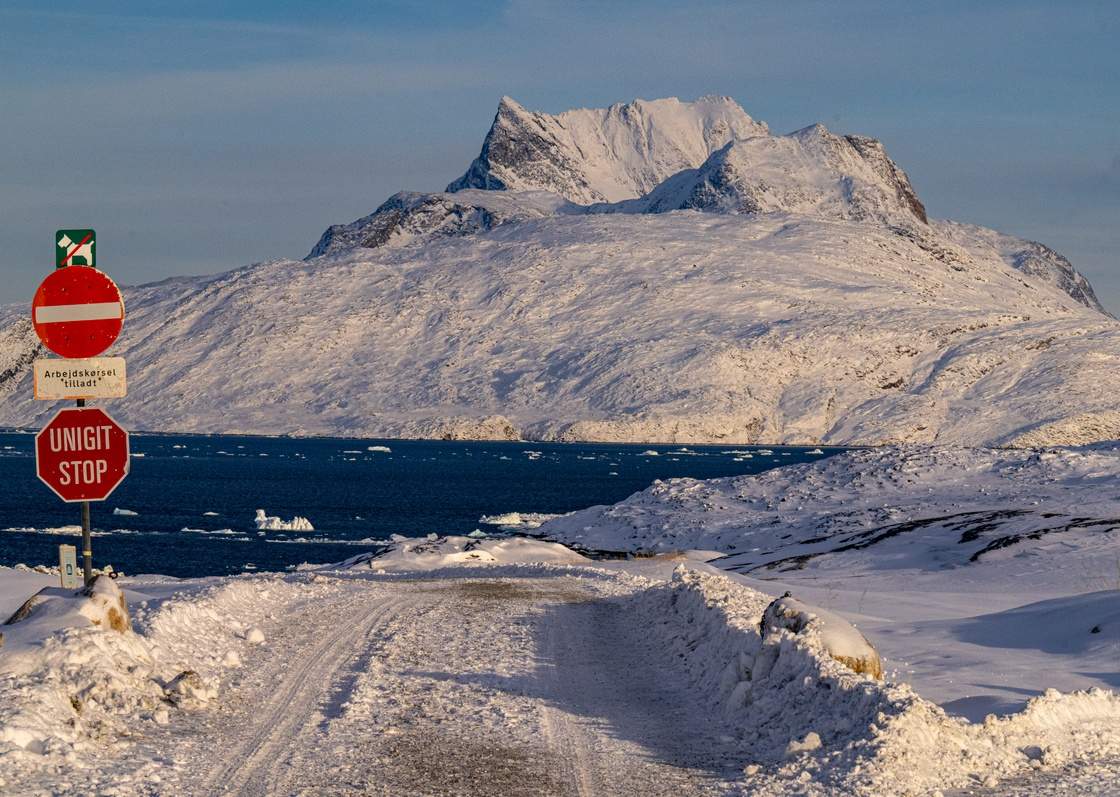
The coffee freezes to the rim of the mug in under three minutes. I know because I sat on a wind-scoured ridge in Disko Bay years ago, watching the breath of our small crew turn instantly to gray crystals, wondering why anyone would mortgage their sanity to scratch at the belly of the earth where the earth itself wants you dead.
Down here, in corporate headquarters thousands of miles away, an oil strike looks like a spreadsheet. It is a neat little cell in Excel, a projection of quarterly yields, a neat line drawn across an Arctic map. But out there, it is screaming wind, black water that will kill you in two minutes flat, and silence so heavy your own thoughts start to echo like someone else talking in the dark.
Recently, a U.S. oil outfit decided they didn't want to wait for the paperwork.
They dropped drilling gear onto the Greenlandic ice without permission.
Let that sink in. A sovereign Arctic frontier, an island of ancient glaciers and small towns where everybody knows everyone's business, suddenly found heavy iron machinery sitting on its threshold. No stamp. No signature. No polite diplomatic nod over tea in Nuuk. Just the heavy thrum of uninvited steel.
To understand why a company would take a gamble that brazen, you have to look past the international laws and look straight into the psychology of modern desperation.
Imagine Henrik, a hypothetical local fisherman in a small wooden cutter off the coast of Qeqertarsuaq. Henrik wakes up before dawn, the wooden hull of his boat creaking against the dock. He drops his lines where his grandfather dropped his lines. Except today, the halibut are moving north, chased by warming water that shouldn't be this warm. The ice is retreating, leaving behind open water and open wounds. Henrik is watching his entire livelihood dissolve into a liquid blue riddle, while somewhere overhead, satellite eyes belonging to men in suits are mapping out the oil fields buried beneath his fishing grounds.
The world is running out of easy energy. That is the cold, uncomfortable truth we whisper about over boardroom tables. Every major basin on the map has been poked, prodded, and bled dry. What is left are the hard places. The dangerous places. The places where the cost of extraction is so astronomically high that it only makes financial sense if you ignore the rules, bypass the bureaucracy, and hope the local government is too slow to catch you before the core samples are packed away in crates.
When a U.S. firm moves iron onto foreign ice illegally, it is not a administrative oversight. It is a calculated gamble.
The math goes something like this: The fines, if caught, are a line item. A cost of doing business. But the data? The proprietary geological proof that oil flows beneath a specific shelf of Disko-Nuussuaq? That is worth billions. That changes stock prices. That secures funding rounds that keep failing balance sheets alive for another decade.
It is trespassing at a planetary scale.
I remember talking to an old surveyor in a timber-framed bar in Ilulissat. He smelled of diesel fuel and stale tobacco, and he looked at the horizon with eyes that had cataract rings around the blue. He told me something I have never forgotten.
"They think this ice is empty," he said, slamming his glass down so hard the condensation jumped. "They look at the white and they see a blank page. They don't see that every inch of this ice is written on by the people who live here. They don't see the history. They just see space to park a rig."
That is the core disconnect. The corporate mindset reduces geography to coordinates. To a distant executive in Houston or Denver, Greenland is a frontier. It is an abstract polygon on a GIS software dashboard. But to the indigenous communities whose ancestors navigated these fjords in sealskin kayaks, it is a living room. It is a pantry. It is an ecosystem that reacts violently when you punch a hole in it.
When the news broke about the unauthorized gear, the reaction in Greenlandic administration was swift and furious. You do not simply drop heavy machinery onto an autonomous territory's sovereign soil and wave away the concern with a corporate press release. The authorities stepped in. They demanded answers. They demanded removal.
Yet the psychological damage was already done.
Consider what happens next in a scenario like this. The gear gets hauled back. Lawyers issue strongly worded statements. Executives issue apologies blaming a "misinterpretation of local permitting scope." The machinery is loaded back onto cargo ships and hauled away into the gray mist. The incident fades from the front pages of international newspapers.
And the oil companies? They go back to the drawing board. They refine their satellite imaging. They wait for the political climate to shift. Because the ice isn't getting any thicker, and the corporate hunger isn't getting any smaller.
We are living through a slow-motion gold rush, but nobody wants to call it that because the gold is black and it burns the sky.
The temptation to bypass regulation grows in direct proportion to the scarcity of the resource. When stakes are existential, ethics become negotiable. We have watched this pattern repeat itself from the tar sands of Alberta to the deep-water trenches of the Gulf. The frontier always attracts the impatient, the reckless, and the desperate.
Standing on that ridge in Disko Bay all those years ago, I watched a single iceberg calve into the sea. It didn't make a sound at first—just a massive, silent fracture that sent a shockwave through the water. Ten seconds later, the roar hit us like rolling thunder, echoing off the basalt cliffs until my teeth vibrated.
The earth speaks in its own time. You can drop all the drilling gear you want onto its frozen crust, you can forge permits in boardrooms and bypass the law with a wink and a checkbook, but you cannot silence the ice when it decides to break.
The unauthorized rigs are gone now, hauled off the Greenlandic shore under the watchful eyes of an angry government. But the machinery is still sitting in warehouses, waiting. The maps are still on the desks. And out on the dark water, the wind is still blowing straight off the pole, carrying the scent of salt, diesel, and a future we are racing toward far too fast.