The silence of the exclusion zone does not sound like peace. It sounds like an ticking watch buried under a pillow.
When you walk through the abandoned streets of Pripyat, your brain constantly tries to fill the void. You listen for the phantom rattle of a Soviet-era tram, the distant shouts of children who would now be in their late forties, or the hum of the four massive reactors that once anchored this entire region to the modern world. But the air offers nothing except the soft, rhythmic click of a handheld dosimeter.
Click. Click.
Then, a sudden snap of a dry twig breaks the monotony. It is not a ghost. It is a Eurasian lynx, its tufted ears twitching as it steps out from the shadow of a decaying concrete apartment block. It looks at you with amber eyes, entirely unafraid, before melting back into the dense, overgrown brush.
Thirty-six hours after the number four reactor at the Chernobyl Nuclear Power Plant exploded on April 26, 1986, more than 100,000 people were evacuated from a 1,000-square-mile area straddling the border of Ukraine and Belarus. They left their meals on tables, their pets tied up in yards, and their entire lives behind. We thought we had created a permanent dead zone. We believed that by poisoning the soil with cesium-137 and strontium-90, we had written a multi-millennial eviction notice for every living thing.
We were wrong. We underestimated the resilience of the natural world, and more importantly, we vastly underestimated just how toxic human presence is to the planet.
The Unexpected Eden
For decades, the dominant scientific narrative surrounding Chernobyl was one of absolute desolation. Researchers focused on the horrific initial impacts: the Red Forest that turned ginger-brown and died from acute radiation, the stunted growth of trees, and the mutations found in local barn swallows. It made intuitive sense. If an environment is too dangerous for a human being to inhabit without a hazmat suit and a stopwatch, it must be a wasteland.
But ecosystems do not read human textbooks.
A landmark, multi-year study published in the journal Current Biology upended everything we thought we knew about the zone. An international team of researchers analyzed decades of wildlife data, including helicopter census tracks and winter track sampling. What they discovered was staggering.
The population of large mammals inside the Chernobyl exclusion zone did not collapse. It boomed.
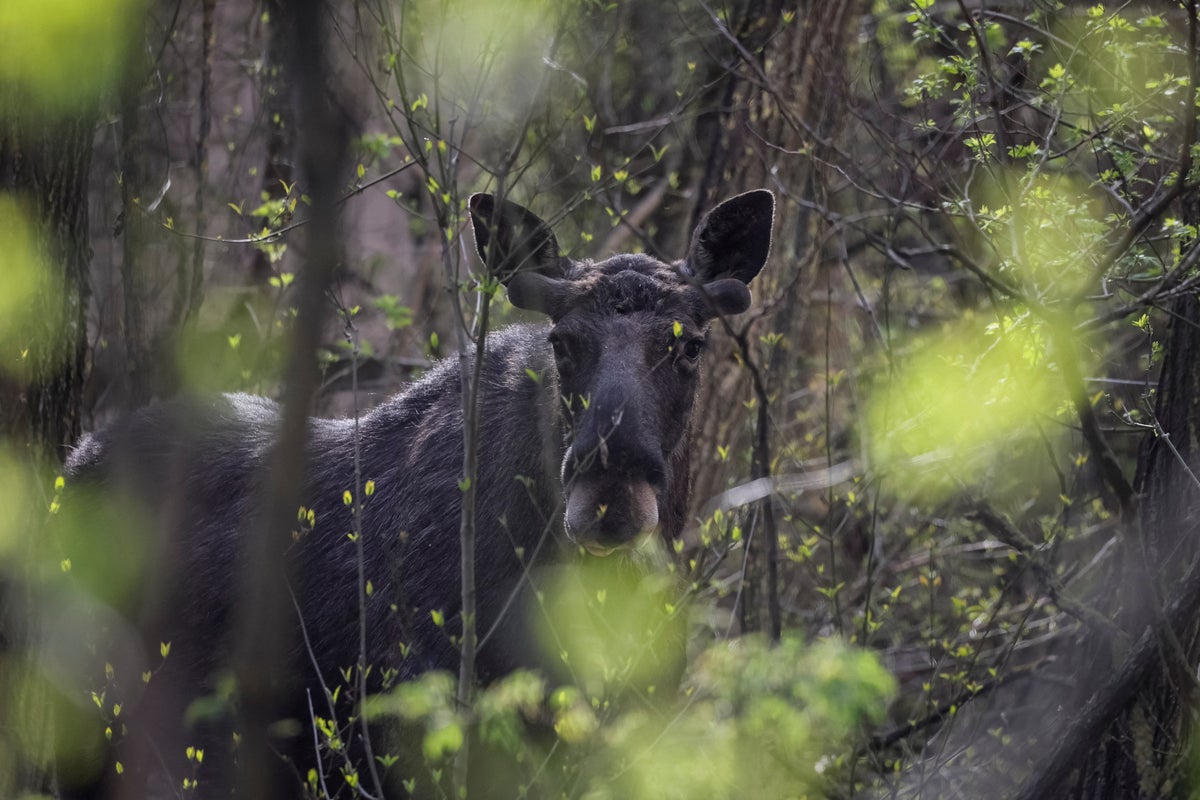
Today, the zone supports a wildlife density that rivals, and in many cases exceeds, the most heavily protected, pristine nature reserves in Ukraine. Elk, roe deer, red deer, and wild boar are thriving. The gray wolf population inside the zone is seven times higher than in comparable, uncontaminated reserves outside of it. The endangered Przewalski’s horse, introduced to the area in the late 1990s as an conservation experiment, has found a rare stronghold in the radioactive grasslands.
Consider the paradox. The very site of the world’s worst nuclear disaster has accidentally become one of Europe's largest wildlife sanctuaries.
To understand how this happened, we have to look past the radiation levels and look at ourselves.
The Heavy Weight of Our Footsteps
Imagine a hypothetical wolf cub born in the forests near Kyiv, and another born inside the exclusion zone, just a few miles from the crumbling sarcophagus of reactor four.
The Kyiv wolf faces an uphill battle from day one. Every direction it runs, it encounters roads. It hears the relentless roar of combustion engines. It must navigate field after field of monoculture crops treated with synthetic pesticides, reducing its natural prey base. If it wanders too close to a village, it risks being shot by a farmer or hit by a semi-truck. Its habitat is fragmented, dissected by fences and human ambition.
The Chernobyl wolf, meanwhile, grows up in a contiguous wilderness. There are no logging crews clearing the canopy. There are no poachers tracking its pack through the snow. No tractors turn the soil; no chemical fertilizers run off into the streams.
Yes, the Chernobyl wolf is exposed to chronic, low-dose radiation. It breathes in isotopes. It consumes prey that has grazed on contaminated vegetation. Scientists still debate the long-term genetic costs of this exposure, noting elevated rates of cataracts, smaller brain sizes in certain bird species, and subtle DNA damage.
But the data reveals a harsh truth. The biological tax of radiation is significantly lighter than the tax of human civilization.
Our everyday existence—our farming, our driving, our building, our mere physical presence—is more destructive to an ecosystem than a catastrophic nuclear meltdown. Nature, it turns out, would rather endure chronic radiation than endure us.
Tracking the Invisible
Proving this phenomenon required a level of scientific detective work that spanned generations. In the immediate aftermath of the disaster, field research was sporadic and dangerous. Researchers couldn't exactly spend three weeks camping in the woods to count deer feces.
But as the decades wore on and radiation levels decayed, the zone became a massive, living laboratory. Scientists began using two primary methods to understand the wildlife boom: winter track counting and camera trapping.
Winter track counting relies on fresh snowfall. Researchers traverse specific routes, recording the footprints left behind by mammals within a 24-hour window after a snowstorm. When compared to historical data collected before the accident, the numbers showed an unmistakable upward trend. By 1987, just a year after the evacuation, the wildlife populations were already rebounding. The sudden absence of humans acted like a spring that had been compressed for centuries, suddenly released.
More recently, technology has allowed for continuous, non-invasive monitoring. Hundreds of motion-activated camera traps have been strapped to the trunks of radioactive birches and pines.
The footage looks like something out of a speculative fiction novel. A mother brown bear—a species that hadn't been seen in the region for more than a century before the accident—strolls past the camera with her cubs. European bison trudge through the marshes. Golden eagles scan the open fields from the rusted frames of abandoned agricultural machinery.
The cameras do not lie. The animals are not just passing through; they are living, mating, hunting, and dying in the shadow of the cooling towers.
The Lessons of the Wasteland
This accidental sanctuary forces us to reexamine our entire approach to conservation. For generations, the standard model of environmental protection has been the creation of managed reserves. We draw a line around a piece of forest, hire a few rangers, and declare it protected.
Yet, these reserves are often islands in a sea of human development. They are vulnerable to political shifts, funding shortages, and the creeping pressure of surrounding cities. They are curated versions of nature.
Chernobyl offers a radical alternative: rewilding through total abandonment.
It suggests that sometimes, the best thing we can do for the planet is to simply get out of the way. When humans are entirely removed from the equation, ecosystems possess an uncanny ability to self-correct, to heal, and to adapt to conditions we consider unlivable.
This does not absolve us of the tragedy of 1986. The human cost of Chernobyl remains immense—the lives cut short among the liquidators who fought the fires, the displaced families who lost their ancestral homelands, and the psychological trauma that still lingers across Eastern Europe. The zone is a monument to human error, arrogance, and the terrifying power of our technological reach.
Yet, walking through this vibrant, radioactive wilderness, it is impossible not to feel a strange sense of optimism. The earth does not need our permission to heal. It only needs our absence.
As night falls over Pripyat, the dosimeter continues its steady rhythmic click, a reminder of the invisible poison still woven into the soil. But above that sound, echoing through the empty, crumbling concrete plazas where Soviet flags once flew, comes the unmistakable, haunting howl of a wolf pack. They are reclaiming the territory we broke, thriving in the ruins of our greatest mistake.