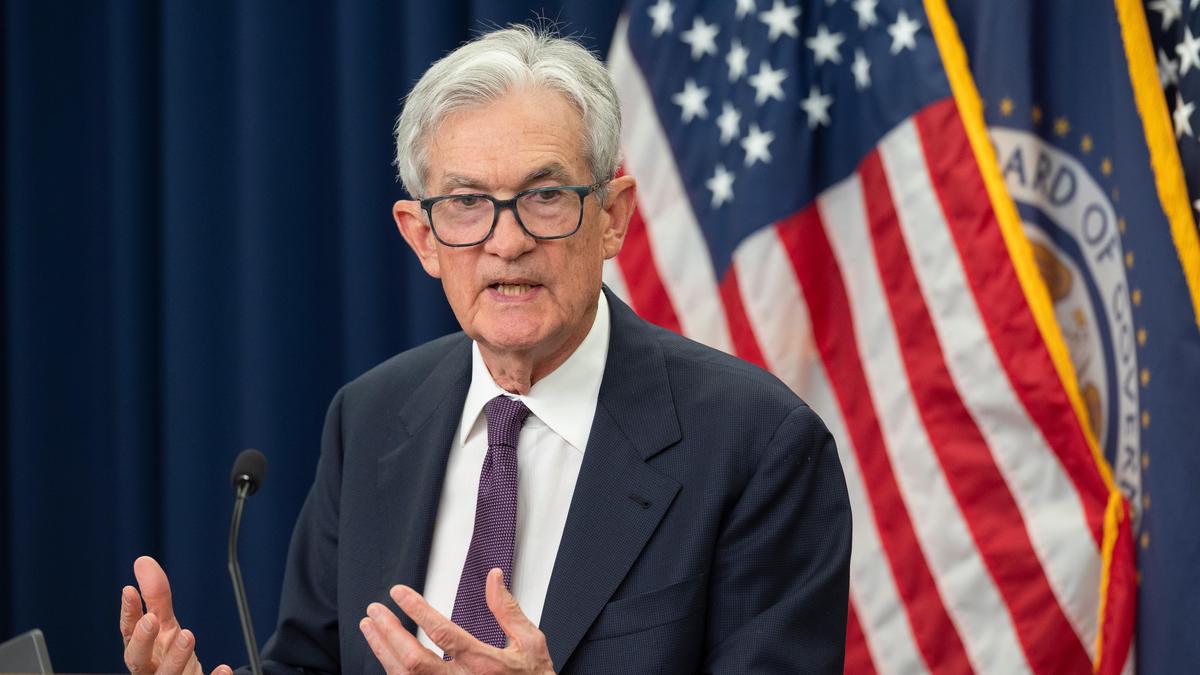
The marble halls of the Federal Reserve’s headquarters in Washington, D.C., are designed to swallow sound. When you walk across the thick carpets of the boardroom, the air feels heavy, pressurized by the weight of trillion-dollar decisions. For years, Jerome Powell has been the face of this silence. He is the steady hand, the man who speaks in deliberate, rounded tones designed to keep markets from jumping at their own shadows.
But the silence is about to change.
There is a name echoing through the corridors of power, whispered by traders in Lower Manhattan and policy wonks in the West Wing: Kevin Warsh. To the uninitiated, he is a former Fed governor and a brilliant economic mind. To those who understand the machinery of global finance, he represents a "revolution" that is no longer a possibility, but an impending reality.
Power rarely shifts with a bang. It shifts through the subtle alignment of political will and economic necessity. Jerome Powell, whose term as Chair technically runs until May 2026, is a man who respects the institution above all else. He is not a fighter of lost causes. If the winds of the next administration blow toward a new philosophy—one that is leaner, faster, and perhaps more aggressive—Powell will not stand in the doorway. He will hold it open.
The Architect of a New Script
Consider a hypothetical investor named Elena. She manages a mid-sized pension fund. For a decade, her life has been dictated by the "Fed Put"—the belief that the central bank will always step in to save the markets if things get too shaky. She watches the dot plots and the beige books like they are holy scripture. To Elena, the Fed is a slow-moving ocean liner.
Kevin Warsh is a speedboat.
Warsh represents a departure from the academic consensus that has governed the Fed for twenty years. He doesn't just want to manage inflation; he wants to rethink the very footprint of the central bank in American life. His critics call him hawkish. His supporters call him a realist. In a world where the national debt is a screaming siren that everyone has learned to tune out, Warsh is the one pointing at the speakers and demanding someone turn the volume down.
The tension isn't just about interest rates. It is about the soul of the economy. Warsh has long been a skeptic of "Quantitative Easing," that fancy term for the Fed printing money to buy bonds. He sees it as a distortion, a thumb on the scale that helps the wealthy while leaving the Elenas of the world guessing about the true value of an asset.
The Handover of the Keys
The transition won't look like a coup. It will look like a polite conversation over coffee. Jerome Powell has spent his career being the "adult in the room." He navigated the chaotic waters of a global pandemic and the subsequent inflationary spike with a dogged, almost boring commitment to data.
However, the political landscape has shifted. The incoming administration doesn't just want a technician; they want a visionary who aligns with a high-growth, deregulatory agenda. Warsh fits that mold perfectly. He is young, he is connected, and he possesses a rare ability to translate complex monetary theory into the language of power.
If Powell senses that his presence is becoming a friction point between the central bank and the White House, he will step aside. Not out of weakness, but out of a deep-seated belief that the Fed’s independence is best preserved when it isn't at war with the President. The "Warsh Revolution" isn't a hostile takeover. It is a natural succession in a system that is tired of the old ways of doing business.
Why the Small Stuff Matters
We often talk about the Fed in terms of "basis points" and "liquidity injections." These are cold, sterile words. They hide the human reality of what happens when the cost of money changes.
Imagine a young couple trying to buy their first home in a suburb of Atlanta. To them, the "Warsh Revolution" isn't an abstract policy debate. It is the difference between a 4% mortgage and a 7% mortgage. It is the difference between a spare bedroom for a new baby and staying in a cramped apartment for another three years.
Warsh’s philosophy suggests a return to a more disciplined monetary policy. This might mean higher rates for longer to crush the last embers of inflation, or it might mean a more volatile market as the "Fed Put" is dismantled. It is a world with less padding. It is a world where risk actually carries a price tag again.
For years, we have lived in an era of artificial calm. The Fed kept the lights low and the music soft. If Warsh takes the baton, he’s likely to flip the breakers and open the windows. It will be brighter, louder, and significantly less comfortable for those who have grown used to the dark.
The Ghost of 1980
History has a way of repeating itself, though it usually changes its clothes first. In the early 1980s, Paul Volcker took a sledgehammer to the American economy to break the back of stagflation. He was hated for it. People mailed him the keys to their foreclosed homes. But he saved the dollar.
Warsh isn't Volcker—the challenges today are different—but he shares that same willingness to be the most unpopular person in the room. He understands that the "long run" eventually arrives. You cannot run a deficit forever. You cannot keep interest rates at zero forever without breaking something fundamental in the way people value labor and time.
Jerome Powell knows this too. But Powell is a builder of bridges. Warsh is a clearer of land.
The move toward a Warsh-led Fed signals a shift away from the "wait and see" approach. It suggests a central bank that is more proactive, perhaps more willing to let the markets take a bruising if it means long-term stability. It is a move toward a harder, more crystalline version of capitalism.
The Invisible Stakes
Why does this matter to you?
It matters because the Federal Reserve is the closest thing we have to a global thermostat. If the person at the dial changes their mind about what "comfortable" looks like, every room in the house feels it.
We are moving away from an era of consensus. For a long time, there was a feeling that any "qualified" person at the Fed would do roughly the same thing. They would look at the same charts, talk to the same Ph.D.s, and come to the same cautious conclusions.
That era is over.
The Warsh Revolution is about the return of the individual. It is about the idea that one person’s conviction can steer the course of the global economy. It is a gamble. It assumes that the old models are broken and that we need a new architect to design the replacement.
Jerome Powell sees the blueprints on the table. He isn't reaching for an eraser. He is reaching for his coat.
As the sun sets over the Potomac, the shadows in the Eccles Building grow long. The quiet remains for now, but it is the quiet of a theater before the curtain rises. The actors are in place. The script has been rewritten. All that is left is for the lights to come up and for the new lead to take his place at center stage.
The silence is about to be broken.