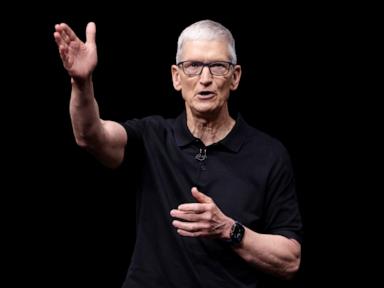
The lights inside Apple Park never truly go out. They dim to a soft, ethereal glow that makes the massive ring look less like an office building and more like a landed spacecraft waiting for a signal from the stars. For over a decade, that signal was sent by Tim Cook. He was the man who turned Steve Jobs’s wild, flickering neon dreams into a steady, unblinking beam of global commerce.
But the beam is shifting.
Tim Cook is stepping down. The news didn't arrive with a thunderclap or a dramatic product reveal. It moved through the industry like a change in the weather—a cold front signaling the end of one era and the uncertain dawn of another. In his place stands John Ternus, a man whose name isn't etched into the cultural zeitgeist like his predecessors, but whose fingerprints are all over the glass and aluminum you carry in your pocket.
The Accountant of Human Desire
To understand what Apple is losing, we have to look past the stock price. Cook’s tenure was a masterclass in the poetry of logistics. He didn't invent the future; he ensured the future arrived on time, in the right color, and in quantities large enough to satisfy seven billion people.
Think of a hypothetical developer in Bangalore. Let’s call him Aarav. Ten years ago, Aarav’s ability to build a life around an app depended on a supply chain so fragile that a single storm in the South China Sea could derail his career. Cook fixed that. He built a fortress of predictability. He was the quiet gardener who made sure the soil was so rich that even a seed of an idea could grow into a billion-dollar ecosystem.
Cook’s Apple was about refinement. He took the jagged edges of the Jobs era and polished them until they were smooth. He was the steward of the "S" years—those incremental updates that critics mocked but the world bought by the hundreds of millions. He knew that while the world craves revolution, it pays for reliability.
The Man in the Machine
Now enters John Ternus.
If Cook was the architect of the system, Ternus is the master of the object itself. Since joining Apple in 2001, he has been the invisible hand behind the Mac, the iPad, and the iPhone. He is the person who understands how to cram an impossible amount of power into a space thinner than a pencil.
When you feel the haptic click of a trackpad or the satisfying snap of a MagSafe charger, you are interacting with Ternus’s philosophy. He is obsessed with the tactile. While Cook managed the global flow of parts, Ternus managed the atoms.
The transition feels like a shift from a leadership of "How many?" to a leadership of "What next?"
Inside the halls of Cupertino, the whispers about Ternus aren't about his ability to manage a spreadsheet. They are about his eye. He is described as a "true believer" in the hardware, someone who views a circuit board with the same reverence a Renaissance painter viewed a blank canvas. This matters because we are reaching the end of the smartphone’s dominance. The world is getting bored of rectangles.
The Stakes of the Handover
Changing a CEO at a company worth trillions isn't like changing a captain on a ship. It’s like trying to swap the engine of a plane while it’s flying at Mach 2.
The invisible stakes are found in the tension between the shareholders and the dreamers. The shareholders loved Cook because he was a safe harbor. He grew the Services division into a monster that prints money even when people aren't buying new phones. He turned privacy into a product. He was the adult in the room when the rest of Silicon Valley was breaking things and moving too fast.
Ternus inherits a kingdom that is beautiful but arguably static. The Vision Pro, Apple’s foray into spatial computing, is a brilliant piece of technology looking for a reason to exist. It is a Ternus masterpiece—heavy on engineering, light on cultural necessity. His challenge isn't just to keep the trains running; it’s to build a whole new track to a destination we can’t see yet.
Consider the anxiety of a veteran Apple engineer. For years, they worked under a man who prioritized the "Apple Way"—a methodical, grinding pursuit of perfection. Now, they report to one of their own. Does that mean a return to the "pirates" mentality of the eighties? Or does the weight of a three-trillion-dollar valuation crush any hope of genuine, messy innovation?
The Weight of the Ghost
Every Apple CEO lives in the shadow of the man who started it all. Cook survived that shadow by being the literal opposite of Steve Jobs. He was calm where Jobs was volatile. He was transparent where Jobs was secretive. He was a marathon runner in a world of sprinters.
Ternus doesn't have the luxury of being an opposite. He has to be a synthesis.
He must maintain the brutal efficiency that Cook perfected—because the moment an iPhone launch is delayed, the myth of Apple invincibility cracks. But he also has to inject a sense of wonder back into the brand. He has to convince us that we need something we haven't even imagined yet.
The transition is a gamble on the idea that Apple is, at its heart, a hardware company. By choosing the guy who builds the things rather than the guy who sells the services or manages the money, the board is making a loud statement: the device is still king.
The Silent Transition
There will be no fireworks. No tearful goodbyes on the Steve Jobs Theater stage. That isn't the Cook way. Instead, there will be a gradual receding. A slow handoff of the baton in a race that never ends.
We often think of corporations as cold, unfeeling machines. We forget they are just collections of human egos, fears, and ambitions. Tim Cook is leaving because he has finished the job he was hired to do. He saved Apple from the chaos of its own success. He gave it a spine.
John Ternus takes over at a moment when the world is questioning the very value of the technology he spent twenty years perfecting. He isn't just inheriting a CEO title; he’s inheriting the responsibility of proving that the most successful company in human history still has a soul.
The lights in the ring stay on. A different hand is on the dimmer switch now. The room feels the same, but the shadows are beginning to stretch in new directions.