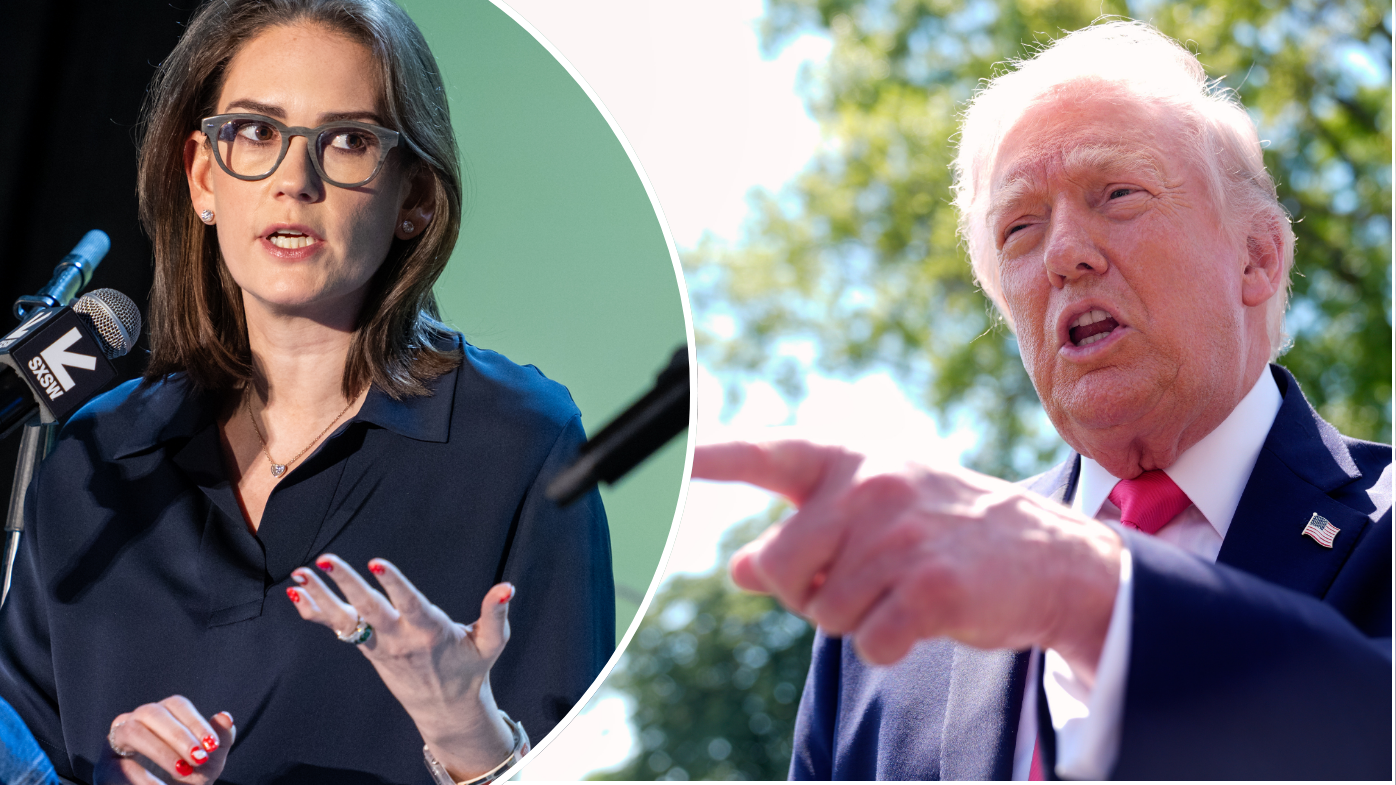
The studio lights are a special kind of cruel. They don't just illuminate; they interrogate. Every pore, every stray hair, every micro-expression is magnified a thousand times before being beamed into the living rooms of millions. For a television presenter, those lights are the boundary between being a person and being a product.
When Donald Trump turned his attention toward a female broadcaster, demanding her removal because she was, in his estimation, "the least attractive," he wasn't just critiquing a performance. He was reinforcing an old, jagged rule that many hoped was finally breaking. The demand wasn't about her journalistic integrity, her timing, or her ability to handle a breaking news cycle. It was a blunt force reminder that, for some in power, a woman’s right to occupy space is tied directly to her ability to please the eye.
It is a dehumanizing math.
Consider a hypothetical producer named Sarah. She has spent fifteen years in the trenches. She’s covered wars, local elections, and the mundane tragedies of the evening news. She wakes up at 3:00 AM to ensure her scripts are tight. But as she sits in the makeup chair, she isn't thinking about the lead story. She is looking at the fine lines around her eyes and wondering if today is the day a powerful man decides she has expired. This isn't paranoia. It’s the lived reality of an industry where "visual appeal" is often used as a weaponized synonym for "disposable."
The Mirror in the Oval Office
The rhetoric used in this specific instance—calling for a professional to be stripped of her platform based on her appearance—is a window into a specific brand of power. It is the power of the spectator who believes he owns the stage. When a former president and current candidate uses his massive megaphone to comment on a woman’s face rather than her facts, he sets a permission structure for everyone else to do the same.
This isn't just about one woman on one network. It’s about the cultural signal it sends to every girl watching: Your brain is a secondary character. Your face is the lead.
Statistics in the media industry have long told a lopsided story. Research consistently shows that female presenters face significantly more scrutiny regarding their clothing, hair, and perceived "likability" than their male counterparts. While a graying man is often seen as "distinguished" or "authoritative," a woman showing the same signs of experience is frequently pressured to seek out the nearest syringe of Botox or face the quiet side-lining of her career.
When Trump leans into these insults, he isn't being a "straight talker." He is acting as the ultimate arbiter of a rigged game. He is validating the idea that a woman is a decoration first and a professional second.
The Weight of the Gaze
Imagine the internal dialogue of the woman at the center of this. She prepares for an interview, sharpening her questions, verifying her sources, and checking her citations. She walks onto the set ready to hold power to account. Then, the notification pings. A man with the eyes of the world on him has decided her nose is wrong, or her skin is too old, or she simply doesn't meet his personal standard of beauty.
The story stops being about the news. The story becomes her face.
This is the invisible tax paid by women in the public eye. They have to do the job twice as well while being scrutinized ten times as hard for things they cannot control. It is exhausting. It is a slow-motion drain on talent and energy that could be spent on the actual work of journalism.
There is a specific psychological term for this: objectification theory. It suggests that when women are treated as objects to be looked at, they begin to view themselves through that same external lens. They start to self-monitor. They lose the "flow state" required for high-level performance because a part of their brain is always wondering how their jawline looks from the left-side camera. By demanding a presenter be removed for her looks, Trump is attempting to force her—and all women like her—back into that state of self-consciousness.
The Ghost of the "Gold Standard"
We have been here before. History is littered with the names of women who were told they were too old, too loud, or not "soft" enough for the screen. In the 1980s, Christine Craft famously sued a television station after being told she was "too old, too unattractive, and not deferential enough to men." She won her initial case, but the industry’s soul didn't change overnight.
The "Gold Standard" of beauty in media has always been a moving target, designed to keep people running on a treadmill that never ends. By calling for a presenter's firing based on her appearance, the rhetoric skips past the "meritocracy" argument entirely. It doesn't even pretend to care if she's good at her job. It is an admission that the job, in the eyes of the critic, is merely to provide a pleasing aesthetic experience for men.
The cruelty is the point. It is meant to diminish. It is meant to remind the world that no matter how much authority a woman garners, she can be reduced to a "rating" on a scale of one to ten by a man with a smartphone and a grudge.
Beyond the Screen
What happens when we accept this? If we allow the standard of "attractiveness" to dictate who gets to speak in our democracy, we lose the voices of those who have spent their lives gaining the wisdom that only comes with time. We trade depth for surface. We trade truth for a filter.
The stakes are higher than a single job at a television network. This is about the digital town square. If the price of entry for a woman to speak her mind is a flawless exterior that satisfies the whims of a powerful man, then the town square is not a democracy. It’s a pageant.
We often talk about the "boldness" of political attacks, but there is nothing bold about picking on someone's appearance. It is the oldest, laziest trick in the book. It is the move of someone who cannot win the argument on its merits and must instead resort to the playground tactics of the bully.
But the real damage isn't to the presenter. She has her talent, her resume, and her dignity. The damage is to us, the audience. Every time we engage with this kind of rhetoric, every time we click, share, or nod along, we are agreeing to live in a world that is smaller, meaner, and more superficial. We are agreeing that the "least attractive" person in the room is the one who should be silenced, regardless of what they have to say.
The studio lights eventually go down. The cameras turn off. The makeup is wiped away. What remains is the work. A person’s worth isn't found in the symmetry of their face or the youth of their skin. It is found in the courage to stand under those unforgiving lights and speak a truth that someone, somewhere, is desperate to silence.
The man in the red hat wants us to look at the woman’s face so we don't listen to her words. He wants us to judge the container so we never taste the contents. But as the glare of the screen fades into the dark of the room, the silence that follows isn't a victory for "beauty." It is the sound of a window closing on a world that desperately needs to see more than just what is on the surface.