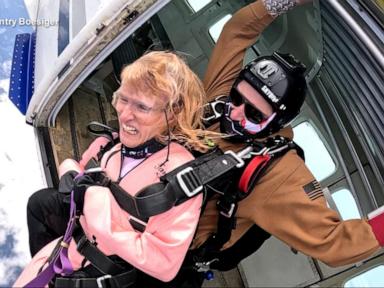
The air at fourteen thousand feet doesn't care about your medical history. It is thin, biting, and smells faintly of aviation fuel and adrenaline. For most people, standing at the open door of a Twin Otter airplane involves a frantic internal negotiation between the lizard brain screaming "no" and the ego whispering "yes." But for Kimmy Watkins, the negotiation ended years ago. When you have spent over a decade navigating a world that ends at the tips of your fingers, the prospect of falling isn't a threat. It is a liberation.
Kimmy is a quadriplegic. She is also a mother, a record-breaker, and, for a few minutes over the desert floor, a human projectile moving at one hundred and twenty miles per hour. Also making waves recently: Stop Forcing Fake Resilience Because Constant Grit is Destroying Your Potential.
Most news outlets treated her recent jump as a "heartwarming" segment, the kind of fluff that fills the three minutes before the weather report. They focused on the mechanics of the harness. They showed the landing. They missed the entire point. This wasn't about a woman in a wheelchair doing something "brave" for the cameras. It was a calculated assault on the concept of physical limitation. It was a mother showing her children that the ground is only the limit if you refuse to leave it.
The Weight of Stillness
To understand why a woman who cannot feel her legs would choose to hurl herself out of a plane, you have to understand the heavy, suffocating silence of a body that no longer takes orders. Further information into this topic are explored by Cosmopolitan.
Imagine waking up and finding that your nervous system has declared independence. The simple, mindless act of scratching an itch or reaching for a coffee mug becomes a logistical operation. Quadriplegia isn't just "not walking." It is a constant, grinding battle against a world designed for the able-bodied. It is a series of "no's" delivered by curbs, stairs, and narrow doorways.
Kimmy’s injury resulted from a car accident that severed her spinal cord at the C5-C6 vertebrae. In the medical world, this is a diagnosis. In the human world, it is a life sentence of dependency. But Kimmy didn't just want to survive her injury; she wanted to outrun it.
She began looking at the world record for the highest skydive by a female quadriplegic. The record wasn't just a number. It was a target. To hit it, she didn't need pity. She needed physics.
The Physics of the Fall
Skydiving is, at its core, a dance with gravity. For an able-bodied jumper, the body acts as a rudder. You arch your back to stable yourself; you use your arms to turn; you use your legs to track across the sky. When those limbs don't respond, the physics change. You aren't a pilot anymore; you are cargo.
Or at least, that’s what the skeptics thought.
The preparation for this jump was a masterclass in specialized engineering. This wasn't a standard tandem flight where you just clip in and go. The team had to design a custom strapping system to ensure Kimmy’s legs wouldn't flail in the high-speed buffeting of freefall, which could cause a dangerous spin or internal injury. They had to account for her blood pressure, which can fluctuate wildly in quadriplegics when exposed to extreme altitude and rapid acceleration—a condition known as autonomic dysreflexia.
But the biggest hurdle wasn't the equipment. It was the mindset.
"People see the chair and they think 'fragile,'" one of her jump masters remarked during the training sessions. "But Kimmy is the least fragile person in the hangar. She’s the one keeping us calm."
The Ascent
The day of the record attempt was clear. The sky was a bruised shade of blue, stretching out over the drop zone like an unwritten page. Inside the plane, the noise is deafening. The vibrations of the engine rattle your teeth.
Kimmy sat on the floor of the aircraft, her back against the pilot's bulkhead. Her two children were on the ground, watching through binoculars. This is the part the news cameras usually skip: the quiet terror of a mother wondering if she’s being selfish. Is a record worth the risk of leaving them?
But then she looked at her hands. They were still. They were always still.
Up here, that stillness felt different. It felt like potential energy.
When the door opened, the temperature inside the cabin plummeted. The jump master checked the clips one last time. Oxygen hissed through a mask. Then, the slide to the edge.
In that moment, the wheelchair—the device that defines her existence on the ground—was gone. She was just a person at the edge of the world.
One Hundred and Twenty Miles Per Hour
The exit is never graceful. It is a tumble, a chaotic blur of silver wing and white cloud. Then, the wind catches you.
In freefall, Kimmy Watkins was no longer a quadriplegic. The wind supported her in a way that no ergonomic chair ever could. For sixty seconds, she wasn't navigating a world of ramps and elevators. She was falling through a medium that didn't care about her spinal cord.
The speed is visceral. It pulls the skin back from your face and fills your lungs with a pressure that feels like a physical weight. But there is a paradoxical peace in it. When you are moving that fast, the past and the future vanish. There is only the immediate present.
The record she sought was an altitude of 14,000 feet, a mark that required her to stay in the air longer and drop faster than any woman in her condition had before.
She wasn't just falling. She was flying.
The Invisible Stakes
Why do we care about a woman falling out of a plane?
Because we are all paralyzed by something. Maybe it isn't a C5-C6 injury. Maybe it’s a soul-crushing job, a fear of failure, or a grief that makes the legs feel like lead. We look at someone like Kimmy and we see the extreme version of our own constraints.
If she can find agency in a sky that offers no handholds, then what is stopping us from navigating our own obstacles?
The record attempt was a success. The parachute bloomed like a giant, colorful lung above them, slowing the world down from a scream to a whisper. The descent was long and quiet. From two thousand feet, she could see the tiny dots on the ground that were her family.
She landed in a plume of dust, a bit jarred, definitely exhausted, but fundamentally changed. She hadn't just broken a record. She had reclaimed the narrative of her own body.
Beyond the Landing
The headlines the next morning were predictable. They called her "inspirational." They used words like "overcoming" and "triumph."
But "inspiration" is a cheap word. It’s a word we use to distance ourselves from the grit of someone else’s reality. Kimmy didn't do this to inspire us. She did it to remind herself that she is still an actor in her own life, not just a character in a tragedy.
The gear was packed away. The plane was refueled for the next load of tourists. Kimmy was lifted back into her chair.
On the surface, everything returned to the status quo. She still needed help with the mundane tasks of daily living. The ramps were still there. The narrow doorways remained.
But as she watched the sun set over the airfield, there was a different light in her eyes. It was the look of someone who knows a secret that the rest of the world has forgotten.
The ground is a constant. Gravity is a law. But the way we choose to meet them is entirely up to us.
She looked at her children, her heart still racing with the ghost of the wind, and smiled. She wasn't a quadriplegic mom who jumped out of a plane. She was a skydiver who happened to use a chair.
The distinction is everything.
The world will always try to tell you where you belong. It will build walls and call them "protection." It will draw lines and call them "limits."
Sometimes, the only way to find out who you really are is to go where the lines don't exist. To find the open door, feel the cold air on your face, and let go.
The fall doesn't break you. It’s the landing that tells you who you’ve become.
And Kimmy Watkins landed as a giant.