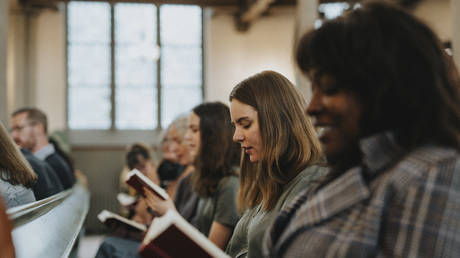
The prevailing narrative of a dying American religiosity is hitting a sudden, friction-heavy wall. For decades, the data suggested a straight line toward secularization, a slow bleed of congregants leaving empty limestone shells in their wake. But the numbers are beginning to twitch in the opposite direction. This isn't a traditional revival in the sense of sawdust trails and tent meetings. It is a calculated, often desperate search for community in a society where every other third place has been monetized or digitized into oblivion. Americans are returning to church not necessarily because of a sudden surge in doctrinal orthodoxy, but because the secular world failed to provide a viable alternative to the Sunday morning social contract.
We are witnessing a structural migration. Younger demographics, particularly Gen Z and young Millennials, are showing up in pews at rates that defy the "Nones" trend of the 2010s. This isn't a monolith of evangelical fervor. It’s a fragmented, messy collection of high-church traditionalism, basement-dwelling house churches, and tech-savvy congregations that function more like lifestyle brands than religious institutions. They are solving for loneliness, and the church—historically the most efficient engine for local networking—is the only infrastructure still standing.
The Infrastructure of Loneliness
The decline of the American mall, the bowling league, and the local fraternal order left a vacuum. For a while, the internet filled it. We thought digital forums and social media groups were a sufficient replacement for physical proximity. We were wrong. The current return to church is the byproduct of a loneliness epidemic that has reached a breaking point. When you lose the places where people know your name without a login, you eventually gravitate back to the one place that never stopped asking you to show up in person.
In many urban centers, the "revival" looks like a reclamation of ritual. High-church Anglicanism and Eastern Orthodoxy are seeing a spike in interest among young professionals. These are people who spend forty hours a week in the abstract world of data, emails, and Zoom calls. They want something heavy. They want incense, ancient liturgy, and hard wood under their knees. It is a rejection of the "seeker-sensitive" model of the 90s that tried to make church feel like a rock concert. Today’s converts don’t want a light show; they want a sense of permanence in an era of planned obsolescence.
The Economics of the New Congregation
Religious institutions are also adapting their business models to survive this shift. The mega-churches of the past were built on suburban sprawl and cheap land. The new growth is happening in smaller, more agile spaces. Some congregations are buying up defunct storefronts or sharing space with coffee shops and coworking hubs. This isn't just about saving on rent. It’s about being where the people already are.
Consider the "Dinner Church" movement. Instead of a sermon delivered from a stage to a passive audience, the entire service happens around a meal. It breaks the fourth wall of traditional worship. It also appeals to a generation that values authenticity over production value. If you can’t afford a house and you work a gig-economy job, a weekly communal meal that costs nothing but your time is a powerful incentive. The church is becoming a mutual aid society again, out of necessity.
The Theological Pivot
While the social aspect is the primary driver, we cannot ignore the shift in messaging. The hellfire and brimstone of the mid-century have been largely replaced by a focus on mental health and "wholeness." This is a delicate line to walk. If a church becomes just a therapy group with better music, it loses its distinct identity. Yet, the most successful growing congregations are those that have integrated psychological language into their spiritual frameworks.
They are addressing anxiety, burnout, and the crushing weight of modern achievement culture. In a world that demands constant self-optimization, the message of "grace"—the idea that you have value regardless of your output—is a radical, counter-cultural product. It sells because people are exhausted.
The Counter-Argument of Cultural Pressure
Not everyone sees this as a pure spiritual awakening. Skeptics point out that in a hyper-polarized political climate, the church remains one of the few places to find a "tribe." There is a risk that this revival is less about faith and more about ideological sorting. We see "patriot churches" on one side and "social justice" parishes on the other. Both are growing, but they are growing apart.
This fragmentation suggests that the church is being used as a tool for identity reinforcement. If you feel like the broader culture is hostile to your values, the church becomes your fortress. This isn't a new phenomenon, but the intensity is higher now because the digital world has made middle ground almost impossible to inhabit. You aren't just joining a church; you are joining a side.
The Role of Tech and the Anti-Algorithm
Oddly enough, the very technology that contributed to the decline of church attendance is now being used to fuel its return. But it’s being used as an "anti-algorithm." Churches are marketing themselves as the one place where you can’t be cancelled, where you aren't being tracked by a pixel, and where the "content" is live and unedited.
There is a growing "analog" movement within these communities. Cell phone lock-boxes at the door, paper hymnals instead of screens, and an emphasis on silence. In a 24/7 attention economy, sixty minutes of forced quiet is a luxury good. The churches that recognize this—the ones that offer a break from the noise rather than adding to it—are the ones seeing the most consistent growth.
The Data Gap
We have to be careful with the statistics. While "attendance" is up in certain pockets, "membership" in the traditional sense is still erratic. People are participating without committing. They show up for the community, the music, or the childcare, but they are hesitant to sign on the dotted line. This creates a stability problem for religious leaders. How do you fund a revival when your "revived" congregants are wary of institutional loyalty?
The "giving" model is shifting from tithing to project-based funding. People will give money to fix the roof or fund a local food bank, but they are less likely to write a blank check to the general fund. This forces churches to operate more like non-profits and less like sovereign entities. It’s a professionalization of the pulpit that is changing the internal culture of American religion.
The Rural-Urban Divide
The nature of this revival changes drastically depending on geography. In rural America, the church is often the only institution left after the factory closes and the grocery store moves to the next county. There, the revival is a matter of survival. It’s the post office, the town hall, and the emergency room all rolled into one.
In the cities, it’s a choice. It’s a lifestyle accessory that provides a moral compass in a sea of relativism. The urban churchgoer is often a "re-vert"—someone who grew up in the faith, left it in their twenties, and came back in their thirties once they had children. They realized that teaching a child ethics in a vacuum is nearly impossible. They want the structure they once rebelled against.
The Innovation of Tradition
The most fascinating aspect of this shift is how "innovation" is now defined as "looking backward." The churches that are trying to be "cool" are failing. The churches that are leaning into their weirdest, most ancient practices are thriving.
- Liturgy over TED Talks: People want the mystery, not just a self-help speech.
- Physicality: Communion, laying on of hands, and baptism are rituals that cannot be digitized.
- Accountability: In a "do whatever feels right" culture, people are surprisingly hungry for clear boundaries.
This isn't a return to the 1950s. It’s something different. It’s a modern population using ancient tools to fix modern problems. Whether it lasts depends on whether these institutions can handle the influx of people who are coming for the community but staying for the conviction.
The American church is currently the only major institution that hasn't completely outsourced its soul to an algorithm. For a population starving for something real, that’s enough to fill the pews. The real test will be what happens when the novelty of the "offline experience" wears off and the hard work of actual belief begins. It is easy to join a crowd; it is much harder to sustain a community once the initial fire dies down.
Get comfortable with the silence between the hymns.