A Shadow Falls Over the Pyrenees
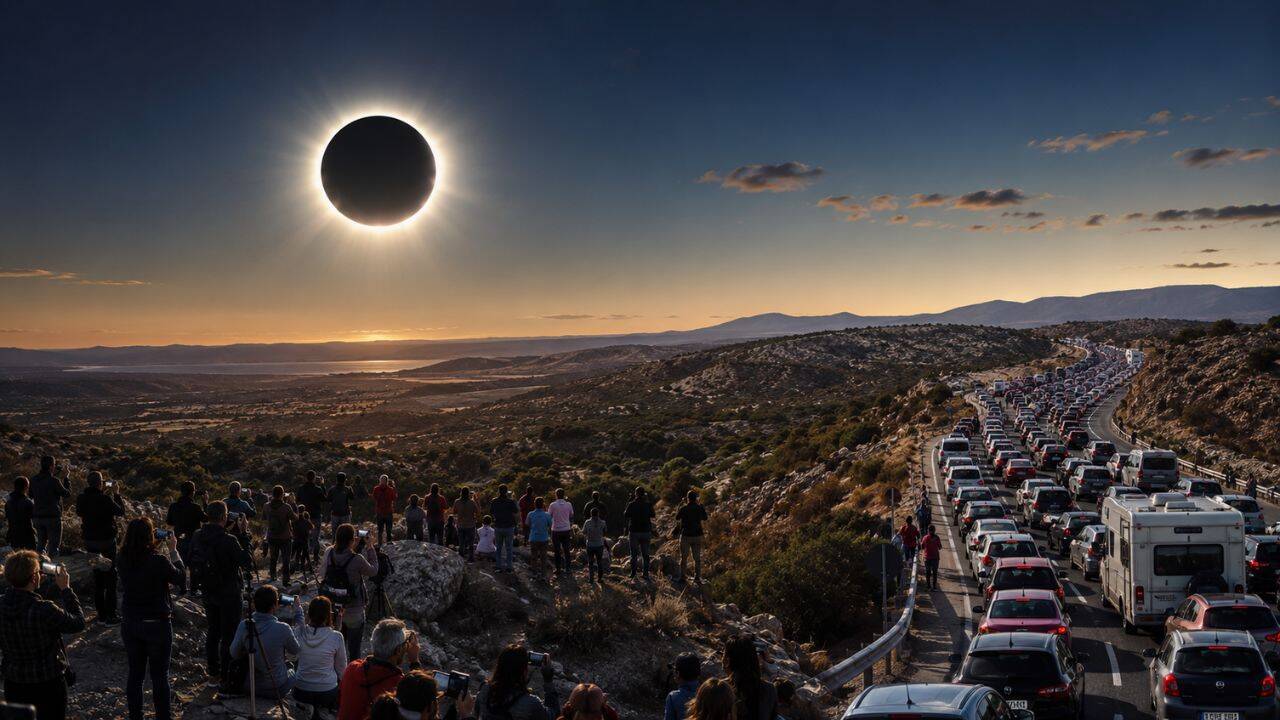
The air cools by ten degrees in less than two minutes. Crickets begin their night songs in the middle of a warm August afternoon, and the light taking over the Spanish countryside turns an eerie, metallic silver. Millions of eyes turn to the sky, waiting for the solar crown to flare into view.
Instead, thousands see only a ridge of jagged granite, a thick wall of coastal fog, or the bumper of a stalled compact car on a two-lane road outside Burgos. Learn more on a connected topic: this related article.
On August 12, 2026, the first total solar eclipse to cross mainland Europe in twenty-seven years will sweep across the Iberian Peninsula. It promises to be a legendary astronomical spectacle, drawing over a million travelers from every corner of the globe. Photos will saturate social media feeds, showing perfect black pearls glowing over ancient stone towers.
Yet a vast number of the people who traveled thousands of miles for those two precious minutes will miss totality entirely. Further journalism by AFAR explores related perspectives on this issue.
The reasons are not secret. They are written in the brutal geometry of planetary orbits, the unforgiving physics of late-afternoon atmospheric distortion, and the static geography of Spanish mountain ranges.
The Sunset Geometry Problem
To understand why this specific eclipse is a high-wire act for observers, you have to look down at your watch and then up at the horizon.
Most total eclipses occur high in the sky. When the moon covers the sun at noon, you simply tilt your head back and gaze upward. Trees, buildings, and distant hills stay comfortably out of your line of sight.
August 12 will be vastly different.
The moon’s shadow will touch down in Greenland, sweep across Iceland, race across the Atlantic Ocean, and make landfall in northern Spain during the final hours of the afternoon. By the time totality hits historic cities like León, Bilbao, and Zaragoza, the sun will be positioned exceptionally low—between two and ten degrees above the western horizon, depending on where you stand.
Ten degrees is roughly the width of a fist held at arm's length against the sky. Two degrees is barely a thumb's width above the dirt.
Imagine standing in a lush valley in the Picos de Europa, waiting for the ultimate cosmic curtain call. The clock strikes 8:26 PM local time. You look west. But instead of seeing the sun's corona, you see the massive pine-covered shoulder of a hill three miles away. The sun has dipped behind the earth's natural topography minutes before totality even begins.
You are bathed in darkness, yes, but you cannot see the ring of fire. You missed it by a mere hundred feet of elevation.
The Coastal Haze Trap
Geography is only the first layer of the puzzle. The second, and far more deceptive, is the air itself.
Consider a traveler named David—a hypothetical veteran eclipse chaser who booked a beachfront resort in A Coruña three years in advance. On paper, his plan is brilliant. Northwest coast of Spain. Path of totality right overhead. Ocean views.
What the hotel brochure does not mention is the marine layer.
Along the Atlantic coast of Galicia and the Bay of Biscay, late summer afternoons regularly trigger a phenomenon known as advection fog. Warm air moves over the colder ocean water, creating thick banks of low-lying haze that hug the shoreline.
When the sun is high at midday, its intense heat burns through this vapor. But as the afternoon wanes and the sun sinks low toward the sea, solar radiation drops. The air cools. The fog rolls back in like a slow-moving tide.
Because the 2026 eclipse happens so late in the day, the line of sight to the sun passes through a massive slice of dense atmosphere. Instead of shooting straight up through five miles of air, your vision must cut diagonally through fifty to one hundred miles of thick, humid surface atmosphere hovering right above the water.
Even on what appears to be a clear, cloudless afternoon, that dense atmospheric blanket can render the delicate solar corona completely invisible, turning a brilliant cosmic event into a murky, featureless brown smudge.
The Modern Migration Bottleneck
Now add human behavior to the equation.
Spain possesses a spectacular network of high-speed trains and modern motorways. But its rural regions—where the skies are darkest and the mountain valleys deepest—rely on narrow, winding two-lane roads designed centuries ago for farm carts and pack mules.
During the total eclipse that crossed the United States in 2017, traffic jams stretched for fifty miles along rural highways in Wyoming and Oregon. Drivers spent six hours sitting motionless on gravel roads, watching the sky darken through their windshields because they stayed in their cars five minutes too long trying to find the "perfect" spot.
Spain will face an even tighter spatial squeeze.
Because the path of totality cuts diagonally from the northwest coast through the heart of the country down to the Mediterranean coast and the Balearic Islands, millions of local residents from Madrid, Barcelona, and Seville will jump into their cars on Wednesday afternoon to drive short distances into the shadow zone.
Combine those millions of day-trippers with hundreds of thousands of international tourists, pack them onto rural routes leading up to scenic mountain viewpoints, and you have a recipe for gridlock on a massive scale.
If you are stuck on a mountain pass behind a line of five hundred idling camper vans when the shadow hits, you cannot move west to clear a ridge. You are trapped in place.
The Balearic Paradox
Further east, off the coast of Valencia, lie the Balearic Islands—Majorca, Minorca, and Ibiza. For many, these islands seem like the ultimate dream destination to witness the eclipse over the Mediterranean Sea.
Yet the islands present the most radical gamble of all.
By the time totality reaches Majorca, the sun will be less than two degrees above the western sea horizon. Totality will occur just minutes before sunset.
At two degrees elevation, even a distant cargo ship, a light swell in the sea haze, or a thin bank of summer convective clouds fifty miles offshore on the Spanish mainland can block the view entirely.
More crucially, the speed of the moon's shadow on the islands means totality will last a fleeting, precious minute or less. There is zero margin for error. A single passing cloud floating along the horizon at 8:30 PM will swallow the entire experience whole.
How to Beat the Odds
So how do you avoid becoming another cautionary tale in the annals of eclipse chasing?
Success on August 12, 2026, will not come from booking the most expensive hotel or buying the biggest telescope. It will come from flexibility, tactical positioning, and an honest respect for geography.
First, prioritize sightlines over luxury. Seek out high, elevated ground with an unobstructed view straight down to the western horizon. Flat plateaus like the Castilian plains near Burgos or Palencia offer miles of flat terrain where hills will not swallow the setting sun.
Second, avoid the immediate coastline if you suspect atmospheric humidity. Moving just fifteen miles inland dramatically reduces the risk of low-level ocean fog and coastal cloud banks.
Third, establish your position early. Set up your base twenty-four hours before the event. Attempting to drive into the path of totality on Wednesday afternoon is a gamble that history proves most people lose.
Finally, keep your plan mobile until the morning of the event. Monitor local high-resolution weather models rather than general forecasts. If clouds build over your chosen spot, use major east-west motorways early in the day to pivot before traffic freezes the road network.
The alignment of the sun, moon, and earth is a matter of precise mechanics. Your view of it, however, comes down to human decisions made on the ground. Position yourself wisely, look west, and give yourself room to clear the horizon.