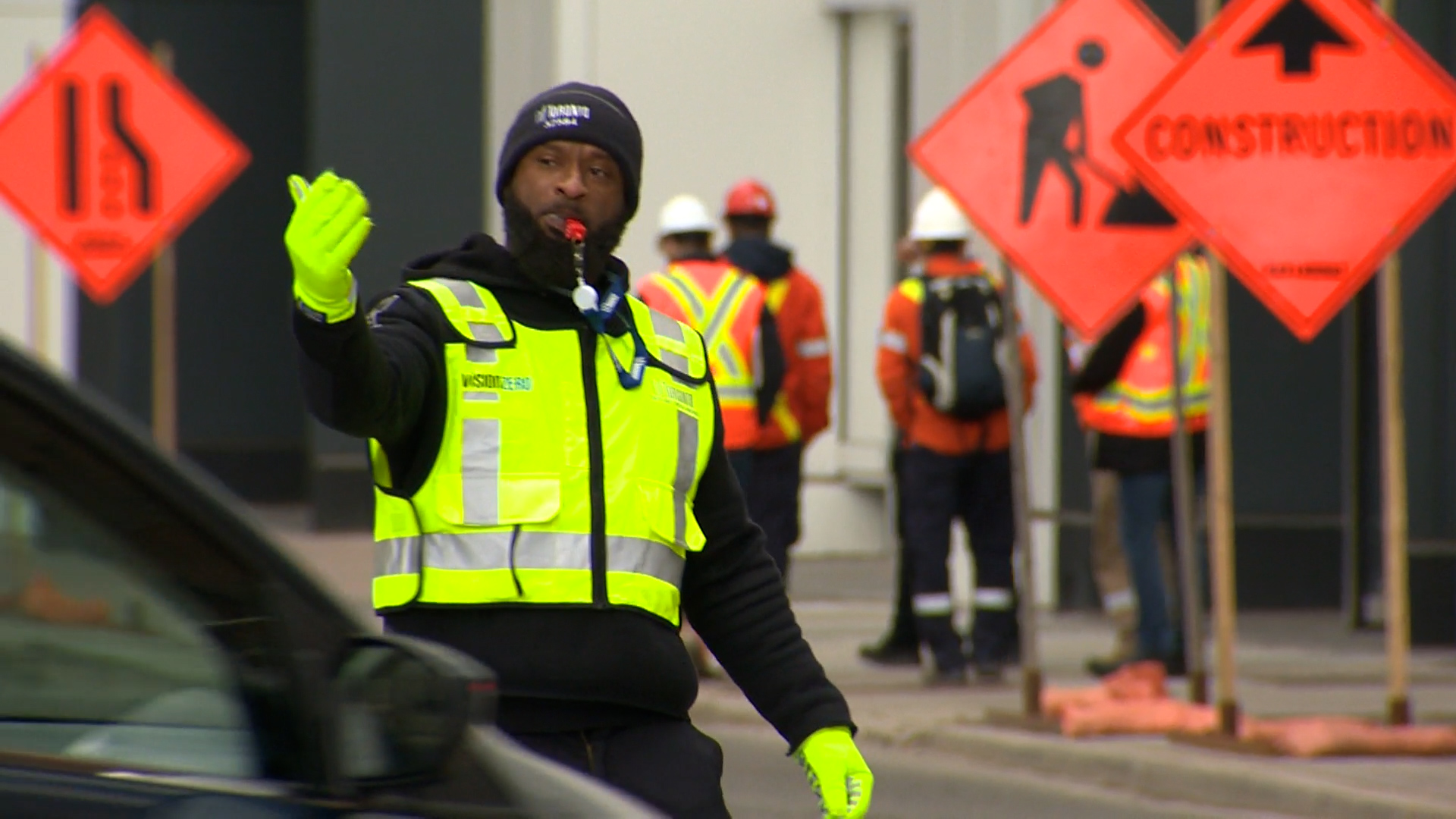
The air at the corner of Bay and Front smells of hot asphalt, scorched brake pads, and the sharp, metallic tang of a city holding its breath. It is 4:45 PM on a Tuesday. To a tourist, it is a mess. To a commuter, it is a purgatory of red taillights stretching toward the horizon of the Gardiner Expressway. But to the person standing in the middle of that chaos, wearing a high-visibility vest and wielding a whistle like a conductor’s baton, it is a high-stakes puzzle where the wrong move costs thousands of people their sanity.
Toronto is tired of being stuck. We have become a city defined by the "crawl," a place where the distance between two points is measured not in kilometers, but in podcasts. When the city announced it would be ramping up its Traffic Agent program—expanding the force to nearly 200 officers—the news was met with a cynical shrug from those behind the wheel. We have heard promises of "congestion management" before.
Yet, there is a fundamental shift happening on our pavement. The city isn't just throwing more bodies at the problem; it is preparing for a reckoning. With the FIFA World Cup looming on the horizon, Toronto is about to become the world’s living room, and right now, the hallway is blocked by a delivery truck with its hazards on.
The Invisible Wall of the Box
Consider a hypothetical driver named Sarah. Sarah is not a villain. She is a dental hygienist who needs to pick up her son from daycare before the $2-a-minute late fee kicks in. She sees the light turning yellow. She calculates. If she guns it, she’ll make the intersection. But the traffic on the far side hasn't moved. The light turns red, and Sarah is stranded in the middle of the intersection. She has "blocked the box."
In that moment, Sarah has become a brick in an invisible wall. Because she is sitting in the middle of the intersection, the cross-traffic can't move when their light turns green. A streetcar full of eighty people grinds to a halt. An ambulance three blocks away has to find a new route. The ripple effect of Sarah’s three-second decision stretches for miles.
This is where the Traffic Agent comes in. Unlike a static traffic light, which operates on a rigid, pre-programmed heart beat, an agent has eyes. They have intuition. They can see that a construction crew is narrowing the lane three blocks up and adjust the flow accordingly. They are the manual override for a system that has outgrown its own programming.
The Math of Human Friction
The city's plan involves a massive scaling of this human intervention. By deploying these agents to the most choked arteries—Spadina, University, Jarvis—the goal is to reduce the "friction" that turns a busy road into a parking lot.
Statistically, the impact of a single person directing traffic is staggering. Data from previous pilot programs suggests that having an agent at a key intersection can reduce delays by as much as 20%. That doesn't sound like much until you multiply it by the 50,000 cars trying to exit the downtown core. That 20% is the difference between a parent making it home for bedtime and a parent watching a grainy video of a bedtime story from a parked SUV on the Don Valley Parkway.
But the agents aren't just there to wave hands. They are there to enforce. The city has signaled a move toward more aggressive ticketing for those who treat "No Stopping" zones as "I'll Just Be a Minute" zones. It’s a necessary friction. For too long, the private convenience of one person has outweighed the collective movement of the city.
The Ghost of 2026
If the current congestion feels like a headache, the upcoming FIFA World Cup is a looming migraine. When hundreds of thousands of fans descend on the city, the infrastructure will be pushed past its breaking point. You cannot simply build more roads in a city hemmed in by a lake and a century of skyscrapers. You have to optimize the space you have.
The deployment of these agents is a dress rehearsal. The city is attempting to build a muscle memory of movement. They are identifying the "dead zones" where traffic goes to die and stationing keepers at those gates.
There is a psychological component to this as well. When you are stuck in traffic, the world feels chaotic and unfair. You feel helpless. But when you see a human being in a fluorescent vest actively managing the flow, the frustration softens. There is a sense that someone is in charge, that the gridlock isn't just a natural disaster, but a problem being actively solved. It shifts the narrative from "the city is broken" to "the city is trying."
The Cost of a City in Motion
The investment isn't cheap. Millions of dollars are being funneled into training and salaries. Critics point out that this is a band-aid on a gushing wound—that until we have world-class transit and fewer cars, the agents are just rearranging deck chairs on the Titanic.
They aren't entirely wrong. But we live in the "now." We live in the gap between the city we have and the city we want.
Imagine the frustration of a courier trying to make ends meet in a city that refuses to let them move. Imagine the exhaustion of a nurse finishing a twelve-hour shift only to spend ninety minutes staring at the bumper of a Mercedes. These are the people for whom the Traffic Agent is a lifeline.
The reality of urban life is a constant negotiation for space. Every square meter of Toronto's downtown is some of the most expensive real estate on earth, and for some reason, we have decided to use a vast portion of it to store idle machinery. Until that fundamental math changes, we are reliant on the whistle-blowers.
The Symphony of the Street
Watch an experienced agent work a four-way intersection during a rainstorm. It is a dance. They are reading the body language of cars—the aggressive inching of a taxi, the hesitant crawl of an out-of-towner. They are managing the frustration of pedestrians who are tired of waiting for their turn.
The agent holds up a hand. A line of cars stops. They beckon a streetcar forward. The metal giant groans and moves. In that moment, the agent has prioritized eighty lives over eight. It is a moral calculation performed in real-time, hundreds of times an hour.
This expansion is more than a logistical update; it is a desperate attempt to reclaim our time. We have traded too much of our lives to the asphalt. We have accepted the "Toronto crawl" as an inevitable law of nature, like gravity or the cold of January. But it isn't. It is a choice.
As the agents take their posts at the intersections of our lives, they carry a heavy burden. They are the frontline soldiers in a war against stasis. They are trying to prove that a city of millions can still breathe, even when its lungs are packed with steel and glass.
The next time you are sitting at a light, and you see the flash of a neon vest and hear the sharp, piercing note of a whistle, don't just see a bureaucrat. See a person trying to pull the city out of its own way. They are the only ones keeping the pulse of the city from flatlining.
The light turns green. The agent waves you through. For a moment, the road is clear, and the city feels like it might actually be going somewhere.