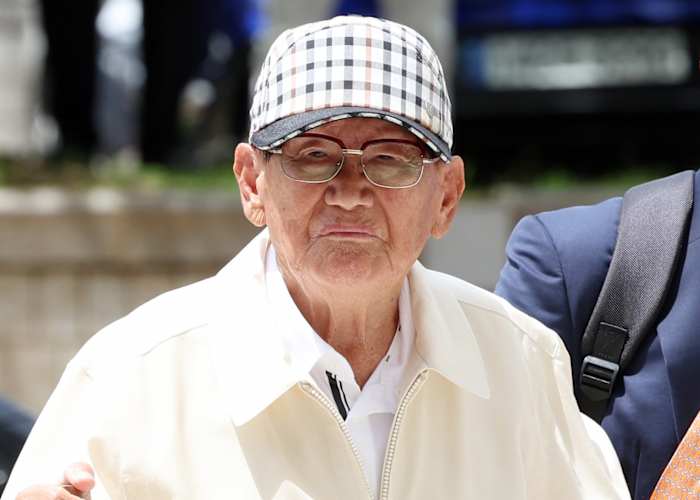
The late-night arrest of 95-year-old Shincheonji founder Lee Man-hee marks the unraveling of a multi-year operation that systematically injected tens of thousands of cult members into South Korea's conservative political apparatus. Prosecutors are exposing a hidden transactional alliance between secretive religious groups and the highest levels of the state. Lee stands accused of mobilizing over 50,000 followers to illegally infiltrate the People Power Party primaries to secure favors, a revelation that expands the ongoing criminal purging of the disgraced, imprisoned former President Yoon Suk Yeol.
This is not a simple case of a fringe religious group meddling in civic affairs. It is an exposure of structural corruption where massive block-voting blocks were traded for concrete regulatory protection and construction permits. The Seoul Central District Court issued the warrant based on an explicit risk that the nonagenarian leader would orchestrate the destruction of evidence. As the special team of prosecutors and police expands its dragnet, the investigation is laying bare how modern democratic primary systems can be subverted from within by highly disciplined, insular organizations.
The Underworld of Block Voting
In democratic systems, political parties rely on membership drives to gauge grassroots enthusiasm. The system assumes these members join out of individual political conviction. Shincheonji exploited this vulnerability by operating as a single, coordinated entity with a rigid military-style command structure.
Between 2021 and 2024, investigators allege that Lee weaponized his regional branches. He did not merely suggest political participation. He ordered a massive, coordinated influx of more than 50,000 devotees into the conservative People Power Party (PPP). The influx concentrated specifically on internal presidential and legislative primaries, where voter turnout is traditionally low, meaning a disciplined block of tens of thousands can completely dictate the outcome.
The primary target of this mobilization was the nomination of Yoon Suk Yeol. By flooding the PPP with internal registrations, the church effectively turned its members into a secret electoral army capable of tipping the scales for candidates who would protect the church's expansive commercial and real estate interests. For a church that has faced intense public hostility since it became the primary vector for the 2020 pandemic outbreak, securing friends in high places was a matter of survival.
A Transactional Peace
The strategy behind the infiltration was entirely transactional. Shincheonji has long sought to expand its physical infrastructure across the country, a goal constantly thwarted by local zoning boards, secular protests, and hostile neighborhood associations. By establishing a backdoor into the ruling party, the leadership expected to bypass these bureaucratic roadblocks.
+------------------------------------------------------------+
|            THE SHINCHEONJI INFILTRATION PIPELINE           |
+------------------------------------------------------------+
|                                                            |
|  [Church Command] ---> Orders issued via regional branches  |
|          |                                                 |
|          v                                                 |
|  [50,000+ Adherents] -> Registered as PPP Primary Voters     |
|          |                                                 |
|          v                                                 |
|  [Primary Primary Elections] -> Block voting swings results  |
|          |                                                 |
|          v                                                 |
|  [Political Favors] --> Expected zoning & expansion permits |
|                                                            |
+------------------------------------------------------------+
South Korean law explicitly bans religious entities from engaging in organized party politics under the Political Parties Act. This law exists precisely to prevent spiritual devotion from being converted into raw legislative coercion. Yet, for years, the boundaries blurred. The church offered an unmatchable resource to cash-strapped, clout-hungry politicians, which was a guaranteed, highly motivated base that asked for no public policy debate, only private bureaucratic leniency.
This dynamic explains why mainstream conservative politicians frequently looked the other way when secular groups sounded the alarm about cult infiltration. In the razor-thin margins of South Korean presidential politics, a reliable pool of 50,000 dedicated primary voters is worth more than gold. It represents an institutional capture executed under the guise of civic participation.
The Broader Purge of the Old Guard
Lee Man-hee is merely the latest domino to fall in what has become a total systemic cleansing of the previous administration. The investigation into Shincheonji is directly tied to the collapse of Yoon Suk Yeol’s presidency. Yoon's short tenure ended in historical disgrace following his botched, brief declaration of martial law in December 2024, an act that led to his impeachment, his removal from office in April 2025, and a subsequent life sentence for rebellion.
With a liberal administration led by President Lee Jae Myung now firmly in power, the state is aggressively picking apart the networks that sustained the previous government. What they are finding is a vast web of fringe spiritual groups operating as political brokers.
Only months prior to Lee’s arrest, authorities indicted Hak Ja Han, the leader of the Unification Church. She stands accused of instructing subordinates to bribe Yoon’s wife, Kim Keon Hee, alongside a powerful conservative lawmaker. The goal was identical to Shincheonji’s, which was buying immunity and securing corporate favors. The judiciary has shown little appetite for leniency. Kim Keon Hee was sentenced to four years in prison this April for her role in accepting luxury goods and financial bribes from these exact circles.
The Mechanics of Cult Infiltration
To understand how this occurred, one must look at the internal psychology of these organizations. Adherents view Lee Man-hee not as a political strategist, but as a divine messenger. When an instruction descends from the top of the hierarchy to register for a specific political party and select a specific candidate, it is treated as a spiritual mandate.
Mainstream democratic parties are fundamentally unequipped to defend against this. They lack the vetting infrastructure to distinguish an enthusiastic citizen from a subversified plant acting on behalf of a self-proclaimed prophet. The church utilized its secrecy to mask the operation, distributing party registration forms through closed messaging networks and tracking compliance through internal cell leaders.
The political system became addicted to this synthetic grassroots support. Candidates who benefited from the surge in membership could claim wide public support, while secretly knowing their victory was manufactured in the secretive meeting halls of a controversial sect. This created a dangerous dependency. A politician indebted to a cult for their nomination cannot easily enforce public health mandates, investigate financial irregularities, or deny construction permits when that same cult demands their reward.
The Failure of Secular Safeguards
South Korea's rapid modernization has left a unique sociological vacuum. Traditional institutions have struggled to keep pace with social anxieties, allowing aggressive, apocalyptic movements to flourish on the margins of society. These groups are heavily capitalized, holding massive real estate portfolios and controlling corporate entities that employ thousands of people.
The mistake of the political establishment was treating these groups as mere voting blocs rather than sophisticated, self-serving corporate entities. By allowing them to participate in the internal mechanisms of political parties without oversight, the state effectively outsourced its democracy. The ongoing trials of Yoon Suk Yeol, his wife, Hak Ja Han, and now Lee Man-hee show that this symbiosis was not an anomaly. It was a structural feature of how power was maintained.
The current legal offensive under President Lee Jae Myung is framed by the state as an essential restoration of constitutional boundaries. Critics argue that the sweeping nature of the investigations carries its own political motivations, aimed at permanently crippling the conservative opposition by tying them irrevocably to fringe religious movements. Regardless of the underlying political motivations, the evidence presented in the arrest warrants points to a profound vulnerability in the way political parties manage their internal democracy.
The prosecution now holds internal church communications, financial records, and digital registries that map out the entire recruitment drive. The 95-year-old Lee, who previously survived intense scrutiny during the pandemic, faces the real prospect of spending his remaining years behind bars. His arrest strips away the layer of untouchability that South Korea's mega-church leaders have enjoyed for generations. It signals a major shift in how the state views religious organizations that cross the line from spiritual guidance into state subversion.
The current judicial process cannot simply end with the conviction of aging leaders. It requires a fundamental restructuring of the Political Parties Act, closing the loophole that allows mass, coordinated registrations without clear transparency regarding institutional affiliation. Until the internal mechanisms of primary voting are insulated from block manipulation, the vulnerability remains open for any well-funded, disciplined group to buy a piece of the state. The collapse of the Yoon administration proved that the price of such alliances is ultimately paid by the stability of the democracy itself.