For decades, bringing professional open-wheel racing to the core of the United States capital was considered an administrative impossibility. Bureaucratic red tape, environmental reviews, structural engineering hurdles, and the sheer nightmare of shutting down federal arteries usually kill such proposals before they leave a lobbyist's desk. Yet, the inaugural Freedom 250 Grand Prix transformed the asphalt surrounding the National Mall into a high-speed motorsport circuit. Propelled by a presidential executive order and an alliance between the White House and motorsport tycoon Roger Penske, Washington welcomed a spectacle where IndyCars rocketed past federal landmarks at speeds approaching 160 miles per hour.
This multi-million-dollar endeavor was engineered to bypass conventional municipal delays. When series owner Roger Penske brought the concept to President Donald Trump, the bureaucratic engine shifted gears in minutes rather than years. An administrative directive forced federal agencies, including the Department of Transportation and the Department of the Interior, to expedite permits, clear roadblocks, and coordinate seamlessly with the District of Columbia.
Street circuits demand extraordinary technical preparation. Crews had to weld more than two hundred heavy maintenance hole covers directly to the concrete substructure. Otherwise, the staggering aerodynamic downforce generated by modern IndyCars would create enough vacuum suction to pull the heavy iron covers right out of the street, risking catastrophic airborne crashes. Road surfaces along Pennsylvania and Independence avenues required localized repaving, while temporary concrete barrier systems and high-tensile catch fences were erected in the shadow of the Capitol and the National Gallery of Art.
The logistical choreography mirrored a military deployment. Long before the grandstands filled with upwards of 150,000 spectators, teams of engineers, city planners, and broadcast technicians from Fox Sports worked around the clock. For Penske, securing a downtown race in the nation's political hub realized a twenty-year ambition. For the administration, the race served as a centerpiece for the broader America 250 patriotic programming, merging high-octane entertainment with national pageantry.
Beneath the veneer of checkered flags and roaring turbocharged engines, the event unfolded against a backdrop of acute political friction. The administration utilized sports diplomacy as a high-visibility counterweight to domestic pressures, including lingering economic anxieties and a foreign conflict in the Middle East that pushed gasoline prices upward. Staging a massive motorsports festival on federal turf provided an unmistakable visual of motion and power at a time when critics accused the White House of political distraction.
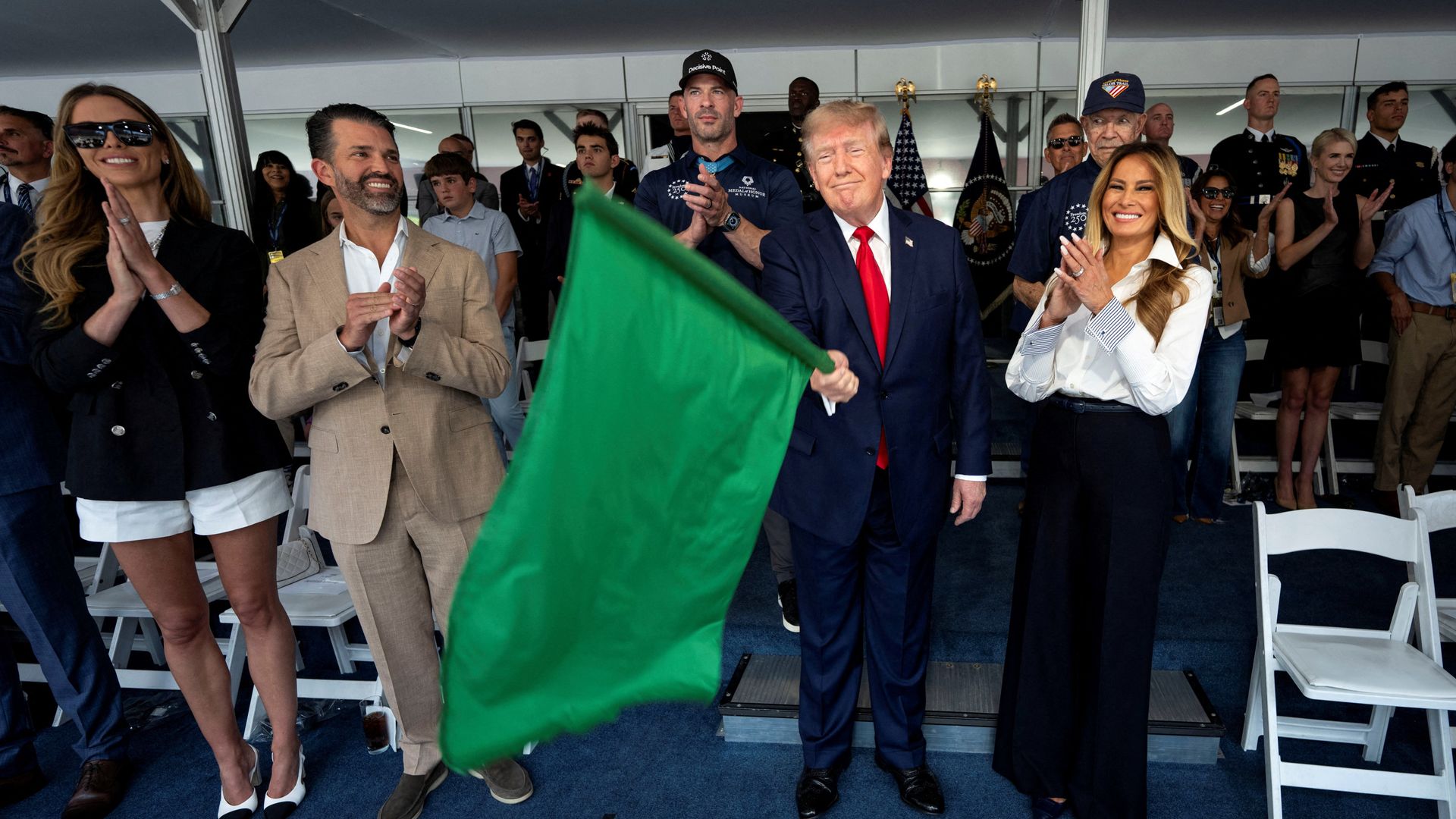
Spectators arriving at the Air National Guard Fan Zone on the National Mall encountered a classic festival atmosphere mixed with campaign-style styling. Concession tents served high-priced festival fare while vendors hawked specialty merchandise. Patriotic tropes dominated the pre-race ceremonies, featuring a performance of the national anthem by tenor Christopher Macchio and the dramatic release of a trained bald eagle that soared above the starting grid before returning to its handler. Before the official wave of the green flag, President Trump and First Lady Melania Trump completed an honorary slow lap around the 1.66-mile circuit inside the heavily armored presidential limousine known as The Beast.
On the track, the 147-lap endurance test punished equipment and drivers alike. The tight, seven-turn layout left zero margin for error. Early in the competition, American driver David Malukas slid wide coming out of a tight corner, slamming hard into the concrete wall. Fellow American Sting Ray Robb had nowhere to go, piling directly into the disabled machine. While safety crews cleared the wreckage without serious injury, the incident set the tone for a chaotic afternoon of attrition.
Championship leader Alex Palou saw his afternoon unravel during a sequence of pit lane missteps and a subsequent spin that dropped him out of the lead lap, heavily damaging his points cushion. Meanwhile, Andretti Global driver Kyle Kirkwood drove a masterclass in defensive and aggressive positioning. The 27-year-old Floridian managed restarts brilliantly, holding off hard-charging rivals through the final stretch to claim victory. In the post-race media pen, Kirkwood admitted that next to the Indianapolis 500, winning the inaugural Washington street race instantly became the pinnacle ambition for an open-wheel driver.
The success of the weekend has already sparked serious discussions among congressional leaders and series promoters about establishing the race as a permanent fixture on the calendar. Yet, long-term viability hinges on whether future municipal administrations will tolerate the massive disruptions to commuter traffic and the intense logistical strain placed on local infrastructure. For one weekend in August, however, the capital traded legislative gridlock for pure velocity, proving that with enough political will, even the streets of Washington can become a racetrack