You don't expect a mountain to fall silent, and then roar all at once. When a massive wall of ice and rock broke loose high in Langtang National Park near the Nepal-China border, it didn't just trigger a localized emergency. It sent a 5.2-magnitude seismic shockwave that seismologists initially misread as a major tectonic earthquake. There was no shaking ground beforehand. There was no monsoon cloudburst. Just an enormous chunk of a hanging glacier—roughly the size of 25 professional soccer fields—shearing off a cliff face and plunging 4,000 feet straight down into the valley below.
Within minutes, that pulverized mix of ice, rock, and mud transformed into a high-speed torrent of liquid concrete. It raced down the Lhende Khola, Bhote Koshi, and Trishuli rivers, wiping out roads, bridges, and hydropower plants with terrifying velocity. Governments and disaster management agencies scrambled to respond, but the sheer speed of the debris flow left communities with zero time to evacuate. Read more on a similar topic: this related article.
The Anatomy of a High-Altitude Catastrophe
Most people think mountain floods come from heavy rain or overflowing glacial lakes. This disaster proved that direct structural failures of glaciers are an entirely different beast. Satellite analysis from organizations like Planet Labs revealed that a massive segment of the glacier known as RGI2000-v7.0-G-15-05732 simply let go.
How does a glacier just slide off a mountain? Scientists point to a dangerous mix of rising temperatures and subsurface melting. As the planet warms, permafrost degrades and water pools beneath the ice sheet. This water acts like a slip-and-slide lubricant, allowing millions of tons of glacial mass to detach violently from the bedrock. More analysis by Al Jazeera highlights similar views on the subject.
The Himalayas are warming at nearly twice the global average. This means the frozen architecture holding these steep mountain ranges together is weakening year by year. When a hanging glacier collapses from thousands of feet up, the kinetic energy converts into intense heat, melting the ice instantly and mixing with river sediment to bulk up the flood. You get a cascading wall of destruction that behaves less like a river and more like a tsunami of mud.
Why Traditional Warning Systems Are Failing
Nepal has spent years improving flood-monitoring technology along its major river basins. But these systems are built for water, not falling mountains. When a glacier collapses or a massive rockslide dams a river upstream, river gauges don't give readings until the wall of debris has already smashed through.
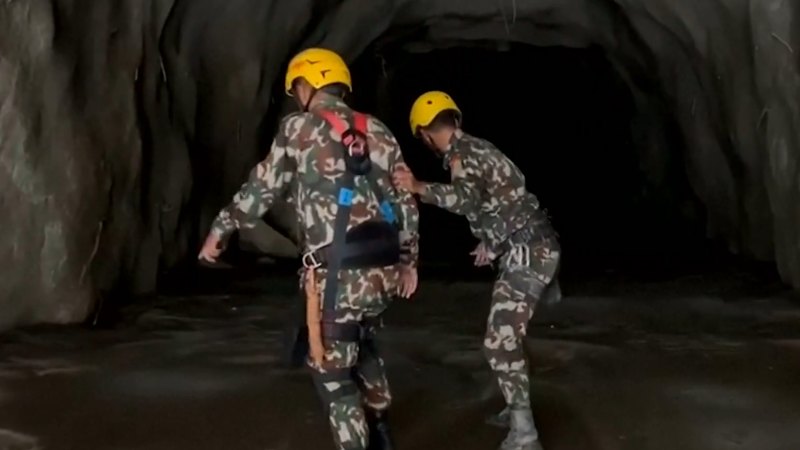
The human cost of this blind spot is staggering. Hundreds of people remain missing, including construction workers trapped deep inside the underground tunnels of multiple hydropower projects lining the Trishuli River basin. Rescue operations face nightmarish hurdles because the roads are gone and helicopters can't land in valleys choked with meters of thick, grey sludge.
We are dealing with a structural mismatch between modern infrastructure development and high-mountain geology. Governments want to harness rushing Himalayan rivers for clean energy, building massive dams and access roads right in the path of potential ancient hazards. Every time a new structure goes up in these narrow gorges without accounting for catastrophic ice-rock avalanches, the vulnerability multiplies.
What Comes Next for Vulnerable Mountain Communities
Fixing this problem requires a radical shift in how we monitor high-altitude environments. Watching river levels at the bottom of a valley is no longer enough. Scientists and engineers need real-time satellite radar and thermal imaging tracking the stability of hanging glaciers thousands of meters above human settlements.
If you live, travel, or invest in mountain regions, the illusion of permanence is gone. These landscapes are shifting in real-time, and standard historical data on weather patterns or flood zones is practically useless. The warning signs are written directly into the melting ice above us, and ignoring them is no longer an option.