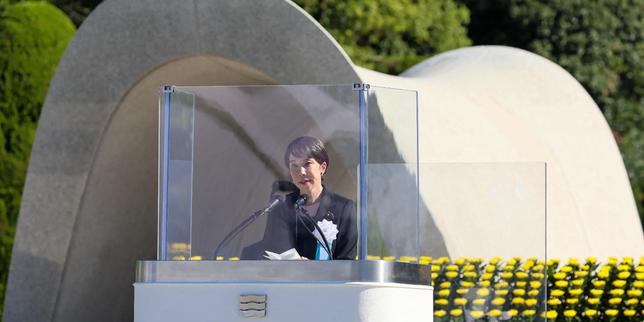
Every August, the global press corps packs into Hiroshima Peace Memorial Park with a predictable script in hand. They nod solemnly at the cenotaph, broadcast the mayor's peace declaration, and wring their hands over the eternal debate surrounding nuclear weapons. The consensus narrative is cozy, tragic, and utterly toothless. It treats August 6 as an annual festival of collective mourning, framing the atomic bomb as a historical anomaly we can moralize away if we just hold enough candlelight vigils.
This lazy consensus is dangerous. In similar developments, we also covered: How India is Quietly Rebuilding Sri Lanka Roads With 250 Metric Tons of Steel.
By reducing the atomic bombing of Hiroshima to a morality play about the inherent evil of splitting the atom, the mainstream media completely misreads why peace has largely held among major powers for nearly eighty years. The uncomfortable truth that polite diplomats refuse to utter at the podium is this: nuclear weapons are the only reason World War III hasn't vaporized every major city on the planet. Treating the bomb as a diplomatic mistake rather than a brutal geopolitical reality keeps us trapped in a perpetual state of strategic infancy.
Let us tear down the comforting illusions. Reuters has provided coverage on this fascinating subject in great detail.
The Sentimentality Trap
Walk through the Hiroshima Peace Memorial Museum and you are hit with an overwhelming wave of human suffering. Shoes belonging to children, melted roof tiles, shadow scorched stone. It is designed to evoke absolute horror.
That emotional gut-punch is necessary history, but it becomes poison when politicians and pundits use it to drive security policy. The standard journalistic takeaway every August runs on autopilot: Look at the devastation, therefore total nuclear abolition is the only moral path forward.
This is emotional blackmail masquerading as foreign policy.
When you strip away the sentimentality, the dropping of the bomb was the terminal phase of total war. It wasn't an unprovoked act of cosmic malice; it was the catastrophic conclusion of a conflict that Imperial Japan started and fanatically prolonged. Pretending that the weapon existed in a vacuum—divorced from the brutal reality of Japanese military governance, kamikaze strategy, and the impending bloodbath of Operation Downfall—is historical illiteracy.
I have sat in defense briefings where idealistic young staffers talk about nuclear disarmament as if it were a software update. They look at the stockpiles and see a UX error. They genuinely believe that if the United States, Russia, China, and the rest of the nuclear club simply signed a piece of paper, humanity would enter a golden age of permanent harmony.
History laughs at that naivety.
The Logic of Mutually Assured Destruction
Let us look at the data that the peace industry conveniently ignores. Since 1945, direct military conflict between nuclear-armed superpowers has dropped to absolute zero. Proxy wars? Yes. Economic warfare? Relentless. Cyber sabotage? Daily. But total conventional war between Washington, Moscow, and Beijing? None.
Why? Because of Mutually Assured Destruction.
Call it grim. Call it dystopian. Call it a sword of Damocles hanging over human civilization. But do not call it ineffective. The moment nuclear weapons entered the chat, the cost of total war became mathematically infinite. When the price of aggression is the complete erasure of your own nation state, rational actors stop rolling the dice.
Before the atomic age, Europe and Asia burned in catastrophic, continent-spanning conflagrations every few decades. The Napoleonic Wars, World War I, World War II—each iteration bloodier and more industrialized than the last. Historians did not predict an era of great-power peace in 1945; they expected World War III to break out over the ruins of Berlin by 1955.
It didn't happen. The bomb broke the cycle.
When pacifists demand unilateral disarmament or the immediate dismantling of nuclear deterrents, they are asking to turn the clock back to an era of uninhibited great-power slaughter. They assume peace is the natural default state of human tribes. It is not. Peace is an artificial construct maintained by the credible threat of total annihilation.
The Hypocrisy of the Annual Hand-Wringing
Every August, world leaders descend on Hiroshima to drop rhetorical platitudes about a world without nuclear weapons. They sign empty declarations, shake hands, and fly home to continue modernizing their nuclear arsenals.
It is the ultimate diplomatic theater.
Take Japan itself. Tokyo relies entirely on the United States nuclear umbrella for its national security while simultaneously playing the role of the innocent victim on the global stage. It is a brilliant geopolitical two-step. Japan gets the security guarantee of the world most powerful nuclear deterrent while maintaining domestic political optics that view nuclear arms as morally abhorrent.
If Japan actually believed its own rhetoric, it would demand the immediate withdrawal of U.S. forces and the total rejection of American extended deterrence. But Tokyo will never do that, because Japanese leadership knows what the peace marchers refuse to admit: China and North Korea do not care about your moral declarations. They care about your capability to retaliate.
Imagine a scenario where the United States unilaterally dismantles its nuclear triad tomorrow. Does Beijing halt its naval expansion in the South China Sea? Does Moscow hand Crimea back? Does Pyongyang scrap its ICBM program?
Of course not. Power abhors a vacuum. Unilateral disarmament does not create peace; it creates an invitation for conquest.
The Real Question We Should Be Asking
Instead of asking, How do we rid the world of nuclear weapons?—a question that is functionally useless and strategically dangerous—we should be asking, How do we maintain crisis stability in a multipolar nuclear age?
The architecture of deterrence built during the Cold War was binary. Washington versus Moscow. Hotlines, clear lines of communication, mutually understood red lines. Today, we live in a messy, tripolar nuclear reality featuring the United States, Russia, and an ascendant China rapidly expanding its silo infrastructure, alongside regional wildcards like North Korea and Pakistan.
Managing this complexity requires serious strategic thinking, not moralizing editorials from journalists who have never had to calculate acceptable losses during a war game simulation.
We need to invest in cyber-defense for command-and-control systems. We need resilient communication channels between Beijing and Washington that cannot be severed by political posturing. We need to understand that the danger today is not that leaders want to use these weapons, but that miscalculation, algorithmic error, or escalation dominance spirals could trigger a launch by accident.
Fixing that requires technical competence and cold realism, not emotional appeals to the spirit of Hiroshima.
The atomic bomb changed the rules of human conflict forever. We can either accept the brutal physics of deterrence and manage them with absolute discipline, or we can keep pretending that human nature will change if we just cry enough tears on television once a year.
History will not spare those who choose the fantasy.