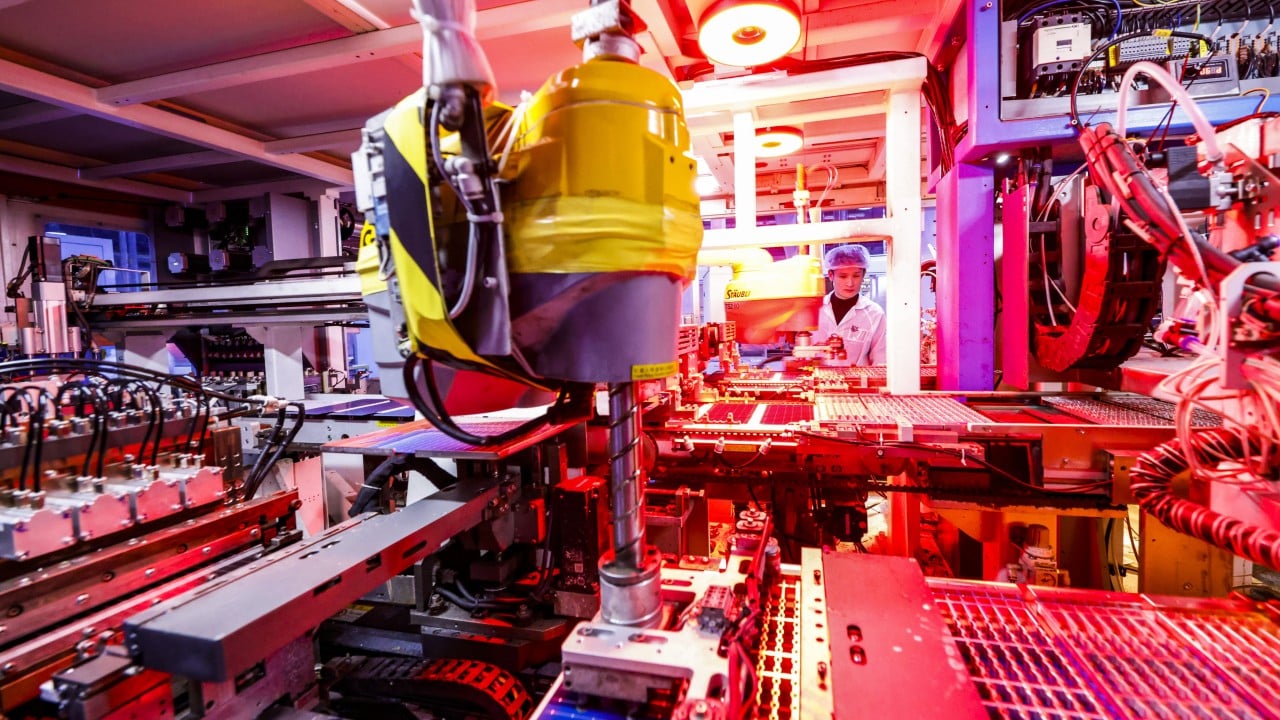
In a dusty industrial park on the outskirts of Shijiazhuang, the lights stay on all night. From a distance, the facility looks like a heart of productivity, a glowing beacon of the Chinese economic miracle. But step inside and the air tells a different story. It smells of stagnant oil and old grease. The machines hum, but they don't sing. They are producing parts for a market that stopped buying them three years ago.
This is a "zombie" firm. For a different look, consider: this related article.
It is a company that, by every law of mathematics and physics, should be dead. It cannot pay its debts. It doesn't innovate. It survives solely on a steady drip of subsidized credit and local government protection. To the economists in Beijing, these companies are laggards, a drag on the national GDP. But to the people inside, they are a lifeline that has turned into a ghost ship.
China has decided to stop the bleeding. The regulatory "headshots" have begun. Related analysis on this trend has been shared by The Motley Fool.
The Anatomy of a Ghost
Consider a hypothetical manager named Chen. For twenty years, Chen has overseen a mid-sized steel processing plant. In the early 2000s, he was a hero. He built the roads; he paid for the local school. But as the global economy shifted and green technology became the new mandate, Chen’s plant became a relic.
His furnaces are inefficient. His carbon footprint is a scar on the province’s records. Under normal market conditions, Chen would have declared bankruptcy in 2019. Instead, a local bank—pressured by a provincial official who didn't want to see three thousand workers hit the streets—extended a "soft loan." Then another. Then a tax holiday.
Chen’s factory became a ward of the state.
The problem with keeping Chen’s factory alive is that it steals the oxygen from everyone else. Every yuan funneled into a failing steel mill is a yuan that cannot go to a biotech startup in Shenzhen or a semiconductor lab in Shanghai. This is the hidden cost of the zombie: it isn't just a dead weight; it’s a predator. By saturating the market with cheap, subsidized goods, zombies drive down prices, making it impossible for healthy, private competitors to turn a profit.
The Cold Logic of the Kill
Beijing’s new regulatory stance is a departure from the "stability at all costs" mantra of the last decade. The central government has realized that you cannot build a "New Quality Productive Force"—the current buzzword for a high-tech, high-efficiency economy—while your basement is full of rotting industrial wood.
The strategy is surgical.
First, they tighten the screws on credit. State-owned banks are being told to look at the books, not the political connections. If the interest coverage ratio has been underwater for more than three years, the tap shuts off.
Second, they are using environmental standards as a scythe. Many of these laggard firms operate on razor-thin margins by cutting corners on emissions. By enforcing strict "Green Development" quotas, the regulators make it legally and financially impossible for the inefficient to exist. It is a death by a thousand cuts, administered with a bureaucrat’s precision.
But the numbers on a spreadsheet don't capture the tension in the tea rooms of local government offices. For a mayor in a third-tier city, a zombie factory isn't a "subsidized laggard." It’s a voting bloc. It’s social stability. When the headshots land, the shockwaves aren't just financial. They are deeply, painfully human.
Why the Old Tricks Failed
For years, China attempted to "merge" its way out of this. The idea was simple: take a failing state-owned enterprise (SOE) and lash it to a successful one. It was corporate alchemy. They hoped the strength of the winner would rub off on the loser.
Instead, they often ended up with two losers.
The healthy company would see its R&D budget swallowed by the debt of its new partner. Innovation stalled. Morale plummeted. The "synergy" promised by planners turned into a parasitic relationship.
The current shift toward liquidation and "market-oriented exit" is a confession. It is an admission that the market is a better judge of a company’s right to exist than any committee. It is a brutal realization, but a necessary one. To save the forest, you have to let the dead trees burn.
The Human Debt
What happens to Chen?
This is where the story gets quiet. When a zombie firm is finally allowed to die, the fallout is immediate. In cities where one factory is the sole employer, the closure feels less like a policy shift and more like an apocalypse.
We often talk about "overcapacity" as if it’s an abstract weather pattern. It isn't. Overcapacity is a warehouse full of solar panels that nobody wants. It is a line of trucks sitting idle because the construction project they were supposed to service lost its funding. It is the sound of a time clock that no one punches anymore.
The government is attempting to soften the blow through retraining programs and a beefed-up social safety net, but these are slow-acting medicines for an acute wound. The transition from a manufacturing-heavy "old economy" to a tech-driven "new economy" is a bridge made of glass. One wrong step, and the social contract shatters.
The stakes are higher than just a few points of GDP. If China cannot successfully purge these laggards, it risks a "Lost Decade" similar to Japan’s in the 1990s. Japan’s banks spent years propping up dead companies, leading to a long, slow stagnation that drained the country’s vitality. Beijing is determined to avoid that fate, even if it means pulling the trigger themselves.
The Ripple Effect
The world is watching this internal purge because the leftovers are being dumped on everyone else’s doorstep. When a zombie factory in China is desperate to stay alive, it exports its desperation. It sells its goods abroad at prices that don't cover the cost of production, just to keep the cash flowing for one more month.
This has triggered a new wave of global trade tensions. From the US to the EU to Brazil, nations are raising tariffs to protect their own industries from the "deflationary export" of Chinese overcapacity.
By killing off its zombies, China isn't just fixing its own house; it’s trying to de-escalate a global economic war. A leaner, more efficient Chinese industrial base is less likely to flood the world with artificially cheap steel, EVs, and chemicals.
The Silence After the Shot
There is a specific kind of silence that follows the closure of a massive industrial complex. It’s not the peaceful silence of nature. It’s the heavy, expectant silence of a stage after the actors have left.
In Shijiazhuang, or Dongguan, or Tangshan, that silence is growing more common.
The "headshots" are working. The number of non-performing loans being cleared is rising. The carbon intensity of the industrial sector is finally beginning to dip. The laggards are falling.
But as the zombies vanish, we are left with the survivors. These are the companies that didn't need the subsidies. They are the ones that innovated while Chen’s factory stagnated. They are leaner, faster, and much more dangerous to global competitors.
The death of the zombie is the birth of a more formidable China. The lights in the industrial park might finally go out for Chen, but for the company in the next town over—the one building solid-state batteries or AI-driven logistics—the day is just beginning.
The cull is cruel. It is calculated. It is necessary.
As the sun sets over the rusted gates of a liquidated mill, the true cost of progress becomes clear. It is measured in the stories of the men and women who built a world that no longer has a place for them. They were the engine of one era, and now they are the debris of the next.
The machines have stopped humming. The air is clearing. The ghosts are finally being laid to rest.