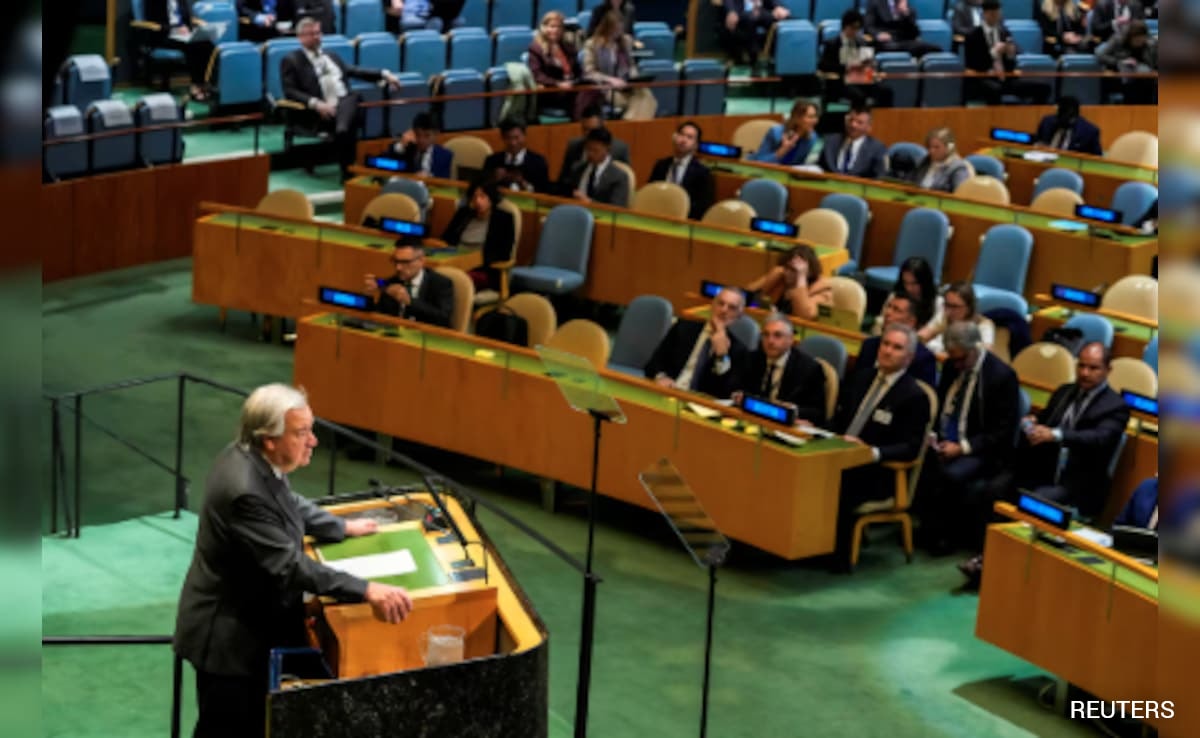
The air inside the United Nations conference rooms in New York doesn't move. It is stale, filtered through decades of bureaucracy and the heavy, invisible weight of history. When the delegates from the United States and Iran sit across from one another, they aren't just men and women in expensive wool suits. They are proxies for millions of people who are currently sleeping, eating, or walking to work, entirely unaware that their biological future is being bartered in a game of semantic chicken.
The recent clash over the Nuclear Non-Proliferation Treaty (NPT) isn't about physics. It isn't even really about uranium. It is about the terrifying fragility of a promise made fifty years ago: that those who have the power to unmake the world won't use it, and those who don't have it won't try to get it.
The Architect of a Ghost Town
Imagine a technician in Natanz. Let’s call him Reza. He isn’t a warmonger or a radical; he is a man with a PhD who likes espresso and worries about his daughter’s math grades. Every morning, he passes through layers of steel and concrete to monitor centrifuges that spin with a high-pitched, haunting whine. To the diplomats in New York, Reza’s work is a "violation of enrichment thresholds." To Reza, it is the only thing keeping his country’s seat at the table from being folded up and put in the closet.
When the U.S. representative stands to accuse Tehran of undermining the NPT, they aren't just talking about hardware. They are talking about a breach of the global social contract. The U.S. argument is grounded in a specific kind of fear—the fear that once the genie of enrichment hits 60% purity, the path to 90% is less a climb and more a short, inevitable slide.
The Iranian response is always draped in the language of rights. They point to Article IV of the treaty, which guarantees the "inalienable right" to peaceful nuclear energy. It is a classic case of two people reading the same book and seeing two different endings. One sees a flashlight; the other sees the ignition for a bonfire.
The Paper Shield
The NPT is often described as the most successful arms control treaty in history. That sounds impressive until you realize it is essentially a piece of paper held together by the collective "pinky swear" of nations that deeply distrust one another.
Consider the sheer audacity of the arrangement. In 1968, the world looked at the mushroom clouds of the past and decided to freeze time. The five countries that already had nukes got to keep them (with a vague promise to eventually get rid of them), and everyone else promised to stay in the "have-not" camp. It was a grand bargain built on a foundation of massive inequality.
Now, that foundation is cracking.
Iran argues that the United States is playing the role of a hypocritical landlord—demanding the tenants keep their stoves off while the landlord keeps a flamethrower in the basement. The U.S. counters that the tenant has been caught sneaking gasoline into the kitchen.
The tension isn't just political. It’s visceral. It’s the feeling of being in a room with a gas leak while someone strikes a match to see better.
The Ghost of 2015
The shadow in the corner of every one of these UN meetings is the ghost of the JCPOA—the 2015 nuclear deal. It was the moment the world took a collective breath. For a brief window, the tension dissipated. Cameras caught diplomats smiling. There were handshakes.
Then, the U.S. walked away.
Trust is a non-renewable resource in geopolitics. Once it is burned, you can't just go to the store and buy more. The current "clash" at the UN is the sound of both sides trying to rebuild a bridge using burnt wood.
The U.S. demands "permanent" restrictions. Iran demands "guarantees" that a future administration won't flip the table again. Both demands are logical. Both are impossible.
In the middle of this logic trap sits the International Atomic Energy Agency (IAEA). These are the inspectors. The referees. They are the ones who have to walk into those Iranian facilities and count the seals on the doors. Lately, they’ve been telling the world that the lights are going out. Cameras are being disconnected. The "continuity of knowledge" is breaking.
If the IAEA is the world's eyes, we are currently suffering from a rapid, progressive blindness.
The Invisible Stakes
Why does this matter to someone buying groceries in Ohio or a student in Isfahan?
Because the NPT is the only thing preventing a nuclear domino effect. If the treaty fails in Iran, it doesn't stop there. Neighbors start looking at their own security. Saudi Arabia has already hinted that if Iran goes nuclear, they will too. Then perhaps Turkey. Then Egypt.
Suddenly, we aren't living in a world of five nuclear powers managed by cold-war logic. We are living in a world where a local border dispute or a miscommunication between two mid-level commanders could trigger a chain reaction that ends human history before lunch.
The "clash" at the UN isn't a debate. It’s an SOS.
The Weight of the Silence
When the speeches end and the delegates retreat to their respective missions, the silence returns to the halls of the UN. It is a heavy, judgmental silence.
We tend to think of history as something that happens in textbooks, written by people who knew how it would end. But we are living in the messy, terrifying middle of the chapter. The delegates aren't just arguing about centrifuges or heavy water reactors. They are arguing about whether the 21st century will be remembered as an era of restraint or the beginning of the Great Simplification.
The most frightening thing about the current stalemate isn't the anger. It’s the exhaustion. Both sides have said the same words so many times that the words have lost their shape. They have become stones, thrown back and forth across a table, while the rest of us wait to see if any of them finally hit the glass.
The tragedy of the "human element" in nuclear diplomacy is that the humans involved are often the least capable of seeing the humanity on the other side. They see positions. They see leverage. They see "strategic depth." They rarely see the technician named Reza, or the family in the suburbs of Maryland, whose lives are the collateral in this high-stakes game of poker.
As the sun sets over the East River, the building glows with a deceptive calm. Inside, the lights stay on late. Men and women continue to shuffle papers, drafting statements that will be parsed by intelligence agencies and translated into a dozen languages. They are searching for a phrase, a comma, a single word that might hold the world together for one more day.
They haven't found it yet.
The centrifuges continue to spin. The ink on the 1968 treaty continues to fade. And the clock in the hallway, though silent, never stops its steady, rhythmic count toward a midnight no one wants to see.